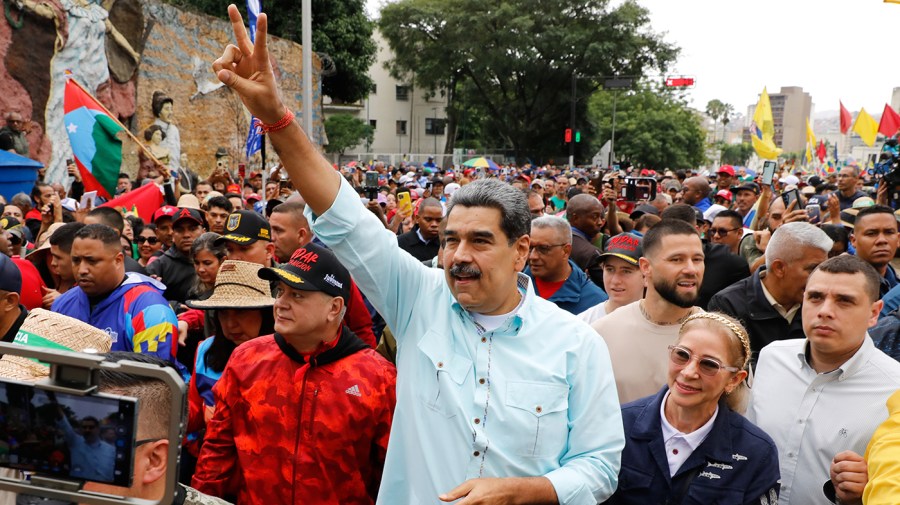

President Trump is turning up the pressure against Venezuela and its strongman leader Nicolás Maduro, seizing a massive oil tanker en route to Cuba this week and slapping additional sanctions against his leadership.
The seizure of the sanctioned ship, called Skipper, is the most recent swipe by the Trump administration against Maduro, whom U.S. officials have called an “illegitimate leader” and accused of heading a drug-trafficking cartel.
The president has ordered lethal strikes against alleged drug-smuggling boats in the Caribbean, in the vicinity of Venezuela, indicated that Maduro’s days are “numbered” and established a massive military presence in the U.S. Southern Command (Southcom) region.
When asked on Thursday whether the campaign against Venezuela is about acquiring oil or thwarting the trafficking of illegal drugs in the region, Trump pointed to various reasons, including barring Venezuelan migrants from illegally entering the U.S.
“Well, it’s about a lot of things,” the president told reporters at the White House. “But one of the things it’s about is the fact that they’ve allowed millions of people to come into our country from their prisons, from gangs, from drug dealers and from mental institutions, probably proportionately more than anybody else.”
Here are the main factors that seem to be driving Trump’s multi-front campaign against Maduro:
Migration
Trump often pins the blame on Maduro for two things when asked about his pressure on Venezuela: migrants and drugs.
“We just have to take care of Venezuela. They dumped hundreds of thousands of people into our country from prisons,” the president said last month.
Venezuela is still one of the biggest sources of migrants in the world. The majority of Venezuelan migrants, over 80 percent, live in Latin America and the Caribbean. In the U.S., there were about 770,000 Venezuelan immigrants as of 2023, according to the Migration Policy Institute, making up below 2 percent of the entire U.S. immigration population.
The number of Venezuelan migrants in the U.S has gone up from about 33,000 in 1980 to 770,000 in 2023, according to the Migration Policy Institute’s report in February.
After an early October ruling by the Supreme Court, more than a quarter million Venezuelans lost Temporary Protected Status (TPS). Before it later expired in November, the Biden-era program shielded Venezuelan nationals from deportation until October next year.
Drugs
The president has accused the Maduro regime of pouring illegal narcotics into the U.S., which it says justifies the ongoing lethal strikes against alleged drug-trafficking boats off the coast of Venezuela.
Since early September, when the lethal military campaign began, the U.S. military has conducted at least 22 strikes against purported drug-smuggling vessels in both the Caribbean and eastern Pacific, killing at least 87 suspected “narco-terrorists.”
The boat strikes have become a political lightning rod for Defense Secretary Pete Hegseth, after survivors of a strike in September were killed in what many Democrats have called a war crime. Hegseth authorized the strikes but has denied specifically ordering the killing of survivors.
The administration has linked some of the individuals on the boat to the drug cartels and argued that every blown-up vessel saves 25,000 American lives. However, the target vessels in the Caribbean are believed to be carrying cocaine, not the far more deadly fentanyl, according to lawmakers who were briefed on the strikes.
In Latin America, the top producer and exporter of cocaine is Colombia.
Trump has touted that maritime illegal drug trafficking in the Caribbean and eastern Pacific has drastically plunged since his administration’s boat strikes began.
“If you look at drug traffic, drug traffic by sea is down 92 percent. And nobody can figure out who the eight is, because I have no idea,” the president said on Thursday. “Anybody getting involved in that right now is not doing well. And we’ll start that on land too. It’s gonna be starting on land pretty soon.”
As part of the pressure campaign, the U.S. government has designated the so-called “Cartel de los Soles” as a foreign terrorist organization and accused Maduro of being its leader.
Oil and Minerals
Venezuela has lucrative oil and gas reserves. Oil makes up close to 90 percent of the country’s export revenues, part of the reason Maduro’s regime has argued that U.S. moves in recent months are meant to secure access to the nation’s energy reserves.
The vessel the U.S. seized on Wednesday, which was previously sanctioned by the U.S. government in 2022 and was sailing under a different name, was believed to be carrying more than 1 million barrels and was falsely flying Guyana’s flag.
If the U.S. were to continue to seize more of Venezuela’s oil tankers, it could thwart the nation’s ability to purchase weapons, buy food and keep the government’s lights on, experts told The Hill on Thursday.
Although the analysts said a full oil blockade would likely be improbable due to Washington’s reliance on Caracas’s oil imports and international pushback, they stated that the president could get to a similar outcome by seizing more tankers.
“So you could get a complete collapse in Venezuelan oil exports if the US does this, because it would be equivalent to imposing a de facto naval blockade of Venezuela,” said Francisco R. Rodríguez, a senior research fellow at the Center for Economic and Policy Research.
Ousting Maduro
Trump and other top administration officials have said that Maduro’s days are “numbered” and the president has not ruled out the option of putting boots on the ground in Venezuela.
In recent weeks, the U.S. has established a gigantic military presence in the Southcom area, dispatching F-35 fighter jets, warships, Marines, spy planes, at least one submarine and USS Gerald R. Ford, the world’s largest aircraft carrier.
Trump has also repeatedly warned that strikes inside Venezuela could come “soon,” but the president has not closed the door on negotiating with Maduro, who he spoke with recently.
Some experts say Trump’s actions are aimed at regime change, a charge that Secretary of State Rubio denied.
Rubio, a Cuba hawk and son of Cuban immigrants who are vehemently anti-socialist, views Maduro’s potential ouster as a heavy blow to Cuba’s leadership, with whom the Venezuelan president has close ties.
The New York Times reported on Friday that the Skipper was part of Venezuela’s efforts to support Cuba financially.
The secretary, who also serves as Trump’s national security adviser, has said that the U.S.’s goal in the region is not to enact regime change in Venezuela, although he recently cast doubt that Washington can strike a deal that Maduro would honor.
“At the end of the day with Maduro — and his problem basically is that this is a guy, if you wanted to make a deal with him, I don’t know how you’d do,” Rubio said during his recent appearance on Fox News’s “Hannity.” “He’s broken every deal he’s ever made.”
Copyright 2025 Nexstar Media, Inc. All rights reserved. This material may not be published, broadcast, rewritten, or redistributed.
For the latest news, weather, sports, and streaming video, head to The Hill.