
When tragedy strikes a community – whether it’s a natural disaster, a large-scale accident or a horrific act of violence – all kinds of people might mobilize in response, such as law enforcement and investigators, relief workers and members of the news media.
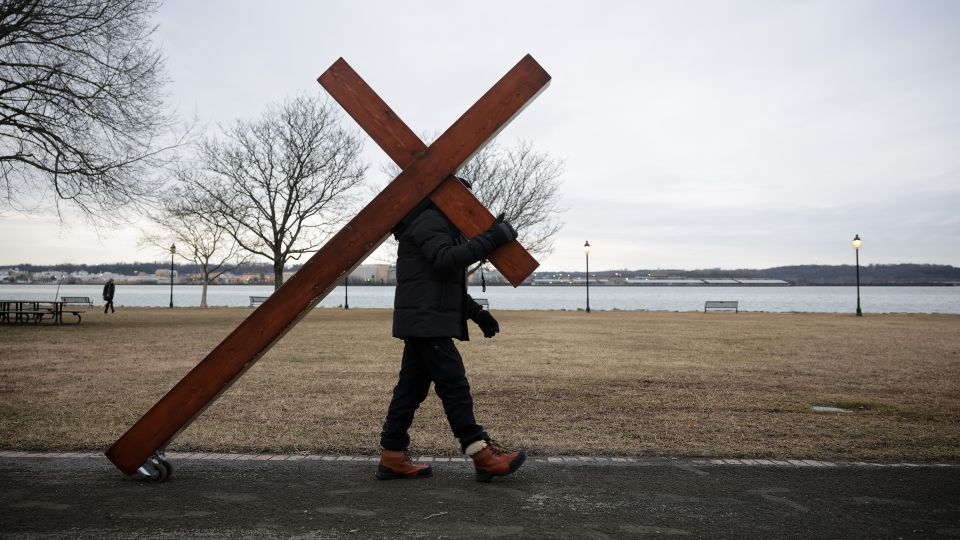
Now, they’re often joined by another person: a Michigan man with a 10-foot cross that he trucks across the country, aiming to bring comfort to devastated communities facing their darkest moments.
“I go wherever people’s hearts are hurting the most,” Dan Beazley told CNN in late September, as he rolled the cross around Grand Blanc, Michigan, in the wake of an attack on a congregation of The Church of Jesus Christ of Latter-day Saints.
“The cross is a message of hope, of healing in their hearts,” he said of the people he meets. “And when they see it, it radiates a light over the entire dark situation, to just begin to lift up peoples’ hearts and help them heal.”
This year alone, Beazley, a real estate broker by trade, said he has visited:
Beazley speaks with students December 15 while holding his cross in front of the Barus & Holley engineering building at Brown University, where students were shot, in Providence, Rhode Island. – Taylor Coester/Reuters
And that list is far from exhaustive. Since starting his ministry in 2021, Beazley said he has made 73 trips to 33 states, hauling his cross to places as near as Detroit – about a half-hour from his Michigan home – and as far-flung as Maui, Hawaii.
Beazley decides when and where to go based on a feeling he said he gets that emanates throughout his body, bringing him near to tears.
“When that happens, I know that I need to go,” he said. “I know that it’s impossible for me not to go. There would be nothing that would stop me from going.”
‘God, what do you want?’
By his telling, Beazley was not always so vocal or even dedicated to his faith. Once Catholic, Beazley said he often thought Christians “were crazy.”
But things started to change about seven years ago, when his wife dragged him “kicking and screaming” to a nondenominational church near their home in Northville, Michigan, a suburb of Detroit.
He remembers he was at church one Good Friday – when the Christian faith marks the crucifixion of Jesus Christ, the precursor to Easter – when he was “radically touched by God.”

Beazley holds the cross outside Mississippi Boulevard Christian Church in Memphis, Tennessee, ahead of Tyre Nichols’ funeral on February 1, 2023. Nichols died after he was repeatedly punched and kicked by Memphis police officers following a traffic stop and brief foot chase. – Seth Herald/AFP/Getty Images
“I just started to cry, and my body was shaking,” he told CNN. “God was shaking me and waking me up.”
At the time, he still didn’t have a strong grasp of his faith, he said. But he began reading the Bible, and he soon started to feel God was asking something of him. He just wasn’t sure what.
“God, what do you want?” he remembered asking. “You have an assignment for me. But I’m still not getting a good feel for this.”
He finally got clarity one Saturday afternoon in November 2020, in the depths of the pandemic, when Beazley saw a Facebook livestream that showed a Georgia man carrying a cross through his own community.
“I just started to cry,” Beazley said. “It was like I knew instantly that that’s what God wanted me to do.”
Beazley reached out to the man, who gave him the plans for his cross, he said. Then, slowly, he started to build.
‘He asks me to be a lampstand’
It took more than six months, Beazley said, but eventually the cross was done: 10 feet tall and about 65 pounds, the cedar cross has a set of wheels at the base that lets him roll it around without damaging the cross. Cedar, he said, was chosen over other types of wood for the balance it strikes between strength and weight.
At that time, he still didn’t have a clear sense of what to do with it, or where to take it. So he started with Detroit.
“It was amazing,” he said of those early forays with the cross. People would stop and ask him about it, opening the door to conversation, he said, and prayer.

Beazley stands with the cross near the site of the shooting and fire at The Church of Jesus Christ of Latter-day Saints in Grand Blanc, Michigan, on September 29. – Emily Elconin/Getty Images
“People would get off at a bus stop in downtown Detroit, and they would chase me down the street, wanting to know why I was doing it,” he told CNN.
“And within a couple minutes, they would be on their knees,” he said, “giving themselves to the Lord.”
Beazley’s ministry evolved dramatically in November 2021, when a teenager carried out a shooting at his high school in Oxford, Michigan, about 40 miles north of Detroit. Four students were killed, and six others and a teacher were wounded.
When Beazley learned of a vigil for the victims, he said he took the cross and wheeled it through the streets of Oxford, stopping not far from a pavilion downtown shortly before the program got underway.
The next morning, Beazley started getting phone calls and messages from people who had seen photos of him and his cross featured on news websites and in newspapers.

Beazley walks with his cross around Oyster Bay RV Park on San Carlos Island near Fort Myers Beach, Florida, after Hurricane Ian, on October 1, 2022. – Cristobal Herrera-Ulashkevich/EPA-EFE/Shutterstock

Beazley walks up the bank of the Guadalupe River while carrying his cross on July 8 in Ingram, Texas, after heavy rainfall caused fatal flooding along the river in central Texas. – Jim Vondruska/Getty Images

Maggie Mae Roddy, left, prays with Beazley at the makeshift memorial for Charlie Kirk outside the headquarters of Kirk’s organization, Turning Point USA, on September 19 in Phoenix. – Joe Raedle/Getty Images
“That’s when the Lord put on my heart and told me that the cross wasn’t just for Michigan,” Beazley said. “It was for the entire country.”
Finally, he said, he understood the true purpose of the cross – and his calling:
“He asks me to be a lampstand,” Beazley said. “The cross is the lamp, but he asks me to be a lampstand – just to hold it up in the darkness.”
‘What I’m doing is minimal’
The years since have seen Beazley undergo other “mission trips” like the one to Oxford, taking him beyond Michigan to whatever corner of the country has been devastated by a natural disaster or act of violence.
“I’ve been very, very busy. But the last five months have been at a different level,” he said, recounting visits to Kerr County, Texas, in the wake of this summer’s flooding; Kirk’s memorial in Arizona; the LDS attack in Michigan; and Washington, DC, after the shooting of two National Guard soldiers, one of whom died from her wounds – among others.

Beazley’s cross lies in his pickup at a memorial for Corey Comperatore, the former volunteer fire chief killed during the attempted assassination of Donald Trump at a campaign rally, in Freeport, Pennsylvania, on July 18, 2024. – Carlos Osorio/Reuters
The work can be taxing: Beazley – who said he funds the lion’s share of travel costs out of his own pocket – drives the cross, however long the journey may be. He regularly sleeps in his truck, he said, either because hotels are unavailable or too far from where he needs to be.
He almost always drives, he said, and has flown only once, when he said he traveled to Lahaina, Maui, in Hawaii, in the wake of the 2023 wildfires there. He would like to fly more, he said, but feels it’s important to drive – because the cross also has an impact on those who see it strapped into the bed of his light gray Ford F-150 while en route.
“My wife says, ‘No, you can’t (fly). You have no idea the amount of people whose lives are touched just in the journey from home to where you’re taking it.’”

Beazley prays on the bank of the Guadalupe River while holding the cross July 8 in Ingram, Texas, after heavy flooding led to multiple fatalities. – Jim Vondruska/Getty Images
And when he arrives, he sometimes faces extreme elements and long days. Still, he persists, saying God gives him energy he otherwise couldn’t muster.
“I cannot tell you how that works,” he said. “I just know what Jesus did for me – he died on a cross – and the suffering he went through. So for me to do what I’m doing is minimal.”
He doesn’t go to every scene of tragedy, working to discern when it is appropriate. In the past, he has at times questioned his own motives: He once struck out for Washington, DC, for a vigil several weeks after the aftermath of Hamas’ October 7, 2023, attack on Israel.
Several hours into the drive, he said, “God just asked me why I was taking the cross. … He asked me if I was taking the cross for people to see the cross, or was I taking it there for people to see me with the cross?”
“And I knew in my heart at that moment that my reason for taking the cross was wrong,” he said. He went home.
‘Focus on the source of love’
The communities Beazley visits “are so confused” in the wake of tragedy, he said.
They ask themselves questions, he said, such as: “Why did God let something like this horrific situation happen to my family, or to my community, and where are we going to go from here? What is that going to look like? How are we going to pick up the pieces and move forward?”
“When I first started this,” he said, “I couldn’t answer that, because I had not had enough experience with it yet.”

Beazley holds the cross next to a memorial for Minnesota state Rep. Melissa Hortman and her husband, Mark, outside the Capitol building in St. Paul on June 18, 2025. The Hortmans were shot and killed at their home in what the governor called a “politically motivated assassination.” State Sen. John Hoffman and his wife were wounded in a separate incident. – Stephen Maturen/Getty Images
But today, he feels better equipped. “I’ve learned, for a community that’s hurting, what it takes for a community to come together and to love each other so they can actually heal.”
Among the pitfalls, he indicated, is the blame and infighting that plagues some communities in the aftermath of tragedy, undermining their chance at healing. In his experience, the communities that overcome these risks are those that “focus on the source of love … and building the community up so these things don’t happen anymore.”
Put another way: “Love your neighbor like yourself.”
“The tragedy isn’t going away,” he said. “But the community can certainly heal from it, and they can grow. … I believe that the cross, the presence of the cross, is just the beginning for a lot of them.”
CNN’s Eric Levenson contributed to this report.
For more CNN news and newsletters create an account at CNN.com