
The Trump administration’s seizure of an oil tanker off the coast of Venezuela is one of the most dramatic twists yet in a military pressure campaign against Venezuelan dictator Nicolás Maduro.
The boarding of a foreign ship is an unusual step and expands a US operation already highlighted by strikes against more than 20 boats in the Caribbean and Pacific Ocean that the administration claims carried drug traffickers.
Early reports suggest the swoop by US Coast Guard personnel, with the backing of the Navy and law enforcement agencies, poses fewer legal and constitutional concerns than the campaign against the boats and Trump’s imminent threats of military action on Venezuelan soil.
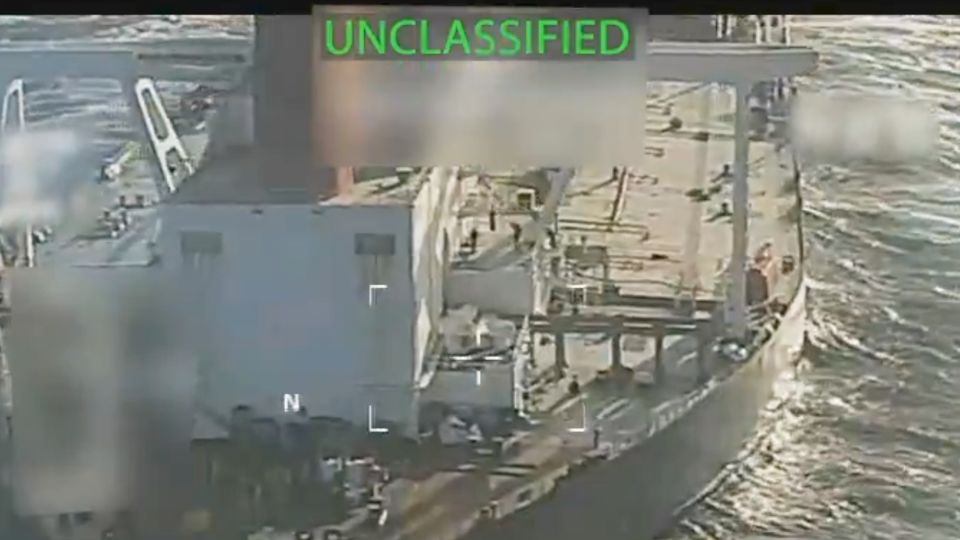
The vessel, the Skipper, was seized in international waters and was carrying Venezuelan crude, a senior US official said. A federal judge had previously issued a warrant for its seizure because of alleged links to Iran-backed terror groups.
This image from video posted on Attorney General Pam Bondi’s X account, and partially redacted by the source, shows an oil tanker being seized by US forces off the coast of Venezuela, on December 10, 2025. – US Attorney General’s Office/X via AP
Still, Trump’s relish in announcing the take-over of the ship and Attorney General Pam Bondi’s release of a video showing US personnel rappelling onto its decks from a helicopter underscore the political significance of the moment.
With his characteristic flair for the dramatic, Trump announced to the press that the US had boarded a “large tanker, very large, largest one ever seized, actually.”
While the tanker might not have been directly related to the current showdown between Trump and Maduro, its interdiction will be seen in the context of a massive US naval build-up in the Caribbean, which is part of an apparent attempt to force Maduro out of power or to convince his subordinates to oust him.
What’s at stake for Trump and Venezuela
Millions of Venezuelans would welcome Maduro’s departure after grim years under an authoritarian regime that has impoverished the country, imposed repression and forced millions of people to flee poverty and persecution.
So, the Washington controversy over Trump’s intentions in Venezuela is less about whether Maduro’s exit after ignoring his loss in a democratic election would be beneficial and more about whether the US president is acting legally. Critics fear Trump is preparing to embroil America in another prolonged foreign policy misadventure as he again seeks to flex unchecked executive power.
Legal questions are most acute over the strikes against alleged drug traffickers in the Caribbean and Pacific Ocean that have killed 87 people. The administration insists that it is justified in using legal military force against what it brands as narco-terrorists that threaten American national security. But Venezuela is not regarded as a major fentanyl trafficking route into the US as the administration insists. And rights groups warn that the boat attacks infringe on the due process of the victims and amount to state sanctioned murder by the administration.
One of those strikes, on September 2, prompted Democrats and human rights groups to accuse the administration of a war crime, as it involved a follow-up strike that reportedly killed survivors of the initial US attack.
Democrats are intensifying a campaign to force Defense Secretary Pete Hegseth to turn over video of the attack to Congress. Trump had earlier said on camera he had no problems with such a step but later denied making the comment.
News of the tanker seizure and deepening intrigue over the double-tap strike came as doubt still shrouded Trump’s aims in Venezuela. The symbolic weight of the massive US naval force off the country, which includes the most advanced US aircraft carrier, USS Gerald R. Ford, means any resolution to the crisis that does not lead to Maduro’s ouster would be a rebuke to US power and Trump’s prestige.

This screengrab taken from a video posted by the Defense Department shows a boat shortly before it is hit by a strike on September 2, 2025. – Defense Department
Trump has meanwhile repeatedly warned that strikes against what he says are drug trafficking sites on land could start soon. But in an interview with Politico this week, he declined to discuss military strategy and said opaquely that he wanted the Venezuelan people treated well and “to be respected.”
CNN reported on Wednesday that the Trump administration was working on plans for what would happen in Venezuela in the event that Maduro fell or left. Critics of the Trump approach have drawn comparisons to the US failure to prepare for regime change in Iraq in 2003 after the US invasion. Some analysts fear that Venezuela could descend into violence and instability if the Maduro regime falls, and that it could prompt a refugee crisis. But the situation there bears little comparison to post-war Baghdad.
In another development that could increase pressure on Maduro’s regime, Venezuelan Opposition leader María Corina Machado dramatically left hiding in the country and traveled to Oslo, where her daughter had earlier accepted the Nobel Peace Prize on her behalf.
Maduro’s government had warned she would be considered a fugitive should she leave Venezuela. But her emergence in the outside world may also present the Trump administration with new opportunities to highlight her cause.
Ship boarding ‘normal,’ former US intelligence official says
The US seizure of the tanker Skipper took place on the basis of a search warrant related to past activity transporting sanctioned oil from Venezuela and Iran, Attorney General Pam Bondi posted on X. She said FBI, Homeland Security Investigations and the US Coast Guard were involved with support from the Department of Defense.
The capture of the tanker is certain to be seen throughout the region as an implicit warning to other tanker captains of the risks in loading up in Venezuela and operating around its waters, as well as a blow to the shadow fleet of tankers that traffic sanctioned oil for nations like Iran.
Venezuela has some of the world’s biggest reserves of crude oil, and its illicit sales are a key source of income for its regime. The first and second Trump administrations and the Biden administration maintained multiple layers of sanctions against the Maduro regime for its suppression of democracy, including against the state-owned oil and natural gas company PDVSA.

People bathe on a beach next to the El Palito refinery of the Venezuelan state oil company PDVSA, in Puerto Cabello, Venezuela February 10, 2024. – Leonardo Fernandez Viloria/Reuters
The government in Caracas condemned the seizure, arguing that it laid bare the true motivation of Trump’s pressure campaign. “It is not migration. It is not drug trafficking. It is not democracy. It is not human rights. It has always been about our natural wealth, our oil, our energy, the resources that belong exclusively to the Venezuelan people,” a government statement said.
But Beth Sanner, a former senior US intelligence official, told CNN’s Jake Tapper that the seizure of a Venezuelan oil tankers was “absolutely normal” as part of an attempt to prevent the regime transporting sanctioned oil. “In the past, everybody has wanted to pick up these kinds of tankers, but we haven’t had the assets in the region to do it,” Sanner said.
Democrats on Capitol Hill are unwilling to take any of actions related to Venezuela at face value.
Asked on CNN whether the US was now closer to a war with Venezuela, Rep. Chrissy Houlahan, who sits on the House Armed Services Committee, said, “How could we possibly not be closer when we are rappelling men and women from our military out of helicopters and descending on civilian tankers flying the flag of another nation? It is definitely escalatory; there is no other way to put it.”
She added that if Trump’s aim was regime change through military force, he was constitutionally required to get an authorization from Congress — although she believed that such a step was not in US interests.
Senate Minority Leader Chuck Schumer meanwhile told Tapper on “The Lead” that Trump’s rhetoric was so unclear that it was impossible to know what his true intentions are. “President Trump throws out so many different things, in so many different ways, you don’t know what the heck he is talking about,” Schumer said. “If Maduro would just flee on his own, everyone would like that.” But Schumer added: “You cannot say, ‘I endorse this, I endorse that’ when Trump is all over the lot.”

US President Donald Trump participates in a roundtable discussion with business leaders at the White House in Washington DC, on December 10, 2025. R – Jonathan Ernst/Reuters
Like so much in Trump’s second term, there is little public transparency about the president’s goals that often seem to depend on his personal whims. Trump prizes unpredictability. He’s thus made no attempt to explain to Americans why so many service personnel are on ships off the Venezuelan coast or what the expensive deployment is supposed to achieve.
If the president were to successfully oust Maduro and transition Venezuela to democracy, he could claim a significant political win. He’d also cement his goal of exerting American power throughout the Western Hemisphere, an aspiration consistent with his recently unveiled National Security Strategy. This appears both an attempt to reshape Latin America in his own MAGA image and a more traditional US strategy to counter Chinese and Russian influence in the region.
But history shows that even in extreme circumstances, dictatorial regimes constructed over decades are often more durable than outsiders believe. The Venezuelan government has been compared to a many layered criminal operation — with key members having huge financial stakes in perpetuating their own power. And while many outsiders hope that Trump’s pressure will lead to the rise of the country’s rightful democratic rulers, nothing is certain.
But the seizing of the tanker cranked the pressure on Maduro up yet another notch. And it led Trump further down what is beginning to look like an inexorable path to a confrontation in which he is investing huge personal credibility.
For more CNN news and newsletters create an account at CNN.com