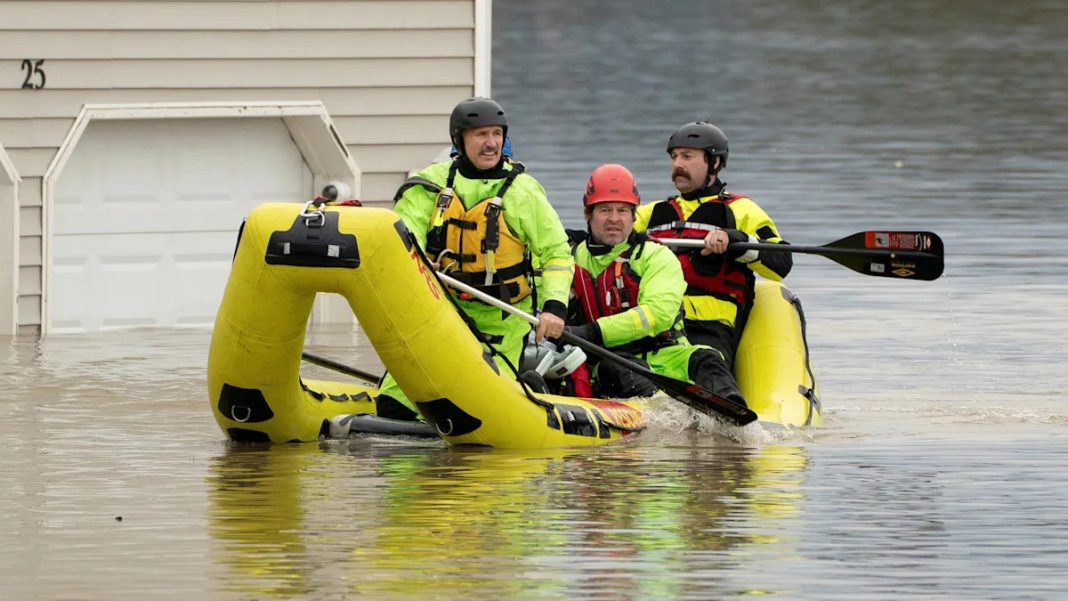

Portions of western Washington state have experienced a month’s worth of rain within the last few days, causing historic flooding, damaging mudslides and over 100,00 people facing potential evacuations.
Gov. Bob Ferguson wrote on X Friday that President Trump approved the state’s request for an emergency declaration in order to provide federal disaster assistance.
No fatalities have been reported, though local authorities and first responders stress the life-threatening dangers associated with record-breaking flooding. The Washington National Guard said on X that it had more than 300 members on duty Friday “to support local first responders in flood areas with life saving measures.”
A foot and a half of rain pushed the water levels of at least four rivers in Washington, including the Skagit River, to hit record highs, surpassing some of their previous records set over 35 years ago.
“Catastrophic flooding impacts along the Skagit and Snohomish Rivers will continue today,” the National Weather Service said Friday. “Major and/or record river flooding is ongoing. Both rivers are cresting this morning, but will remain in major flood stage into Saturday.”
Meanwhile, the Western Cascade Foothills still face “significant flooding impacts” on Friday. In areas with steep terrain, landslides are also possible.
A drone view shows a vehicle next to homes in an area flooded by the Snohomish River in Snohomish, Washington on Dec. 11. (David Ryder/Reuters)
Flooding maps
The following map indicates the flood watches, warnings, and areas under evacuation orders, according to information from the National Water Prediction Service. As of Friday morning, approximately 5 million people remained under flood watches in western Washington, according to NBC News.

Mehmet Yaren Bozgun/Anadolu via Getty Images
Travel has also been brought to a halt in western Washington, with more than 20 highways closed across 11 counties, according to the Washington State Department of Transportation.
Atmospheric Rivers
A series of storms with atmospheric rivers is responsible for the historic flooding, meteorologists say.
“Atmospheric rivers are relatively long, narrow regions in the atmosphere – like rivers in the sky – that transport most of the water vapor outside of the tropics,” the National Oceanic and Atmospheric Administration explains.
“While atmospheric rivers can vary greatly in size and strength, the average atmospheric river carries an amount of water vapor roughly equivalent to the average flow of water at the mouth of the Mississippi River.”
The Washington rivers with record high levels
According to the National Water Prediction Service, the following rivers broke level records due to the torrential rain.
• Skagit River: The previous record of 37.4 feet was set in November 1990, and the river surpassed that record on Thursday evening by a few inches at 37.73 feet.
• Snohomish River: On Thursday morning, the river flooded nearly a foot higher than its previous record of 33.5 feet set in November 1990.
• Cedar River: The previous record level was at 17.13 feet in November 1990. On Thursday, the river just surpassed that level at 18.2 feet.
• Nooksack River: It crested at 150.49 feet on Thursday morning, just above its record set in November 2021 at 149.6 feet.

A driver manages to drive through flood waters from the Snohomish River in Snohomish, Washington, on Dec, 11. (Jason Redmond/AFP via Getty Images)
Forecast for the Pacific Northwest
Drier weather is in the forecast for the upcoming weekend, giving western Washington a much-needed break from the torrential rain, AccuWeather meteorologists say.
Despite that, “the major to catastrophic flooding effects are likely to continue for several days across portions of western Washington State and northwestern Oregon,” according to the NWS.
“There is an indication that a new atmospheric river will develop and extend all the way from near Hawaii to the coastal areas of the Northwest on Monday,” said Brett Anderson, AccuWeather senior meteorologist. “This setup is sometimes referred to as the pineapple express.”
Meteorologists warn that flooding could resume next week in Washington and push further south into Oregon and Northern California.

A sign warning drivers about flood water is partially covered by water in an area flooded by the Snohomish River in Snohomish, Washington on Dec, 11,. (David Ryder/Reuters)