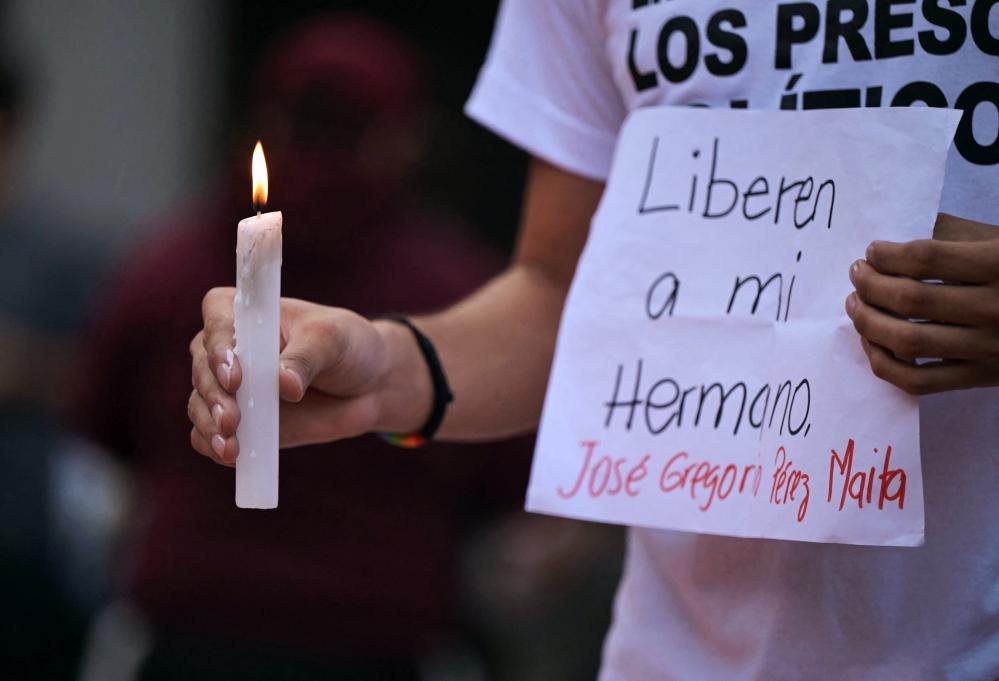

Venezuela has said it has carried out its largest release of political prisoners this year, claiming to have freed 99 people detained for taking part in protests after the 2024 election, widely believed to have been stolen by the dictator Nicolás Maduro, as it comes under increasing military pressure from the US.
Civil society organisations have treated the news with caution and stressed that the releases were insufficient, noting that at least 900 political prisoners remain in the country.
The Maduro regime refuses to acknowledge the existence of political prisoners and said it had freed, in the early hours of Christmas Day, 99 “citizens who were deprived of their liberty for their participation in acts of violence and incitement to hatred following the electoral process of 28 July 2024”.
Related: Trump’s claims to Venezuelan oil are part of broader ‘resource imperialism’, experts say
It framed the move as an expression of its alleged commitment to “peace” and its “unrestricted respect for human rights”, at a moment when the country is facing what it described as an “imperialist siege and multilateral aggression” by the US.
Beyond the deployment of about 15,000 troops and a massive naval fleet off Venezuela’s coast, the US has intensified pressure in recent weeks with a “total blockade” of sanctioned oil tankers entering and leaving the country, the seizure of two vessels and the pursuit of a third, and airstrikes on boats that have killed 105 people in the Caribbean and the Pacific.
The prisoner releases followed a period of escalating internal repression, during which the opposition has been left with virtually no prominent figures either free or still in the country – the opposition leader María Corina Machado, for example, is temporarily in exile after travelling to Norway to receive her Nobel peace prize.
In recent weeks alone, a political scientist, an activist and union leaders were arrested, while last week 17-year-old Gabriel José Rodríguez Méndez became the first teenager convicted of “terrorism”, sentenced to 10 years in prison for taking part in post-election protests.
Demonstrations erupted across the country after Maduro – backed by electoral and state institutions under his control – declared himself the winner, despite the opposition presenting evidence that its candidate, the retired diplomat Edmundo González Urrutia, had prevailed. He is now living in exile in Spain.
As far as is known, no prominent opposition figures who had been detained, nor the 17-year-old Méndez, are among the 99 allegedly released, a group that does include at least three other teenagers.
“The selective and discretionary nature of these releases confirms that deprivation of liberty has been used as an instrument of political persecution,” said the NGO Justicia, Encuentro y Perdón in a statement.
The NGO acknowledged the “positive impact” of the measure on the lives of those freed, but said it was “clearly insufficient” given that hundreds of political prisoners remain, with estimates ranging from 900 to 1,000.
The Committee for the Freedom of Social Fighters and Political Prisoners said most of those released would remain under “conditional” liberty, subject to precautionary measures such as travel bans, regular court appearances and restrictions on speaking to the media about their cases.
The committee and other groups also said they had not yet independently verified that the number of people released was 99, suggesting it may have been lower.