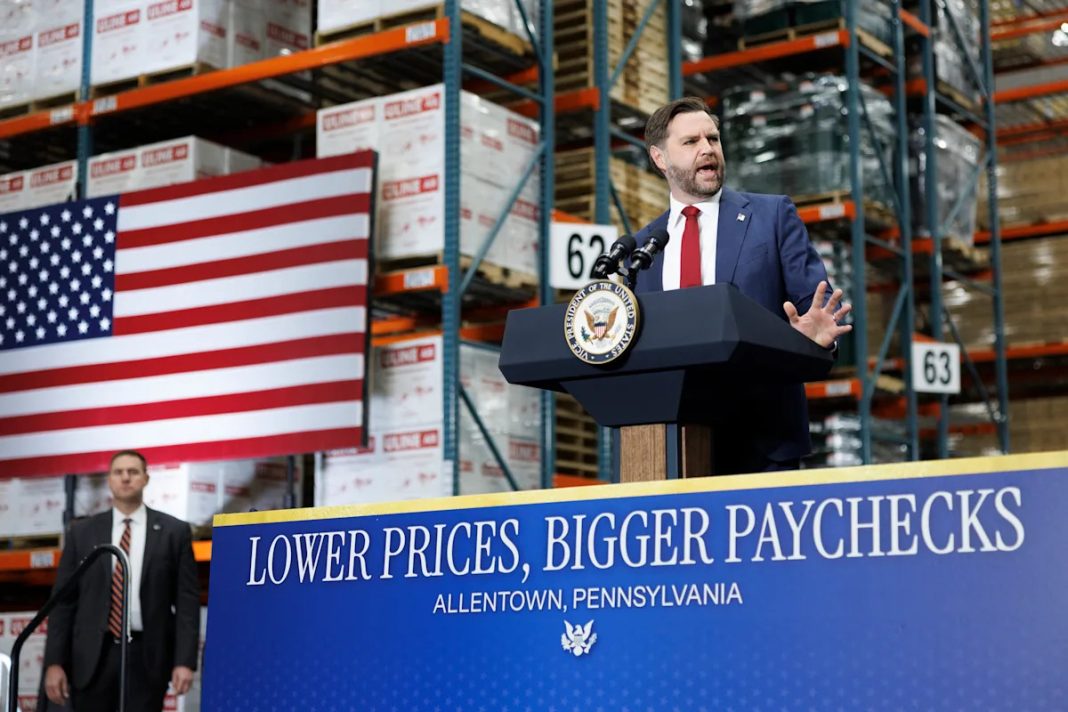

ALBURTIS, Pennsylvania — Vice President JD Vance on Tuesday told this Rust Belt town that he remembers what it’s like to choose between putting food on the table or getting prescription medications — and pledged he and President Donald Trump don’t want that life for American citizens.
Moments later, he said he would grade the economy “A+++,” echoing a similar score the president gave to the economy in an interview with POLITICO last week.
While Vance used his personal story, informed by the tough childhood he documented in “Hillbilly Elegy,” he refused to deviate from Trump’s insistence that the economy is better than an A+. It’s a disconnect that Trump and his administration have repeatedly bumped up against in the six weeks since voters in the off-year elections rewarded Democrats who messaged around affordability concerns.
“I promise you, there is no person more impatient to solve the affordability crisis than Donald J. Trump,” Vance said, speaking to a crowd of about 200 in a Lehigh Valley warehouse a week after Trump addressed the same cost of living concerns at a casino about 50 miles north of here.
Even as the White House acknowledges that affordability could be a major political liability heading into next year’s midterm elections, Trump has consistently wandered from a cohesive message, emphasizing that the economy is strong, blaming higher prices on former President Joe Biden and calling the affordability crisis a “hoax” perpetrated by Democrats and the media.
“I think they’re annoyed that the messaging just isn’t sticking,” said a person close to the White House, granted anonymity to speak candidly. “I totally understand this is not our problem. This is something we inherited. But the reality is, people don’t care about that.”
Vance’s speech on Tuesday likely offers a preview of the themes the administration will hammer over the next 11 months: they feel America’s pain, the pain is Biden’s fault and they’ve already made great strides in relieving that pain.
In Vance, the administration has a more disciplined messenger — and yet even he struggled to thread the needle between the personal outreach and not disagreeing with the president’s report card.
“I know what it’s like for a woman who’s trying to support a grandson but can’t afford prescription drugs because pharmaceutical companies are taking advantage of the United States of America,” Vance said Tuesday. “I remember what it’s like when you have to choose between putting food on the table or getting the prescription that you need to stay healthy. And that is not a life that Donald Trump or I want for the citizens in the greatest country in the world.”
The stakes for the White House as it enters a midterm year couldn’t be higher. Nearly half of respondents to The POLITICO Poll, conducted last month by Public First, said they find groceries, utility bills, health care, housing and transportation difficult to afford — and 46 percent of respondents, including 37 percent of 2024 Trump voters, said the cost of living in the U.S. is the worst they can remember.
In a rambling, 97-minute speech last week in Mount Pocono, Pennsylvania, Trump mocked the word “affordability” and joked that he’s no longer “allowed” to say it.
Others in the White House, meanwhile, have tried to highlight that the economy has improved since Trump took office while also admitting that there is still work to be done. Last week, press secretary Karoline Leavitt told reporters “there’s much work to do, but this has already been significant progress.”
“We know people suffered a lot under the policies of the Biden administration. We’re working very hard to correct those problems,” Vance told reporters Tuesday before boarding Air Force 2 ahead of the event. “I think we’ve made a lot of progress over the past 10 months, but of course there’s a lot more progress to be made.”
Both the president and vice president continue to blame Biden for any persistent economic problems, as they did again on Tuesday following a disappointing November jobs report. Only 64,000 jobs were added to the economy last month according to the delayed report, which also showed the unemployment rate rising from 4.4 percent to 4.6 percent in September. Nevertheless, Leavitt called it a “strong” report, asserting that the data “shows how President Trump is fixing the damage caused by Joe Biden and creating a strong, America First economy in record time.”
White House spokesperson Kush Desai said “every single White House and Administration official understands the gravity of the mandate that we have been tasked to deliver on.”
“The around-the-clock, day-and-night hours that everyone from President Trump on down is working to continue cooling inflation, delivering economic relief, and untapping the potential of the American people reflect our commitment to delivering on that mandate,” he continued.
Vance’s message to Americans on the cost of living — “I know that there is so much more progress to me made” — has a different tone from Trump’s messaging that the economy is strong, inflation is down, and Democrats are pushing a “con job.” Trump’s way of discussing the economy, which has been criticized as half hearted, is politically risky going into 2026, when Republicans are looking to the White House for messaging on the economy.
“Blame has a shelf life,” said Republican strategist Kevin Madden. “It’s just a fact that voters now look to this president and this Congress for answers and solutions to the economy. Right now, voters are still feeling the pressure of everyday costs, and so it’s important to be sympathetic.”
Douglas Holtz-Eakin, president of the center-right American Action Forum, said messaging that appeals more broadly to Americans would be helpful for the GOP in 2026.
“[Trump’s] not legendary for caring a lot about anyone past his own nose. So, this is part of the problem. He had big trouble with the midterm elections last time. He’s not had a lot of coattails for the party,” he said.
The person close to the White House was critical of the administration’s handling of the economy, describing a level of tolerance within the White House that Republicans may lose Congress next year, in part because Trump’s 2024 campaign promise of a stronger economy hasn’t come to fruition.
“There’s a part of the party that, at least the White House, it’s just like they achieved what they set out to achieve, which is getting the White House back,” the person said.
But in Madden’s view, the White House can still win the argument on the economy by focusing less on the past and more on its own policy vision for the future. “Every campaign or battle for public opinion is won by the side that proposes new ideas and a more promising future,” he said.
In recent weeks, the administration has adopted a new line, suggesting that a major economic upturn was right around the corner. At a Cabinet meeting earlier this month, several secretaries were emphatic that 2026 was set up to be a banner year as elements of the One Big Beautiful Bill take effect.
“The best way to address the affordability crisis is to give Americans more money in their pockets, which is what this bill has done,” Treasury Secretary Scott Bessent said. “We can look back, be very proud of this year, but I think 2026 is going to be a great year for the American people.”
Vance echoed the line in the meeting, declaring that “2026 is going to be the year where this economy really takes off.”
A senior administration official, granted anonymity because they were not authorized to speak publicly, pointed to several of the tax cut provisions enacted as part of the law that they believe will have a tangible effect for many Americans next year. But they conceded that implicit in their “wait until next year” optimism is an awareness that there is a lot of work left to do on the economy.
“There’s no finish line with the economy,” the senior official said. “The problem with the first term was we passed tax cuts way too late. People didn’t feel it until the end of the year, or at the beginning of the next year, which was after the midterms during that term, that year. So we got a lot of stuff passed early enough [this year] to settle around where people will feel it.”
As for the president’s defensiveness about his economic record — and Trump’s insistence that affordability concerns are part of a Democratic “con job” giving the opposition party a line they can weaponize in attack ads next fall, the senior official expressed little concern, stating that the president’s track record as an effective communicator is well established.
“He’s been told so many times: ‘Oh no, don’t say this.’ And then it ends up becoming a rallying cry for us and for our events, for our base,” the senior official continued. “Whenever he’s talked about this affordability hoax, he’s always talked about how Democrats have used his phrase in order to rewrite history.”