
At about 4:20 p.m. on a cold Rhode Island Saturday, a message from Brown University flashed up on cellphones all over campus — everyone should run or take cover from an active shooter.
Hours later, horror erupted again, on the other side of the globe, as two gunmen sprayed bullets into a Hanukkah celebration on iconic Bondi Beach in Sydney.
At Brown, two students were killed and nine others were injured. At least 15 people died at Bondi Beach, and more than three dozen remain in the hospital.
There’s little, circumstantially, linking the outrages.
Both featured the now-routine rituals of mass shootings, including jerky cellphone footage of people fleeing for their lives. And two communities were left shattered by the same incomprehensible reality — of death that came suddenly for people gunned down as they went about daily life.
First responders on the scene near Brown University’s Barus and Holley building, the site of a mass shooting, in Providence, Rhode Island, on Saturday. – Bing Guan/AFP/Getty Images
In Rhode Island, students checked in for a final exam. Two victims will now never go home for the holidays. In Sydney, the dead perished on a balmy evening at the beach.
They were victims of a modern curse.
Sudden, public violence can burst out anywhere at any time. Who hasn’t been part of a crowd or at a big event and not felt a chill of fear at its vulnerability to a terror attack or mass shooting?
The Sydney and Brown University attacks have another thing in common: Both quickly become dragged into the politics of a bitter, divided time, as partisans saw each through the prism of their own ideology and disputes.
A horrific Hanukkah
Bondi Beach is an archetype of life Down Under, with its ocean-filled pools, sun, sand, surfers and restaurants. But its legend will now forever be stained with blood.
“The gathering at Bondi Beach was supposed to be a day of joy, advertised as an event adjacent to a playground, with face painting, ice cream, and games for children. Instead, it became the site of unspeakable violence targeting Jews,” Bend the Arc, a US organization of Jews and allies, said in a statement. “On this first night of and through every night of Hanukkah, Jews across the world will recount this horror, casting a shadow over our own celebrations. No one should be made to feel afraid as they practice their Jewish traditions.”
The attack, by father-and-son assailants, underscored an alarming reality: Jews cannot assume they are safe anywhere. A rising wave of antisemitism has seen high-profile killings in Washington, DC; Manchester, England; and Pittsburgh, Pennsylvania.
The massacre in Sydney was on the minds of many attendees at the National Menorah lighting ceremony in Washington on Sunday. Allison Groff said she learned about the attack from her brother, who’d been in another part of Sydney. “Being Jewish, you feel vulnerable,” Groff said.

Belongings of members of the Jewish community are seen at the scene of a shooting at Bondi Beach in Sydney on Sunday. – David Gray/AFP/Getty Images

A woman kneels and prays at a flower memorial to shooting victims outside the Bondi Pavilion at Sydney’s Bondi Beach on Sunday. – Mark Baker/AP
That vulnerability has only increased following the attack on Israeli civilians on October 7, 2023, and after the subsequent Israeli onslaught in Gaza aimed at Hamas. For years, many Western governments were in denial about the rise of antisemitism. That’s no longer a sustainable position.
Jonathan Greenblatt, CEO of the Anti-Defamation League, told CNN’s Fredricka Whitfield on Sunday that Jews were reeling from years of attacks and intimidation. “You can never build walls that are high enough,” he said, calling on political leaders to speak out against incitement.
In 20th century Europe, the legacy of two world wars that killed millions was palpable. It was hard to believe antisemitism would again become a global scourge. But as the last survivors of Nazi death camps fade away, history’s lessons are being forgotten.
The Australia attack will renew huge scrutiny of the huge global demonstrations in solidarity with tens of thousands of Palestinians in Gaza killed during Israel’s onslaught against Hamas. The chant “globalize the intifada” has come to epitomize more radical aspects of the pro-Palestine movement. This latest antisemitic attack underscores why some Jewish people interpret it as a threat.
The political aftermath of the Sydney attack is already opening new divides.
Australian Prime Minister Anthony Albanese early Monday condemned the Bondi attack as “just impossible to rationalize and comprehend.”

Australian Prime Minister Anthony Albanese visits the scene of the attack at Sydney’s Bondi Beach on Sunday. – Flavio Brancaleone/Reuters
But Israeli Prime Minister Benjamin Netanyahu on Sunday faulted Australia for doing too little to acknowledge antisemitism and implied that the foreign policy of the Canberra government and its allies had enabled the attack. He recalled how he had told Albanese in a letter in August that “your call for a Palestinian state pours fuel on the antisemitic fire. It rewards Hamas terrorists. It emboldens those who menace Australian Jews and encourages the Jew hatred now stalking your streets.”
America’s Western allies, who have recognized a Palestinian state that exists only in the aspirations of its would-be citizens, reject the notion that their criticism of Israeli policy fosters antisemitism. Netanyahu’s critics argue that his blocking of the path to a Palestinian state fomented conditions for extremism in occupied territories and anti-Israeli protests that is reshaping Western politics.
Israel’s critics, which include many of its former allies, fervently decry violence and intimidation against Jews, but reject the idea that criticizing Israel is tantamount to antisemitism.
Brown’s tragic new symbolism
Brown University has joined a tragic list of places whose mere names conjure the terror of mass shootings: Sandy Hook Elementary School; Uvalde, Texas; the Pulse nightclub in Orlando, Florida; Virginia Tech; and Marjory Stoneman Douglas High School in Parkland, Florida.
Saturday’s shooting rampage was the latest example of shocking public violence that has rocked America in the last 18 months, including two assassination attempts against then-presidential candidate Donald Trump; the assassination of Turning Point USA leader Charlie Kirk; the murder of Minnesota Democratic state lawmaker Melissa Hortman and her husband, Mark; and a firebomb attack on the residence of Pennsylvania Gov. Josh Shapiro, who is Jewish.
The violence prompted politicians of both parties to accuse their adversaries of incitement. Rebel MAGA Rep. Marjorie Taylor Greene has accused Trump of triggering death threats against her family with his rhetorical attacks after she broke with him on several key issues. And Republicans claim that the characterization by some Democrats of the president as a fascist endangers him.
Democratic Sen. Chris Murphy of Connecticut stoked controversy in his response to the Brown University shootings on CNN’s “State of the Union” on Sunday. He said Trump was “restoring gun rights to felons and people who have lost their ability to buy guns.”
“He eliminated the White House Office of Gun Violence Prevention, and he has stopped funding mental health grants and community anti-gun violence grants that Republicans and Democrats supported in that 2022 bill,” Murphy said. “So he has been engaged in a pretty deliberate campaign to try to make violence more likely in this country, and I think you’re unfortunately going to see the results of that on the streets of America.”

Police patrol Brown University in Providence, Rhode Island, on Sunday, the day after a mass shooting. – Spencer Platt/Getty Images
But Republican Sen. Bill Cassidy of Louisiana argued that Murphy was speaking too soon. “I don’t mean to demean what Sen. Murphy said, but I do find that, if there’s something bad that happens, the checklist is first blame President Trump,” Cassidy said. “Let’s find out what the facts are. Let’s see what’s actually going on.”
The politics of gun violence are stuck. And the tired post-shooting routines are playing out. Trump and Republicans offered prayers for the victims. Some Democrats demanded more gun control. And everyone puzzled over the emotional, mental and societal dislocation that can turn young men into killers.
And almost as soon as news broke of the Sydney shooting, social media filled with Americans seeking a political opening. Some argued falsely that it undermined a frequent argument of gun-control advocates that Australia’s tight restrictions on firearms mean the country doesn’t suffer massacres as often as the US.
But two cities, on opposite sides of the world, were united in mourning. Australia grieved victims including a beloved rabbi and a 10-year-old girl. And a generation of young Americans brought up on duck-and-cover mass shooter drills wondered whether they’d ever be safe on campus.
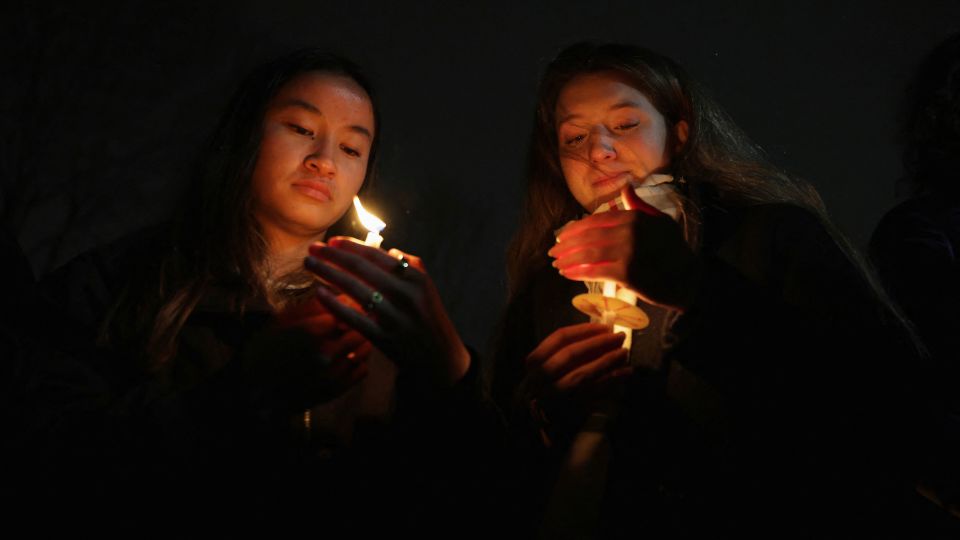
In a moment of emotional synergy with Sydney on Sunday evening, one of the first public events in Providence, Rhode Island, after the Brown shooting was a menorah-lighting ceremony.
“If we can come together … and shine a little bit of light tonight, there’s nothing better that we could be doing as a community,” the city’s mayor, Brett Smiley, said.
CNN’s Aileen Graef contributed reporting.
For more CNN news and newsletters create an account at CNN.com