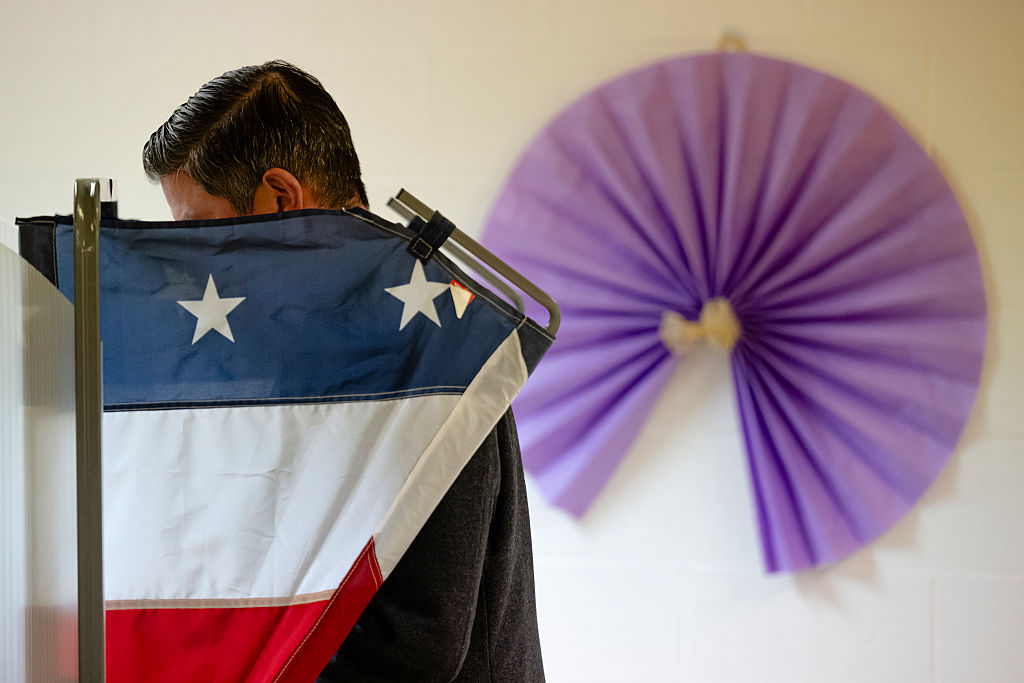

A Tennessee voter casts his ballot in Nashville during a special election this month. The U.S. Department of Justice has sent confidential draft agreements on voter data sharing to more than a dozen states, including Tennessee — part of the Trump administration’s effort to obtain unredacted voter rolls from states. (Photo by Jon Cherry/Getty Images)
The U.S. Department of Justice has sent a confidential draft agreement to more than a dozen states that would require election officials to remove any alleged ineligible voters identified during a federal review of their voter rolls.
The agreement — called a memorandum of understanding, or MOU — would hand the federal government a major role in election administration, a responsibility that belongs to the states under the U.S. Constitution.
A Justice Department official identified 11 states that have expressed an interest in the agreement during a federal court hearing in December, according to a transcript reviewed by Stateline. Two additional states, Colorado and Wisconsin, have publicly rejected the memorandum of understanding and released copies of the proposal.
The 11 states “all fall into the list of, they have expressed with us a willingness to comply based on the represented MOU that we have sent them,” Eric Neff, the acting chief of the Justice Department’s Voting Section, said at the hearing. He spoke at a Dec. 4 hearing in a federal lawsuit brought by the Justice Department against California, which has refused a demand for the state’s voter data.
Neff’s courtroom disclosure, which Stateline is the first to report, comes as the Justice Department has sued 18 states for unredacted copies of their voter rolls after demanding the data from most states in recent months. The unredacted lists include sensitive personal information, such as driver’s license and partial Social Security numbers.
The states Neff identified are led by Republicans — Alabama, Mississippi, Missouri, Montana, Nebraska, South Carolina, South Dakota, Texas, Tennessee, Utah and Virginia.
The draft memorandum of understanding represents a new effort by the Trump administration to gain access to some states’ voter data without litigation.
The administration’s lawsuits mostly target Democratic states, where election officials refused initial requests for voter data and allege the demand is unlawful and risks the privacy of millions of voters. They have also voiced fears that the Trump administration could use the information to target its political enemies.
Neff said four states with Republican secretaries of state — Arkansas, Indiana, Kansas and Wyoming — have “complied voluntarily” with the Justice Department’s demand without memoranda of understanding.
What the DOJ is trying to do is something that should frighten everybody across the political spectrum.
– David Becker, executive director of the Center for Election Innovation & Research
The Justice Department says it needs voters’ detailed information to ensure ineligible people are kept off state voter rolls and that only citizens are voting.
Federal officials say they will follow federal privacy laws, but critics fear voter data is being shared with the U.S. Department of Homeland Security, which operates a powerful citizenship verification tool known as SAVE. The Trump administration has previously confirmed the Justice Department plans to share voter data with Homeland Security.
“What the DOJ is trying to do is something that should frighten everybody across the political spectrum,” said David Becker, executive director of the nonpartisan Center for Election Innovation & Research. “They’re trying to use the power of the executive branch to bully states into turning over highly sensitive data: date of birth, Social Security number, driver’s license — the holy trinity of identity theft.”
Becker, who worked as a senior trial attorney in the Justice Department’s Voting Section during the Clinton and George W. Bush administrations, told reporters on Dec. 8 that several states received the memorandum. But Neff’s identification of 11 states wasn’t widely available until the judge in the California lawsuit on Tuesday ordered the transcript of the Dec. 4 hearing immediately posted to the lawsuit’s public docket, where Stateline accessed it.
A transcript of a Dec. 4 federal court hearing showing Eric Neff, acting chief of the Justice Department’s Voting Section, listing states that he says are willing to comply with a request for voter data based on a proposed memorandum of understanding (MOU). (Screenshot by Jonathan Shorman)
The draft memorandum of understanding, which is labeled “confidential,” outlines the terms of the proposed agreement between each state and the Justice Department. After a state provides its voter roll, the federal department would agree to test, analyze and assess the information. The department would then notify states of “any voter list maintenance issues, insufficiencies, inadequacies, deficiencies, anomalies, or concerns” found.
Each state would agree to “clean” its voter roll within 45 days by removing any ineligible voters, according to the memorandum. States would then resubmit their voter data to the Justice Department for verification.
While the Justice Department has demanded states’ voter rolls since this summer, the memorandum of understanding offers the most detailed picture to date of how the Trump administration plans to use the data.
“It lays out in a way that we haven’t seen in any other context their plan for one of the things, I will say, that they plan to do, which is disturbing,” said Eileen O’Connor, a senior counsel and manager in the voting rights and election program at the Brennan Center for Justice at New York University, a progressive think tank.
O’Connor was a trial attorney in the Justice Department’s Voting Section during the Obama, first Trump and Biden administrations. “I think with each passing lawsuit, they are clearly trying to create a national database of every voter in the country,” she said.
The Justice Department didn’t answer questions from Stateline about how many states had been sent the memorandum and whether any had signed it.
Assistant U.S. Attorney General Harmeet Dhillon, who leads the Justice Department’s Civil Rights Division, wrote in a statement to Stateline that the department has a statutory mandate to enforce federal voting rights laws. Ensuring the voting public’s confidence in election integrity is a top priority of the Trump administration, she wrote.
“Clean voter rolls and basic election safeguards are requisites for free, fair, and transparent elections,” Dhillon wrote.
Federal involvement in elections
The Justice Department memorandum, if implemented, would mark a significant departure from how election officials typically maintain voter rolls.
States, often in coordination with local election officials, check lists for changes in address, deaths and other reasons for ineligibility, such as a felony conviction. States typically perform this task with little to no federal involvement.
Some states participate in voluntary programs that allow election officials to share voter information with other states for the purposes of looking for voters who may have moved or who are registered in multiple locations. But those don’t include the federal government, which plays a limited role in election administration under the United States’ decentralized approach to elections.
Matt Crane, executive director of the Colorado County Clerks Association, said clerks continually look at death records and other sources of data to update voter lists. He said the United States’ localized election system is a strength that guards against election interference.
“The federal government has no role in list maintenance,” Crane said.
But that has begun to change under the Trump administration, as President Donald Trump has made removing noncitizen voters a priority.
Earlier this year, Homeland Security overhauled the SAVE program into a tool that can scan millions of voter records against government databases for evidence of citizenship. The program was previously used for one-off searches to check whether noncitizens were eligible for government benefits.
Some Republican secretaries of state have agreed to upload their voter rolls into SAVE. Democratic secretaries of state object to using the program and say they are wary of what will happen to the voter information once it’s provided to the Trump administration, including its potential use by the Department of Homeland Security.
While SAVE can flag voters with potential eligibility issues, the onus now is still on state officials to investigate whether those voters are actually ineligible and decide whether to initiate a process to remove them from the rolls.
By contrast, the Justice Department memorandum would empower federal officials to take a more active role, allowing them to check the work of state election officials as they remove — or don’t remove — voters.
“We have a system that allows Americans to voice their opinions and to hold government accountable, and that is so fundamentally central to the way our system works,” Oregon Democratic Secretary of State Tobias Read, who has been sued by the Justice Department, said in an interview. “We should be focused on how to make that better, not on erecting artificial barriers and putting people’s privacy and confidence at risk for no reason.”
Republican interest
Some GOP election officials have welcomed the Trump administration’s interest and have accused the Biden administration of not doing enough to help states vet their voter rolls. In particular, they praise the overhaul of SAVE, which some GOP secretaries of state had requested before Trump took office.
Some secretaries have touted the removal of noncitizen voters after using SAVE. Wyoming Secretary of State Chuck Gray, a Republican, in November announced three voters identified as noncitizens had been removed from his state’s voter rolls. Gray has also provided the Justice Department with full access to Wyoming’s voter roll.
“The voter list maintenance that we have been conducting is extremely important for election integrity,” Gray said in a news release.
But as of early December, nearly all states hadn’t provided the Justice Department access to their unredacted voter rolls, with Neff identifying only four that had shared their lists. It also remains unclear whether any state has signed the memorandum of understanding. No state has told Stateline it signed the document.
Nebraska Secretary of State Robert Evnen, a Republican, has received a memorandum of understanding and plans to comply with the Justice Department request, pending the outcome of an ongoing lawsuit, Evnen spokesperson Rani Taborek-Potter wrote in an email to Stateline. A voting advocacy group has sued to block the release of the data.
In an interview with Kentucky Lantern, Kentucky Republican Secretary of State Michael Adams said that his office was “going back and forth a little bit” with the Justice Department over what federal law requires.
“We’ve not really figured out exactly where that line is of what-all they’re entitled to,” Adams said. “What’s not in dispute is they’re entitled to the vast majority of information — people’s names, addresses, birthdays — and we’ve given them all of that.”
Adams added that many state officials “are in the same boat of trying to figure out what exactly they need to do their job and what our obligations are legally.”
Utah Lt. Gov. Deidre Henderson, a Republican, confirmed in a statement to Stateline that her office received a proposed memorandum of understanding from the Justice Department. “We are in the process of reviewing the document with our attorneys and carefully considering our options,” Henderson wrote.
Rachael Dunn, a spokesperson for Missouri Republican Secretary of State Denny Hoskins, wrote in an email that the state hadn’t entered into an agreement with the Justice Department “at this time.”
DOJ ‘contractor’ could get voter data
The draft agreement would give the Justice Department wide authority to share the voter data of states that sign on.
The department would be authorized to share the data with “a contractor” who needs access “to perform duties related” to voter list maintenance verification, according to the draft agreement. The agreement doesn’t name any contractors or specify whether they would be inside or outside of government.
Two states have publicly rejected the draft agreement. Colorado Democratic Secretary of State Jena Griswold announced Dec. 11 she would refuse to sign the memorandum. The Justice Department sued Colorado the following day.
The Wisconsin Elections Commission also rejected the draft agreement that week. In a Dec. 11 letter to Neff, the Justice Department official, the commissioners wrote that state law prohibits them from releasing certain personally identifiable information, such as date of birth, Social Security numbers and driver’s license numbers.
“I don’t look at the action that we’re taking today to be commentary on the motive of the appropriateness of the Department of Justice’s request,” Commissioner Don Millis, a Republican appointee, said at a virtual commission meeting the same day. “The U.S. DOJ is simply asking the commission to do something that the commission is explicitly forbidden by Wisconsin law to do.”
The Justice Department so far hasn’t sued Wisconsin for its voter data.
Justin Levitt, who served as senior policy adviser for democracy and voting rights in the Biden White House and is now a law professor at Loyola Marymount University, told Stateline in an email that he expects no states to sign the agreement.
“It’s no surprise that both Colorado and Wisconsin said no — and I don’t think that’s a question of political leadership,” Levitt wrote. “It’s hard for me to imagine any Republican state with faith in its own list maintenance capacity agreeing to outsource that decision to the DOJ.”
VRLData Sharing Agreement DOJ-WI (2)
Colorado Newsline’s Lindsey Toomer contributed reporting. Stateline reporter Jonathan Shorman can be reached at jshorman@stateline.org.