
A federal moratorium threatening state-level artificial intelligence laws could upend efforts to safeguard the rental and homebuying markets from manipulation, even as both backers and critics of the executive order warn that legal uncertainty could hinder action to lower housing costs ahead of next year’s election.
State lawmakers are increasingly proposing bills to regulate the use of AI in the housing industry over concerns that the technology could be used to promote anti-competitive and discriminatory practices. Supporters of state-level guardrails argue that they prevent predatory efforts to raise rent prices and other housing costs. And a significant number of attorneys general from red and blue states have warned that efforts to preempt their governments’ AI laws are “ill-advised.”
But organizations that back a national standard, as President Donald Trump called for in an executive order Thursday, say a patchwork of regulations could have a chilling effect on technological development that would otherwise help alleviate the cost of housing.
Rent and home prices have become a key cost-of-living concern heading into the midterms, while national policymakers attempt to advance bipartisan solutions for low- and middle-income Americans struggling to afford housing.
“The market is not working like it’s supposed to,” said George Slover, senior counsel for competition policy at the civil rights-focused think tank Center for Democracy and Technology, which has supported state efforts to address the potential for AI-fueled rent-pricing collusion. “It affects everybody.”
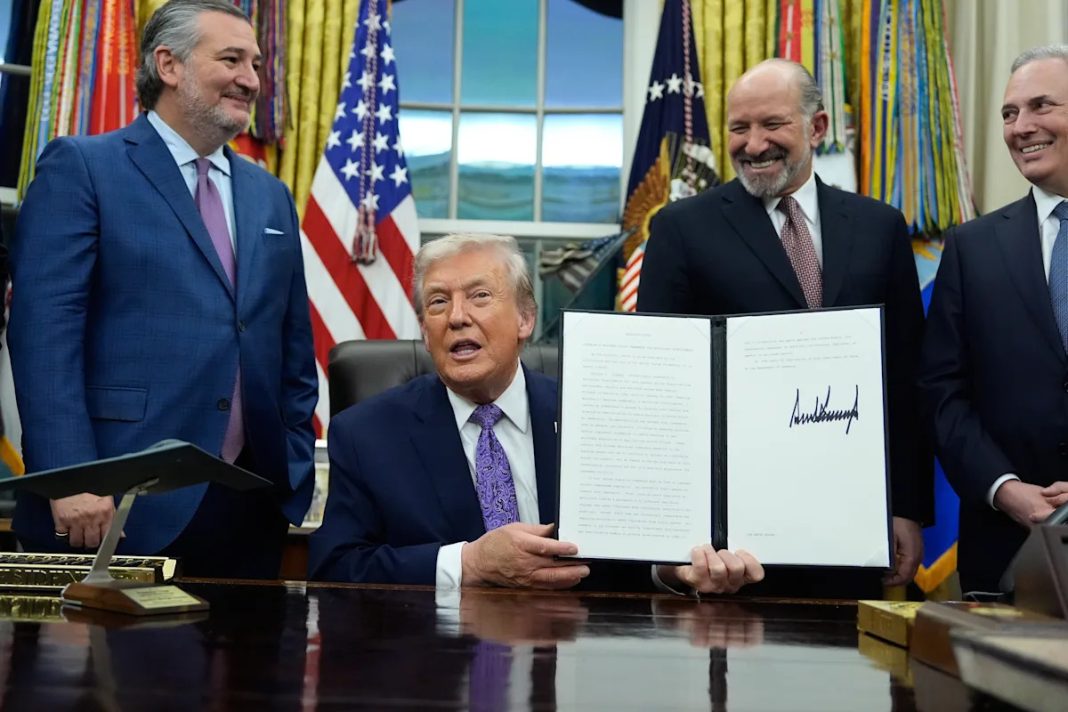
Some state legislators have attempted to address housing costs through bills restricting AI usage in home renting, lending and insurance. But those provisions could face challenges from a presidential AI moratorium. Trump released an executive order Thursday to fight state AI laws that “threaten to stymie innovation.”
A National Conference of State Legislatures analysis from July identified more than 40 pending bills across the country related to AI in the housing sector. Many of those bills reflect a drive to prevent landlords from utilizing AI algorithms to coordinate pricing — taking away leverage from potential renters seeking lower housing costs. The legislative proposals come amid nearly settled Department of Justice litigation on the issue against real estate software company RealPage.
The DOJ joined a group of state attorneys general to sue RealPage during the Biden administration, arguing that the company’s real estate management software functionally empowered landlords to collude on rent prices. Trump’s DOJ continued to prosecute the case and in November came to a proposed settlement preventing the company from using nonpublic data in determining rent.
“The Justice Department’s lawsuit has helped in that regard, bringing attention to the issue,” Slover said.
New York passed a law in October banning the use of AI algorithms that could allow landlords to coordinate rent-pricing, and a similar bill is moving forward in the Massachusetts legislature.
Massachusetts Democratic state Sen. Cindy Friedman, who worked with her colleagues to bring AI rent-pricing bills in both state legislative chambers, said she’d been inspired by the DOJ suit against RealPage.
But she added that Massachusetts’ focus on its own decades-long housing shortage gives her state a unique perspective on the issue. As the cost of housing now receives national attention as a prominent affordability concern, Friedman said it had already been top of mind for residents and lawmakers in her state the past few years.
“I think we’re a bit of a canary in the coal mine,” Friedman said in an interview. Although she said the focus of her legislation is to reduce the cost burden of Massachusetts residents, she added, “I would imagine that a lot of [other state] legislators look at that as well.”
Friedman’s bill received a hearing last month and is waiting for a report from a joint committee, whose Senate leaders have both co-sponsored the legislation.
Friedman said her proposal got a positive reception from leadership because it is “one lever” that state legislators can pull to demonstrate they are taking housing costs seriously.
“It’s not going to solve the housing crisis,” Friedman said. “But at least it’s one of a number of things that we could be doing. And this one is pretty straightforward.”
It’s not clear that the administration would target state bills on algorithmic rent-setting based on Thursday’s White House directive. Still, it could add new uncertainty around state-level efforts to curb the practice.
Although the state efforts to limit AI rent-setting complement the complaint against RealPage continued by Trump’s DOJ, the executive order shows the administration’s intent to contest policies that would get in the way of a “carefully crafted national framework” led by the federal government.
The order calls for launching a DOJ “AI Litigation Task Force” to legally challenge state laws that the administration considers to be overly burdensome. Those fights may not be easy. A bipartisan coalition of 36 states attorney generals in a November letter to congressional leaders signaled their interest in defending state AI legislation.
The directive identifies AI-usage transparency requirements and efforts aimed at preventing AI-fueled discrimination as two examples of state provisions the White House seeks to block.
It was particularly critical of efforts to reduce the likelihood of AI utilization having negative consequences for historically marginalized groups. The Colorado Artificial Intelligence Act passed last year contained anti-discrimination language that could extend to housing policy.
The Mortgage Bankers Association has warned against a patchwork of state laws on AI’s role in potential discrimination or other home lending issues and celebrated Trump’s executive order in a statement Friday.
“Technology does not stop at a state border,” the statement reads. “We believe strongly that a unified federal approach is necessary to avoid a confusing patchwork of state laws.”
The association has previously argued that the mortgage industry is already subject to federal protection aimed at ensuring housing fairness, including the Fair Housing Act and the Equal Credit Opportunity Act.
But whistleblowers warned earlier this year that cuts to the Department of Housing and Urban Development have inhibited the federal government’s ability to enforce the Fair Housing Act. (HUD has denied the whistleblowers’ allegations.) And the nearly defunct Consumer Financial Protection Bureau proposed a rule change last month to loosen aspects of its Equal Credit Opportunity Act regulations that prohibit lending practices disproportionately harmful to marginalized groups.
Nikitra Bailey, executive vice president of the civil rights group National Fair Housing Alliance, said state anti-discrimination efforts are stepping in “where the federal government has failed to act.”
“Any attempt to weaken state-led AI protections would worsen the fair and affordable housing crisis,” Bailey said in an interview before the order was released. “We strongly discourage the Trump administration from haphazardly releasing an executive order on AI that would side with big tech and investors over the people of America.”
But industry groups looking to defend the use of housing sector AI applications say a state-by-state regulatory environment could prevent software development for lowering housing costs.
Kevin Donnelly, the executive director and chief advocacy officer of the Real Estate Technology and Transformation Center, said his industry is “optimistic about the ways AI can be used to modernize our operations, lower costs and improve housing affordability.”
Donnelly, whose organization affiliates with the National Multifamily Housing Council, said that AI technology is increasingly being utilized to identify buildable lots and promote sustainable construction but that innovators could “pull back” from developing similar tools for housing providers due to legal uncertainty from varying state laws.
“All of those potential benefits could be undermined by an expensive, duplicative regulatory landscape.” Donnelly said.
CLARIFICATION: This article was updated to clarify Kevin Donnelly’s title.
CORRECTION: A previous version of this report misstated the name of the Equal Credit Opportunity Act.