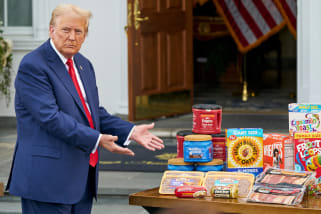

There was an event held at Donald Trump’s golf club in Bedminster, New Jersey, during the 2024 presidential campaign that I think about with some regularity. It involved the former-and-future president speaking to reporters while surrounded by tables showing various grocery items and the increase in their prices during President Joe Biden’s administration.
Trump mostly talked about how bad his opponent, Vice President Kamala Harris, would be for the country, eventually meandering around the tables and reading from the labels. (“I haven’t seen Cheerios in a long time,” he remarked. ) The imagery was incongruous: The billionaire president emerging from his high-end golf club to observe that the prices for things he doesn’t buy had surged during the pandemic. He never really explained how he might bring prices down; he just insisted he would.
In most cases he hasn’t.
onSome of these surges in costs are directly downstream from the tariffs Trump imposed on imports.
A review of nearly 170 items tracked by the Bureau of Labor Statistics (BLS) indicates that seven in ten have seen prices increase since January. Trump has gone from being the guy outside the system complaining about things getting worse to being the guy in charge and getting blamed for still-rising costs.
What hasn’t changed for Trump, though, is that he’s still the guy who likes to slather buildings in gold and visit his private clubs and resorts (which he’s done on 123 of the 340 days of his second term, as of December 23). He’s the guy spending hundreds of millions of dollars to build a ballroom at the executive mansion, while the price of ground beef skyrockets.
Beef is one of the categories that’s seen the highest price increases since January, according to consumer price index data for urban areas through November (the most recent date available). Some of the other largest increases are in the costs of tax preparation, the price of jewelry and the prices of audio equipment and coffee. The prices of those items serve as a reminder of another way in which Trump is poorly positioned to talk about tackling inflation: Some of these surges in costs are directly downstream from the tariffs Trump imposed on imports.
An analysis of data from the Bureau of Labor Statistics. Philip Bump / MS NOW
Again, not all prices have increased. The price of eggs, for example, is down substantially since January — though that’s in large part because an outbreak of avial flu caused the price of eggs to soar in 2024.
In only one category tracked by the BLS have prices dropped on average: transportation, which benefits from a decline in fuel prices. Everywhere else, including in topline indices themselves, prices are still increasing.

An analysis of data from the Bureau of Labor Statistics. Philip Bump / MS NOW
This isn’t surprising, of course. Prices tend to go up; while deflation — prices going down — carries its own problems. But Trump promised repeatedly that he would halt or reverse price increases, promises that were obviously unattainable.
In some cases, the items with the largest price increases in 2025 are ones whose prices were already increasing over the course of 2024. Often, though, prices only started to spike this year, while Trump was president.
You can see both in the charts below, showing the 24 categories in which the price index increased the most in 2025.

An analysis of data from the Bureau of Labor Statistics. Philip Bump / MS NOW
You can likewise see that the items for which prices decreased exhibited both patterns: some drops began only this year, while others (like gas prices) began to fall in 2024.

An analysis of data from the Bureau of Labor Statistics. Philip Bump / MS NOW
As you might expect, Trump mentions the price of eggs a lot. (Such as during his address to the nation last week, for example.) On the subject of inflation overall, though, he tends to be dismissive, clearly not wanting to talk about it. He’s blamed discussions of affordability on Democrats and the media — and suggested that it’s overstated.
Perhaps he thinks it is. He doesn’t go grocery shopping. He doesn’t buy Cheerios. And if he did, he wouldn’t have any trouble paying for it.
But for the rest of us, it isn’t that simple. Many Americans voted for Donald Trump believing that the economic pressure they faced from post-pandemic price increases would evaporate because Trump insisted that it would.
In most cases, it hasn’t.
The post Trump promised to lower prices — it hasn’t worked out that way appeared first on MS NOW.
This article was originally published on ms.now