
By Idrees Ali, Phil Stewart, Shariq Khan and Marianna Parraga
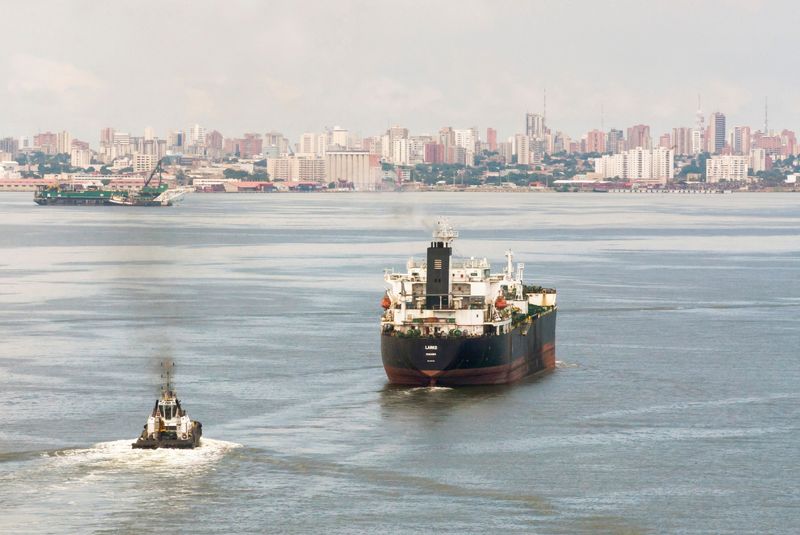
WASHINGTON, Dec 16 (Reuters) – U.S. President Donald Trump ordered on Tuesday a “blockade” of all sanctioned oil tankers entering and leaving Venezuela, in Washington’s latest move to increase pressure on Nicolas Maduro’s government, targeting its main source of income.
It is unclear how Trump will impose the move against the sanctioned vessels, and whether he will turn to the Coast Guard to interdict vessels like he did last week. The administration has moved thousands of troops and nearly a dozen warships – including an aircraft carrier – to the region.
“For the theft of our Assets, and many other reasons, including Terrorism, Drug Smuggling, and Human Trafficking, the Venezuelan Regime has been designated a FOREIGN TERRORIST ORGANIZATION,” Trump wrote on Truth Social. “Therefore, today, I am ordering A TOTAL AND COMPLETE BLOCKADE OF ALL SANCTIONED OIL TANKERS going into, and out of, Venezuela.”
U.S. crude futures climbed over 1% to $55.96 a barrel in Asian trading after Trump’s announcement. Oil prices settled at $55.27 a barrel on Tuesday, the lowest close since February 2021.
Oil market participants said prices were rising in anticipation of a potential reduction in Venezuelan exports, although they were still waiting to see how Trump’s blockade would be enforced and whether it would extend to include non-sanctioned vessels.
In a statement, Venezuela’s government said it rejected Trump’s “grotesque threat.”
U.S. Representative Joaquin Castro, a Texas Democrat, called the blockade “unquestionably an act of war.”
“A war that the Congress never authorized and the American people do not want,” Castro added on X.
EMBARGO EFFECTIVELY IN PLACE
There has been an effective embargo in place after the U.S. seized a sanctioned oil tanker off the coast of Venezuela last week, with loaded vessels carrying millions of barrels of oil staying in Venezuelan waters rather than risk seizure.
Since the seizure, Venezuelan crude exports have fallen sharply, a situation worsened by a cyberattack that knocked down state-run PDVSA’s administrative systems this week.
While many vessels picking up oil in Venezuela are under sanctions, others transporting the country’s oil and crude from Iran and Russia have not been sanctioned, and some companies, particularly the U.S.’ Chevron, transport Venezuelan oil in their own authorized ships.
For now, the oil market is well supplied and there are millions of barrels of oil on tankers off the coast of China waiting to offload. If the embargo stays in place for some time, then the loss of nearly a million barrels a day of crude supply is likely to push oil prices higher.
The Pentagon and Coast Guard referred questions to the White House.
Since the U.S. imposed energy sanctions on Venezuela in 2019, traders and refiners buying Venezuelan oil have resorted to a “shadow fleet” of tankers that disguise their location and to vessels sanctioned for transporting Iranian or Russian oil.
As of last week, more than 30 of the 80 ships in Venezuelan waters or approaching the country were under U.S. sanctions, according to data compiled by TankerTrackers.com.
INCREASED TENSIONS
Trump’s pressure campaign on Maduro has included a ramped-up military presence in the region and more than two dozen military strikes on vessels in the Pacific Ocean and Caribbean Sea near Venezuela, which have killed at least 90 people.
Trump has also said that U.S. land strikes on the South American country will soon start.
In wide-ranging interviews with Vanity Fair, Susie Wiles, Trump’s chief of staff, said the boat strikes were aimed at putting pressure on Maduro.
“He wants to keep on blowing boats up until Maduro cries uncle,” the magazine quoted Wiles as saying in an article published on Tuesday.
Maduro has alleged that the U.S. military build-up is aimed at overthrowing him and gaining control of the OPEC nation’s oil resources, which are the world’s largest crude reserves.
The Trump administration has formally designated Venezuela’s Cartel de los Soles as a foreign terrorist organization, saying the group includes Maduro and other high-ranking officials.
Maduro, speaking at an event on Tuesday evening before Trump’s post, said, “Imperialism and the fascist right want to colonize Venezuela to take over its wealth of oil, gas, gold, among other minerals. We have sworn absolutely to defend our homeland and in Venezuela peace will triumph.”
(Reporting by Idrees Ali and Jasper Ward in Washington, Shariq Khan in New York, Marianna Parraga in Houston, Additional reporting by Julia Symmes Cobb; Editing by Scott Malone and Stephen Coates)