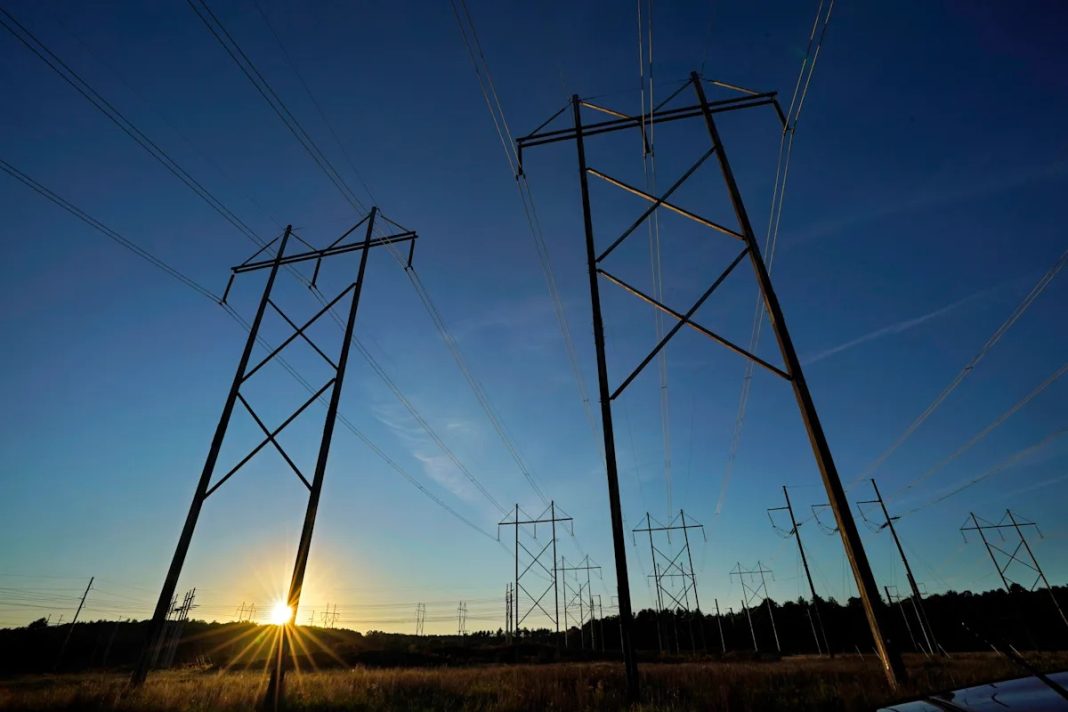

The push to reduce the red tape slowing the construction of energy projects has the support of lawmakers from both parties, the Trump administration and an ideologically diverse army of lobbying groups.
It may not be enough.
The threat of skyrocketing power prices from an influx of artificial intelligence data centers has added urgency to yearslong negotiations in Congress about overhauling federal permitting rules for energy projects of all kinds, from solar and wind farms to long-distance power lines to pipelines and gas export plants. At stake is what has emerged as the single-biggest election issue facing Republicans next year: voters’ frustration at persistently high — and rising — prices.
But President Donald Trump has been missing from the fight, and has not endorsed a bipartisan bill that the House passed by a 221-196 vote Thursday.
The White House has supported the general effort in Congress to streamline the federal permitting process, which frequently adds years to the time it takes to build projects. But Trump has dismissed the issue of affordability as a “hoax” — despite polls showing the issue is a top concern of voters — and the White House’s engagement with Congress on the legislation has been mostly limited to providing technical advice.
Proponents view boosting the production and delivery of all sources of domestic energy as necessary for tackling the affordability crisis. Data released Thursday showed consumers’ power prices have climbed by 7.4 percent over the previous 12 months, while their natural gas costs are up 6.9 percent — both well above overall inflation.
Room for any legislative compromise is narrow, however. One reason is that House conservatives oppose including language that would protect renewable energy, while Democrats fear that Trump wouldn’t abide by any congressional limits on his power to block solar and wind projects.
Sen. Kevin Cramer (R-N.D.), a close Trump ally, said the president should embrace a potential compromise that relaxes environmental statutes but allows renewable energy projects that are under development to complete their permitting.
“If we do something big and bipartisan, it is pretty easy to argue that it is going to be good for affordability,” Cramer told POLITICO. “There’s room for everybody to brag about it if we do it successfully. And if we don’t, it gets blamed on us. But it would require leadership from the administration. We can’t do it without them.”
Green power supporters, meanwhile, would have to accept the reality that a permitting overhaul means faster approval for oil and gas.
“The path to permitting has always required bipartisanship, and this was always going to be about the adults in the room,” said Sen. Brian Schatz (D-Hawaii). “People need to let go of the idea that this bill is going to be an opportunity to either vanquish clean energy, or vanquish fossil energy.”
That task got even harder after House GOP leaders made concessions to appease foes of offshore wind before passing their permitting bill, known as the SPEED Act.
“Everybody says permitting reform has to happen, and it should be technology neutral,” said Rep. Andrew Garbarino (R-N.Y.). “And if it’s something that 300 members out of 435 want something done, it shouldn’t be up to four or five to derail that.”
To get the votes of hardliners in their party, GOP leaders weakened a part of the bill that was intended to curb the power of presidents to revoke permits. The change would allow the Trump administration to continue to try to block previously approved offshore wind projects. That move prompted one clean energy industry group to yank its support for the bill — and irked Democrats who said Congress should be clearing away red tape for all kinds of energy.
“It’s unfortunate the far right feels that they want to get everything,” said Sen. John Hickenlooper (D-Colo.). “They don’t want to compromise. Then you get nothing.”
But Natural Resources Chair Bruce Westerman (R-Ark.), the architect of the bill, argued that the measure’s bipartisan support — 11 Democrats voted for it — created momentum for the Senate to act.
“We got the best vote we could get passed out of the House,” Westerman said Thursday. “We said our goal was to have a bipartisan permitting bill in the Senate before the end of the year and we did it. We’ve sent them a really good piece of legislation.”
Energy Secretary Chris Wright told POLITICO this week that he has been in conversations with lawmakers and personally supports the SPEED Act, and that the Trump administration “wants to get bipartisan permitting reform done.”
He said finding a compromise on limiting executive branch interference in the permitting process would require a “balance.”
Passage of the SPEED Act was the centerpiece of a legislative package pushed by House Republicans, which included several of their long-held priorities they contend are needed to expand U.S. energy output. That bill would limit the scope of permitting reviews and sharply restrict legal challenges under the National Environmental Policy Act, a bedrock environmental protection law that Republicans and some Democrats believe has been misused by environmental groups and state governments to block projects.
Now, Democrats and some moderate House Republicans who were unhappy with the late concessions to the hardliners said they hope the Senate will negotiate a more bipartisan product that strengthens protections for clean energy.
“I certainly am going to be a strong advocate with the Senate that any final product that gets back here for us to vote on would be inclusive,” said Rep. Adam Gray (D-Calif.), who voted for the SPEED Act despite concerns that the last-minute changes were “counterproductive.”
“We need to build if we’re going to address our problems, both from an affordability perspective as well as a reliability perspective,” Gray added. “We’ve got to build out clean energy. We’ve got to also leverage our traditional oil and gas.”
If the Senate works out a compromise, it would fall to House Speaker Mike Johnson to steer the bill past the hardliners’ opposition.
Some Democrats were not optimistic.
“Serious permitting reform cannot happen on their [GOP] watch,” said Rep. Jared Huffman (D-Calif.). “It has to happen under Democratic leadership. The Freedom Caucus and the oil and gas folks are just never going to let a true bipartisan solution move. Mike Johnson won’t allow it.”
Even as top Republican leaders have remained mum, GOP lawmakers are well aware of what the issue could mean for them in next year’s elections.
“This is the single biggest thing for affordability,” said Sen. John Curtis (R-Utah). “If you get energy prices down, it’s a big deal.”
The urgency has only grown since several previous failed efforts to relax cumbersome federal permitting rules. That’s raised concerns among industry groups and their members about a supply crunch caused in part by rising power demand from the AI boom.
Among the groups calling for Congress to act to update permitting laws are the American Petroleum Institute, Clean Energy Buyers Association, National Association of Manufacturers and the Data Center Coalition.
“I don’t think I’ve seen the support for permitting reform come from so many different angles,” said Senate Environment and Public Works Chair Shelley Moore Capito (R-W.Va.), a key negotiator. “You just can’t build fast enough. It’s hitting every aspect. It’s just a much larger support group.”
The permitting debate is also complicated by the fact that many projects must go through a thicket of state and local approvals, on top of the federal ones. Projects of all types are increasingly facing public opposition from landowners.
GOP policy proposals have tended to focus on easing the requirements of environmental laws while Democrats have focused their effort on smoothing approvals for interstate power lines that could send clean energy long distances. Meanwhile, the hardening partisanship of Trump’s second term has made it harder to meet in the middle.
“It’s no secret that there’s not necessarily a ton of trust between Democrats in Congress and the administration,” said Rep. Josh Harder (D-Calif.), who co-chairs the new bipartisan Build America Caucus.
Much of the distrust has centered on Trump’s assault on renewable energy projects, including the administration’s efforts to revoke already-issued permits and stall once-routine approvals.
Democrats say Trump’s blocking of solar and wind projects — the fastest-growing sources on the electricity grid — risks putting more pressure on power prices, and they are seeking to impose restrictions on presidential meddling in the permitting process in any deal with Republicans.
“Democrats would be insane to offer up a bill to President Trump without the clean energy guardrails that we’ve been trying to put in,” Huffman said. “You’re simply giving them more authority and tools to kill off clean energy in its current form.”
Republican hardliners are adamant, though, the Congress must not hamper Trump’s authority to block renewables, particularly offshore wind. They want to speed up the federal permitting process only for fossil fuels.
“The president is probably the only person alive who hates these wind turbines more than I do,” said Republican Rep. Jeff Van Drew, whose home state of New Jersey has been a focus for offshore wind farms. He added, “We don’t have to have wind turbines in order to get the permitting [reform] for oil and gas.”
Permitting proponents like Westerman and Capito have proposed a neutral approach that would hasten approvals for all energy sources, regardless of the type of technology.
That message is also meant to appeal to Democrats who are increasingly embracing an “all of the above” approach instead of only embracing climate-friendly sources, in order to capitalize on Trump’s anti-renewables bias.
“In order for permitting reform to happen, it has to be a bipartisan ‘all of the above’ approach,” said Rep. Seth Magaziner (D-R.I.). “We need to put making life more affordable for Americans ahead of politics, and that’s going to require a culture change on both sides of the aisle.”
Even as the House GOP passed the SPEED Act, more challenges await when the issue moves to the Senate in the new year.
That effort would require at least seven Democratic votes — along with universal Republican support.
Along with changes to the NEPA process, including by limiting legal challenges against projects, a broader deal between the Senate and House would also probably modify the Clean Water Act to smooth oil and gas pipeline project approvals — a key Republican demand that Democrats have resisted in the past. And it would have to include measures to facilitate the development of interstate transmission lines needed to help bring clean energy onto the nation’s power grid — a top priority of Democrats that House Republicans have bristled at.
“It’s going to be hard,” Capito said. “So it won’t be as big [of a deal] as we would want, but I still think we’ll get there.”
Kelsey Tamborrino contributed to this report.