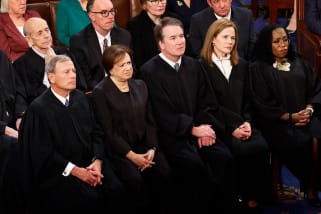

In a closely watched case in 2019, the Supreme Court sided with Curtis Flowers, a Black man who was tried six times for the same quadruple murder in Mississippi. Over dissent from Justices Clarence Thomas and Neil Gorsuch, the high court said the judge in Flowers’ sixth trial had wrongly approved prosecutor Doug Evans’ move to keep a Black person off the jury. The state declined to seek a seventh trial against Flowers, who maintained his innocence.
On Monday, the court took up the case of another Black death row prisoner in Mississippi: Terry Pitchford, who argues that Evans illegally kept Black people from his jury, too.
A notable brief from prospective jurors who were kept off Pitchford’s jury highlighted the overlap in the two cases. “The similarities between this case and Flowers’ sixth trial are striking. Just as in Flowers, in Pitchford’s case, Evans relied on race in deciding who to strike from the jury,” they wrote to the justices, urging them to take Pitchford’s appeal. “This Court is no stranger to Evans,” they wrote.
But whether Pitchford will win, like Flowers did, remains to be seen.
In agreeing to review his appeal, the court said that it will focus on a procedural question: whether the state’s top court unreasonably found that Pitchford had waived his right to rebut the prosecutor’s race-neutral justification for striking the prospective jurors. In their order granting review, the justices cited the Antiterrorism and Effective Death Penalty Act, or AEDPA, which the court’s Republican-appointed majority has read to block relief for state criminal defendants challenging their convictions in federal court. That wasn’t at issue in Flowers’ appeal, which the justices reviewed directly from Mississippi state court.
In Pitchford’s case, U.S. District Judge Michael Mills found the state courts’ rejection of his jury bias claim was unreasonable. Mills, a George W. Bush appointee, said the Flowers case was, “at the very least, informative, and should have been examined in the state appellate court’s consideration” of Pitchford’s claim.
But a federal appellate panel of fellow GOP appointees reversed that relief, reasoning that Mills was too hard on the state court. The panel noted that Mills had found that Pitchford’s lawyer sufficiently objected to Evans’ strikes such that he didn’t waive his rights. But the panel said that even if Mills was correct, that still wouldn’t entitle Pitchford to relief in federal court, due to AEDPA’s limits. “It is well-settled that even an erroneous state ruling is not enough to overcome AEDPA’s relitigation bar,” the appeals court said.
That even an erroneous ruling wouldn’t lead to relief shows the challenge that state defendants face in federal court, especially considering how this Supreme Court has construed federal law.
So, what is the court thinking in granting review of Pitchford’s appeal?
Despite the court’s strict application of AEDPA against criminal defendants, it would be an odd case to take up if a majority of the justices were set on ruling against Pitchford, given the court’s lopsided ruling in Flowers’ case — even if the legal question presented is different in Pitchford’s case. “The State’s relentless, determined effort to rid the jury of black individuals strongly suggests that the State wanted to try Flowers before a jury with as few black jurors as possible, and ideally before an all-white jury,” Justice Brett Kavanaugh wrote for the majority in the Flowers case.
Since that 2019 ruling, the court’s Republican-appointed majority has grown, following Ruth Bader Ginsburg’s 2020 death and her replacement by Justice Amy Coney Barrett.
Plus, the high court has broad jurisdiction over its docket, so it could have rejected Pitchford’s appeal outright if it wanted to. It takes four votes to grant review, and the vote tally isn’t public. What a majority of the court is thinking could become clearer at the forthcoming hearing, which hasn’t been scheduled yet.
Subscribe to the Deadline: Legal Newsletter for expert analysis on the top legal stories of the week, including updates from the Supreme Court and developments in the Trump administration’s legal cases.
The post Supreme Court again takes up a case involving race, juries and an infamous prosecutor appeared first on MS NOW.
This article was originally published on ms.now