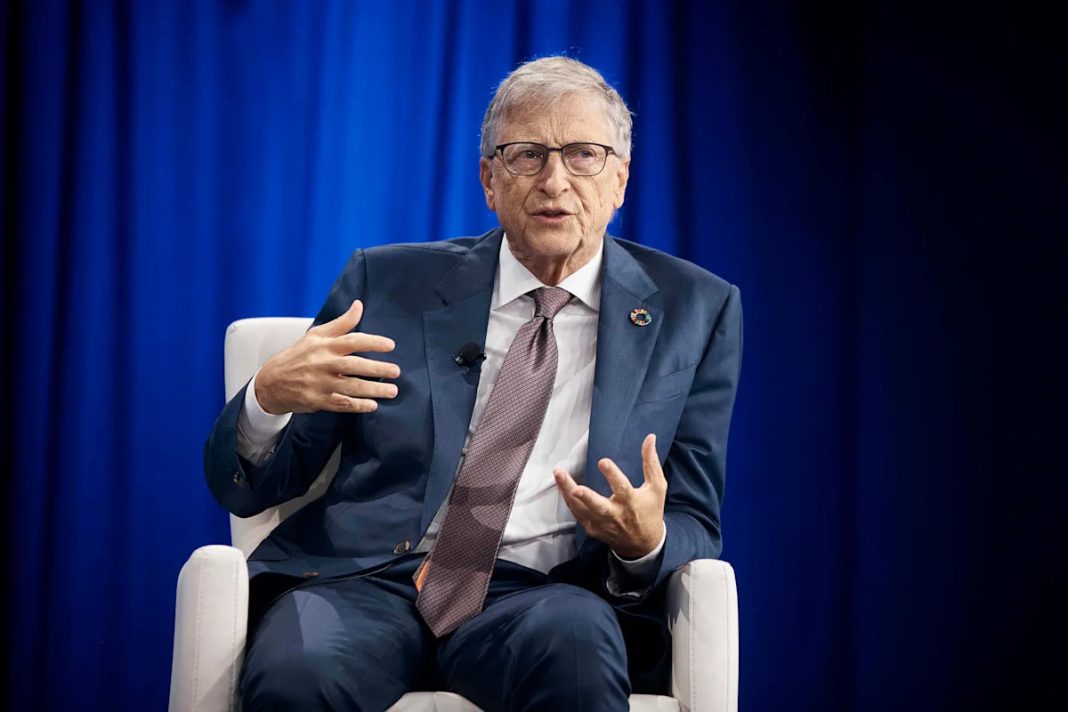

To this day, Bill Gates remains a relatively mild-mannered, non-political guy. But he’s also not going to ignore reality.
For the first time in 25 years, the number of child deaths is on track to rise from the previous year, to the tune of an additional 200,000 deaths, according tothe Gates Foundation. And it’s not a coincidence, he says, that it’s coming after the Trump administration and other wealthy countries slashed foreign aid at the beginning of the year.
“There were sudden and massive cuts — you just can’t deny that’s led to lots of deaths,” Gates said in an interview with the Conversation.
The Trump administration disputes that notion, of course, but regardless, Gates is still eager to work with them. He said he’s had good conversations with President Donald Trump and Secretary of State Marco Rubio to try to boost funding going forward.
In a wide-ranging conversation, the Microsoft co-founder-turned-philanthropic giant also touched on his decision to pull back on climate funding, the potential job displacement caused by AI and his conversations with Robert F. Kennedy Jr., the vaccine skeptic now running the Department of Health and Human Services.
“Robert Kennedy wrote a book that says I kill millions of children and make billions of dollars on vaccines,” Gates said. “It’s close to correct. I spend billions of dollars to save millions.”
This conversation has been edited for length and clarity.
Your annual Goalkeepers report delivers a pretty sobering headline: 2025 will be the first year this century where preventable child deaths are projected to rise. The report says this is because of cuts to global health funding made by wealthy countries. Of course, the U.S. is one of those countries that scaled back. You’ve been at this for more than two decades. What was your reaction when you first saw these projections?
Well, it’s first important to know that it’s really a miracle what happened from 2000 to 2025. The Gates Foundation was created in the year 2000. I was horrified to learn that 10 million children were dying every year, partly because there were so little resources for them. They weren’t getting vaccines that they deserved for diarrhea and pneumonia, and the whole global health movement has a lot to celebrate that we cut that death level in half.
So it’s only with the understanding of how far we’ve come that you can say, okay, that setback after the 25 years of the greatest reduction in childhood death ever in human history, that now we’re seeing that reversal. In that context, that’s disappointing. We increased the amount of money for the first 25 years, and now we’re decreasing the money, and it’s not surprising that’s resulting in more deaths.
Where do you see these cuts in foreign aid from the U.S. and other countries having the most negative impacts?
In parts of the world like northern Nigeria, over 10 percent of the kids die before they reach the age of five. In the U.S., that number would be well below 1 percent, and that would mostly be difficulties at the time of birth. Malaria’s been a tough one. The U.S. abruptly fired a lot of people and cut off a lot of money in the first half of the year. So that’s where the bed nets were being handed out, the food was being handed out, TB cases were being detected.
But to be clear, it’s not just the U.S. that’s made cuts. The UK made cuts, Germany made cuts, and it’s that overall effect that’s going to make this a tough five-year time period.
Secretary of State Marco Rubio and other Trump administration officials have publicly rejected the argument that cuts in foreign aid have led to more deaths. I wonder if you’ve talked to them about that, and do you think their understanding of the impact of these cuts has evolved or is changing over the course of the year?
Nobody wants to take responsibility for the tragedy that’s going on here. In my dialogue with President Trump, he clearly cares about these issues and wants to find a generous level for the spending so that the U.S. won’t be responsible for these big increases. So I’m hopeful that what we’ve seen this year, where there were sudden and massive cuts — you just can’t deny that’s led to lots of deaths. That net increase, remember it’s way more than that in Africa. Fortunately, India, which is not aid-dependent, continues to reduce deaths. So the aid effect is much more than the net 200,000 [increase in child deaths], because countries that have graduated from aid, we don’t see the increase in deaths at all.
A high percentage of this is in the very poorest countries of the world that only in a 20-year time frame can be expected to get out of the poverty trap and become self-sufficient, so they’re not dependent on the generosity, the less than 1 percent of the budget that comes on their behalf. My discussions with Secretary Rubio and President Trump make me hopeful that they and the Congress will make sure that we get back to very close to the level of generosity that existed before 2025.
Elon Musk is no longer working in the government. He was responsible for taking that chainsaw to USAID and a lot of these programs. You’ve now built relationships in the administration. Do you feel like you’re making progress on the funding front and helping them understand the impact that they could have?
I think the next six months will be very important. It’ll be determined what the Congress’ role is in setting the budgets for global health. It’ll be determined what these new compacts look like.
For the poor countries, do they maintain a level of generosity that can get us back on track? Certainly the U.S. commitment to the global fund was a positive data point. They maintained the huge generosity that they’ve had there, which is very helpful to me as I go to the European countries and say, “Okay, this is a one-for-two match construct. So please don’t cut this.” That helped me get the cuts in those European numbers to be way less than they would have been.
Because they’re kind of following what the U.S. does in a lot of ways.
They have aging societies. They of course have pressure to increase their defense budgets. All rich countries have very tight budgets. So that’s why I always make it clear this is less than 1 percent of the budget. When you ask somebody in general, they’ll think it’s quite high, like 5, 10 percent. And no, in the U.S. case, it’s never, never reached 1 percent. The big increase in the U.S. that got us up to almost 1 percent was under President Bush, where he saw that people dying of HIV in Africa —
PEPFAR.
That really wasn’t the golden rule to let those people die when the medicines could be so very, very inexpensive. Now we have a chance because of the innovation pipeline, to do things that can even more effectively cut deaths.
One of the points the report makes is that vaccines are still the best tools for global health. Here in the U.S., we’ve seen HHS Secretary RFK Jr. inject some of his longtime skepticism about vaccines into government messaging changes on the CDC website. Does it hinder your work at all to have U.S. officials cast doubt on vaccine safety?
The U.S. was a very generous supporter, one of the top four supporters of Gavi [a global vaccine alliance]. The two biggest donors have been the UK government and the Gates Foundation. And that right now is not continuing. That’s certainly a disappointment. I was disappointed Gavi raised less money than they did. They raised money every five years. So in June in Brussels, they raised about 25 percent less than they had five years ago. That will result in more deaths. Even though we bring the price of vaccines down — we graduate countries that have economic growth, new things like this RSV vaccine — we won’t be able to introduce that in as many countries as we should, and we won’t save those lives.
How do you counter vaccine skepticism at home and assure that globally the public understands that vaccines are not only safe but necessary?
Well, it’s in rich countries where these diseases are not very present, you can actually be pretty lax. You can actually have a fair number of kids go unvaccinated, and you won’t see the negative effects of that for quite some time. Measles usually is not in the U.S. It is right now. We’re having record measles cases. We’re going to lose our elimination status for measles. But in poor countries, the kids are malnourished and there isn’t good health care.
In the U.S., about five kids will die for every thousand that get measles. In Africa, more like 200 will die. And so very quickly what happened with Samoa, where they stopped measles vaccination and then they had a lot of deaths, people are reminded because it’s so grim to watch a baby die from measles. I’ve been in wards, seen babies dying from measles. That’s deeply affecting. But in rich countries that doesn’t happen often enough to remind people what a miracle the measles vaccine is.
Have you had that conversation with RFK Jr. or any of the folks in his world?
In my meetings with RFK, we agree that vaccines is an area we’re not going to have a common view. And yet, there’s a lot of incredible research and work going on inside the HHS, at the NIH that we can continue to partner on.
So you’ve decided we’re just not touching that. We’re going to talk about the things where we can actually be productive.
No, we touched on it briefly, but it was clear that they weren’t going to convince me that vaccination should come to an end. And so we moved to other topics.
And you didn’t feel you could convince them the other way around?
That’s right.
I know polio eradication has been a huge priority for you, and I know you’ve spoken with Trump directly about this. He’s seen people in his life go through it, and he is of that generation that understands more intimately what this disease is. Do you think there’s an opening there on polio in particular?
I had great conversations with President Trump about polio. And I don’t think there’s any chance the U.S. is going to reduce its funding for polio eradication. We’ve got Rotary on our side. It’s not a huge part of the budget. It’s like $210 million. We’ve been trying to get it up a little from that. It comes from both HHS and the State Department. And we’re very close.
In my discussions with President Trump, he said this is important to him. He’d love to be in charge when this is brought to an end. And there’s every prospect of that happening. He even engaged with me on, okay, what is it we want Pakistan to do? And so when he was on a phone conversation with the field marshal of Pakistan, he had me brought into the call and we talked about prioritizing the security work. There’s a part of Pakistan, South Khyber Pashtun, where the army has to escort the vaccinators in. Pakistan and Afghanistan are the only two countries that have never gotten to zero. Africa got to zero, and now polio’s come back there. So we have two areas we’re working on, but the most urgent is Pakistan, Afghanistan, where President Trump has been a big help.
He’s actively working with you on this?
That’s right. He said to me, “What do I need to say to the field marshal?” I went through that with him, but then literally the next day he was on the phone with the field marshal and he said, “Hey, get Bill into this phone call.” And then I had a follow-up call with the field marshal about specifically what type of NGO work and army escort would help us. We have 400,000 kids in that area who are unvaccinated. And unfortunately that’s enough kids that they can maintain polio. So we need to get in there and vaccinate those kids.
You made a splash in October when you dismissed some of what you called the doomsday outlooks on climate change and instead called for limited resources to be more focused on helping the world’s most vulnerable adapt to the changes that we’re seeing. You acknowledged that you’d probably get some blowback on this, and you did. Some accusations were that you were doing this for political reasons. Were you surprised by the intensity of reaction, especially in the climate community?
We’re having to make trade-offs. The same budget that funds vaccines funds various climate activities. And so we should make sure that money is spent on the best thing. I’m a big giver and investor in climate adaptation. I’m a big giver to climate mitigation and I’m a big giver to global health — the largest in all three. And I’m also the biggest funder of advocacy of encouraging rich countries to be generous to poor countries.
I wish all of those things were on the increase and we wouldn’t have to look at trade offs. But some climate funding is actually pretty low-impact. So in the same way I speak out about global health funding, making sure that’s well spent, I was saying to the climate community, let’s adopt a metric of human wellbeing and look within both portfolios to make sure we’re picking the right things.
Some people were saying you created a false dichotomy there. Do you think people misunderstood the point of your memo?
When there’s finite money, you are making choices. So one of the reactions I got was, “Oh, we should have enough money for all these things and not have to make those trade-offs.”
If I lived in that world, I wouldn’t have had to write the memo. So it’s saintly to say we should have infinite for all three, but we’re getting a bit less money for all of these activities. We’re not anywhere near zero. Even on the climate front, a lot of things have been preserved. Funding for fission and fusion and geothermal and a lot of things is still continuing. The U.S. is not completely withdrawn from the mitigation work.
How different is your relationship with the president this time around than the first time that he was in the Oval?
I’d say it’s fairly similar. He met with me a lot of times in the first administration. I met with him more times than I met with Biden.
Wow. I think a lot of people will be surprised to hear that.
Yeah. I was in the Biden White House a number of times when there was a possibility of having a meeting, but it never came through. And so I would meet with chiefs of staff and other people instead.
We’ve had a few presidents that were pretty hands-on. Clinton, Obama and Trump, although they’re different, they’re all three pretty hands-on. They are interested in learning new things. Biden had more of a delegation style to how he did things. And in the first Trump administration, there were people that I encouraged the president to stick with, like Francis Collins, that I think my input made a difference there.
After decades of living a relatively apolitical life, what’s it like to see yourself become a bit of a boogeyman in some right-wing circles in recent years? Is that something you think about? Has it been odd to witness that trend?
Well, I’d say it’s pretty fringe. Robert Kennedy wrote a book that says I kill millions of children and make billions of dollars on vaccines. It’s close to correct. I spend billions of dollars to save millions. So it’s just —
Just a little off.
Just negate what was being said, because I am connected to vaccines. I plead guilty to being involved in that miracle. He’s kind of an outlier in terms of saying that I’m the villain behind the curtain.
I have a vivid memory of covering an anti-lockdown protest in Olympia, Washington during the pandemic. I was used to seeing signs with George Soros, he was the go-to boogeyman for a long time. And then suddenly I saw a sign with Bill Gates on it. I was like, “Wait, Bill Gates? Why is this happening?” And it clued me into there’s a new era of this mistrust and conspiracy going on here.
Well, it is almost ironic that the Gates Foundation was very involved in getting Covid vaccines out to the world. The thing where you could use the swab for the test, we pioneered that. We were the first ones to show that there was Covid in the U.S. from people who hadn’t left the country. We funded a lot of the vaccine capacity. The idea that that turned into “I’m using Covid vaccines to track people’s whereabouts,” you almost have to laugh.
I’m sure you’re very curious where everyone is.
Yeah. I mean, now that I have that information, what am I going to do with it? This lady came up to me on the street and said, “You’re tracking my location,” and was yelling at me.
What did you say?
I said, “Why did you go where you went?” I mean really…
That’s an odd grocery store choice you made there.
“What are you up to?”
Track my dog for me if you can. That’d be really helpful.
Alright. We’ll have to vaccinate it, though.
I do want to ask about AI, because I know you’re very bullish on what it can do in a lot of these spaces. At the same time, there is a lot of concern about job loss, about some of the negative impacts. Do you think that Washington right now is A) moving fast enough and B) moving smart enough in taking all of the nuanced pros and cons of AI into account?
Well, there’s no area, including the private sector itself, that has a full understanding of how incredibly impactful AI is going to be. Every industry, whether it’s health care or education or you name it, is being surprised by how capable and increasingly how more accurate AI is becoming. So we should all be in a state of wonder. Even this last month, the improvements are amazing to me. I spend a significant amount of time looking at how we should use it.
For the foundation, we’re going to make sure AI gets out to the poorest at the same time it’s getting out to wealthy countries, getting out to them for farming advice, agricultural advice. We have a goal that an African farmer should have as much data as a rich farmer does. We’re creating virtual medical advice in African native languages. We’ve made sure all these AI models are not just speaking English, but also speaking the African languages as well. So the opportunity for the foundation to drive equity, both in the discovery part but in the delivery part as well, is profound. And that’s partly why I stay up to date on it.
I was at the White House, I think Sept. 3, for the dinner there —
The tech dinner, yeah.
All my tech buddies were there, and when I got called on, I said, “Well, I’m in a slightly different phase of my career. I’m not building data centers and asking you to override the permitting process. I’m here thinking about AI on behalf of the neediest in the United States and outside the United States.” But I see AI as critical even on equity issues domestically.
So you think the benefits will outweigh the costs ultimately?
Well, I think it’s up to us to shape that. It’s not inherent. Unlike many technologies where — electricity, it’s basically a good thing overwhelmingly. A few people got electrocuted and some destruction of the environment took place, but electricity’s been a benefit. Vaccines, same story. AI is a mixed blessing because it’ll bring a level of change that we’ve never seen before. And it’ll bring something that makes you think, “Wow, this thing’s smarter than I am in many, many ways.”
Your role, your purpose in many cases will be questioned. So I’m very excited about AI solving a lot of problems, including the ones we work on, but it’s a disruptor and like nothing in our lifetimes.
The relationship between Silicon Valley and Washington has had many iterations. Right now, it’s pretty cozy. The Trump administration has really opened its arms to a lot of those friends of yours. What do you make of the current state of that relationship?
President Trump himself is absolutely saying to these companies, “Hey, how can I facilitate your work? Are they slowing you down in Europe? Are they slowing you down some place? How can I help you go at full speed?”
I think the tech industry is always going to have a complex relationship with the government. And as AI job displacement is starting to take place, over the next even two, three years, I think the parties are going to have to [answer to], “What’s your party’s view on how you’re going to help me deal with these dramatic changes?” And I don’t think either party has a particularly well developed view.
No one’s gotten it right.
Well, this is very state-of-the-art stuff. It’s not like in global health, where I actually know how money should be spent. I really know some answers in a very few narrow fields. In the case of AI, how do you deal with the disruption? That’s kind of a thing we’ve handed to this next generation of leaders and politicians. There are things like the earned income tax credit that could somewhat moderate the effects of job displacement, but I’m stunned we’re not seeing more discussion about the future job displacement.
Should Washington be doing things differently on AI?
The attempts to regulate technologies when they’re still taking shape are pretty difficult. AI, you can’t spend enough time on it. And so in that sense, I congratulate the fact that at least there’s a dialogue. But accelerating the positive parts of AI, we have clear views on that. How do you really mitigate the disruptive negative parts of AI? I don’t have the answers, and yet I’m disappointed there isn’t more debate about it.