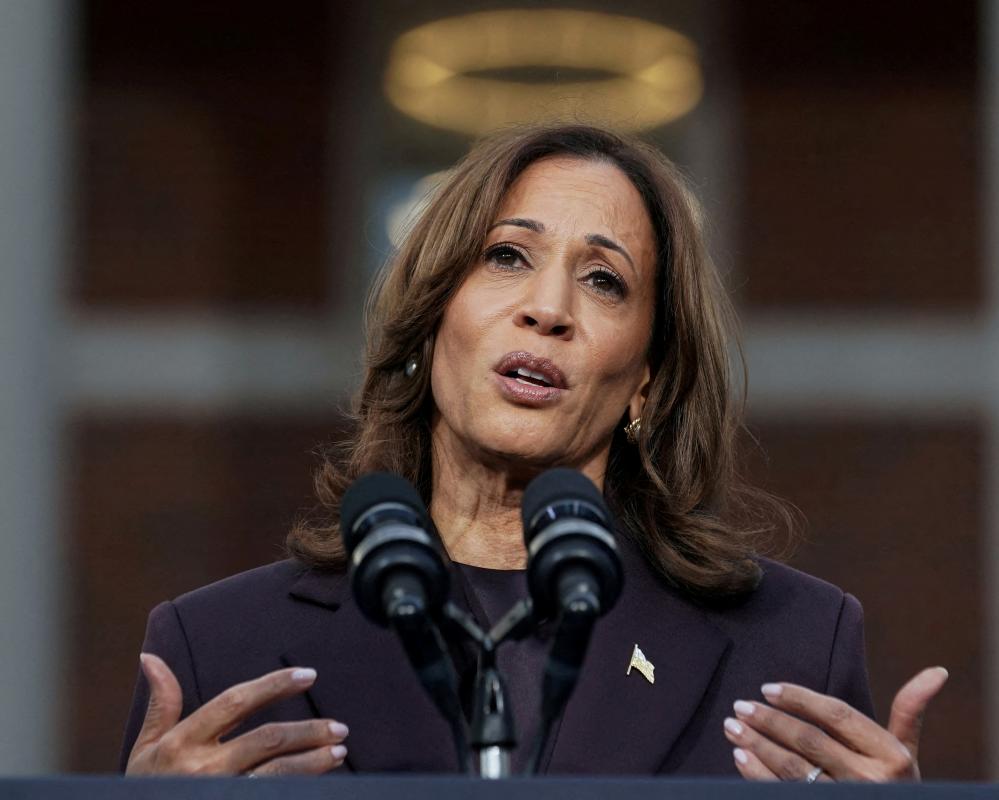

Kamala Harris lost last year’s US presidential election because she chased the wrong voters with the wrong message, ultimately demobilising the very base that she needed to win, according to an autopsy by a progressive grassroots advocacy group.
The vice-president focused on courting moderate Republicans over motivating core Democratic working-class, young and progressive voters, a misstep compounded by her failure to break from Joe Biden on Gaza, says the report by RootsAction.
“To win back the White House and Congress, we urge the Democratic party to change course and embrace economic populist policies that inspire and help working-class Americans,” argues the autopsy. “The Democratic party must show voters that it has a spine and can stand up to corporate and big-money interests.”
The Democratic National Committee has not yet released its “after-action review” of the November 2024 election, in which Donald Trump won the national popular vote by 1.5% after having lost it to Biden by 4.5% in 2020. Trump won all seven major swing states, whereas Biden had won six of them in 2020.
Autopsy: How Democrats Lost the White House, authored by Christopher Cook and edited by Sam Rosenthal, says the pivotal factor was a massive drop in Democratic turnout: Harris received approximately 6.8m fewer votes than Biden did in 2020, while Trump gained about 2.8m votes.
For the first time since 2004, independent voters turned out in greater numbers than registered Democrats. Turnout plummeted in Democratic strongholds. A substantial drop-off in turnout and support among voters aged 18-29, who were disillusioned with the administration’s policies, proved politically fatal.
RootsAction notes that Biden’s initial decision to run for re-election despite low approval ratings and his late exit from the race left the Harris campaign with only 107 days and no primary process to build momentum. It saddled the nominee with an unpopular incumbent’s record.
But the Harris campaign failed to inspire or mobilise millions of voters who had supported Biden in 2020 because of messaging that was out of touch with voters’ economic anxieties.
It adopted “joyful” messaging and sunny talking points (“Bidenomics”) at a time when nearly 70% of voters rated the economy as “not so good” or “poor”. Harris also did not create distance from Biden, stating on The View that “not a thing comes to mind” that she would do differently from him.
Her campaign made a critical strategic error by prioritising an appeal to moderate, suburban Republicans over mobilising its core working-class and progressive base, leading to significant erosion of support among these vital constituencies. A strategy, articulated by Senator Chuck Schumer in 2016, of trading one blue-collar Democrat for “two moderate Republicans in the suburbs” was repeated and failed again.
This led to a catastrophic failure of outreach to the Democratic base. In Philadelphia, campaign organisers were reportedly told not to engage in basic get-out-the-vote activities in Black and Latino neighbourhoods, forcing staffers to form a “rogue” operation in the campaign’s final days.
The campaign also heavily featured former Republican congresswoman Liz Cheney, focusing on themes of democracy while neglecting voters’ more urgent economic concerns. This muddied the Democratic message and consumed valuable resources.
The autopsy notes that the Democratic party’s long-term erosion of support among working-class voters accelerated into a collapse in 2024. According to AP Votecast, Trump won voters without a college degree by a 54% to 44% margin, a significant expansion from his 51% to 47% edge in 2020.
The Harris campaign’s economic message was weakened by corporate influence, RootsAction argues. Advisers such as Uber executive Tony West and billionaire Mark Cuban steered the campaign away from bold populist proposals. A New York Times report noted the campaign adopted “marginal pro-business tweaks” that never “coalesced into a clear economic argument”.
As the election neared, progressive phrases such as “living wage” and “union jobs” dropped out of Harris’s vocabulary, while she spent more time with Cheney and Cuban than with labour leaders like Shawn Fain.
Much of this echoed Democrat Hillary Clinton’s mistakes when she lost to Trump in 2016. In an interview, Norman Solomon, the national director of RootsAction, described the parallels as “unnerving” and said: “In many respects the autopsy that we did for the Hillary Clinton campaign is very similar to the one that we’re releasing now.
“It’s not an exaggeration to say that if you were to interchange the names Clinton and Harris, sometimes it fits like a glove, and it’s been a deterioration because Hillary Clinton didn’t lose the working class per se, but Kamala Harris managed to do it.”
In addition, Harris’s refusal to signal any meaningful shift from the Biden administration’s deeply unpopular policy on Israel and Gaza alienated Arab American, Muslim, young and progressive voters, costing critical support in swing states.
In 2020, Biden won 59% of the Arab American vote. In 2024, polling showed Harris with just 41%, effectively tied with Trump’s 42%. The campaign refused to give a speaking slot to a Palestinian American state representative, Ruwa Romman, at the Democratic National Convention in Chicago.
The strategy failed in Michigan, which Harris lost by 80,000 votes. In Dearborn, a city with a large Arab American population, Trump won 42%-40%, with Green Party candidate Jill Stein taking 15%. This was a reversal from 2020, when Biden won the city 69%-30%.
While the report holds the Democratic party primarily responsible, it acknowledges challenging external factors. Unprecedented spending by special interests, led by Elon Musk’s $29m contribution, fuelled a social media machine that spread lies and disinformation about immigration, disaster relief and candidates.
As a woman of African American and Asian heritage, Harris was disadvantaged by voter biases of sexism and racism. However, the report concludes these were not the primary reasons for her defeat.
A pre-election report entitled Populism Wins Pennsylvania by the Center for Working-Class Politics and others found that “strong populist and progressive economic messages” dramatically outperformed messages about Trump’s threat to democracy, especially among working-class voters.
RootsAction also argues that progressive economic policies passed by wide margins, even in deep-red states: Missouri and Alaska passed a $15 minimum wage; Nebraska, Missouri, and Alaska passed paid sick leave; seven states, including Arizona, Missouri, and Montana, approved constitutional rights to abortion.
The RootsAction report makes three core recommendations. First, it urges Democrats to embrace an agenda that includes enhanced Medicare for All, raising the federal minimum wage, robust union protections aggressive anti-trust enforcement and significantly higher taxes on corporations and the wealthy.
Second, it calls on the party to limit corporate campaign contributions and mount an aggressive challenge to the 2010 Citizens United supreme court decision that opened the floodgates for corporations and other outside groups to spend unlimited money on elections.
Third, the autopsy says Democrats should officially reject the influence of the American Israel Public Affairs Committee (AIPAC) lobby group and realign US foreign policy away from unconditional support for Israel, arguing the previous stance is both “morally indefensible and politically suicidal”.
Solomon added that the Harris campaign and DNC leadership’s motivations should be understood in a context of corporate donors and consultants who feel threatened when the status quo is challenged, for example by insurgents such as Senator Bernie Sanders.
He said: “The solution, much easier said than done, is to have a truly big tent, stop making young people feel unwelcome and, if you’re gonna have a fight club, you need more fight and less club. The message of the autopsy is you can’t have a truly big tent if the inner circle is perceived, quite correctly, as being pretty much closed.”