
—It took 6 months for organised labour to get Tinubu’s attention on insecurity–Ajaero
—As labour demands arrest, prosecution of those funding insecurity
By Johnbosco Agbakwuru
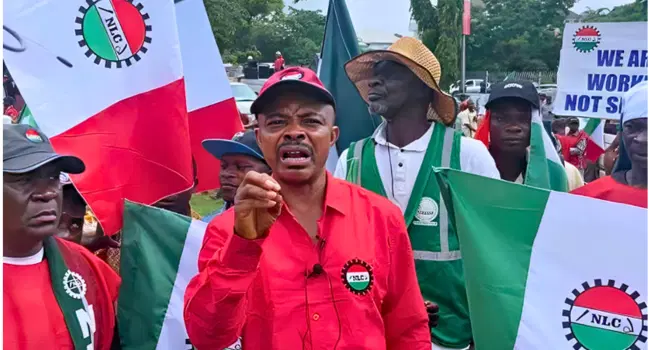
ABUJA – The Nigeria Labour Congress, NLC, on Wednesday staged a nationwide protest in Abuja over the worsening insecurity situation in the country, insisting the federal government must urgently deploy “the full machinery of governance” to reclaim communities, protect workers and restore public confidence.
They also tasked the government with ensuring that all those behind the funding of insecurity are arrested and prosecuted.
But the protest, which was teleguided with heavy security deployment, terminated abruptly as the protesters—who came out in their numbers—were not allowed to go beyond the Ministry of Finance, which is just a few metres away from the Labour House.
The protest commenced between 11:15 a.m. and 11:39 a.m., but NLC President Comrade Joe Ajaero and other top labour leaders were not seen during the procession, as they were locked in a closed-door meeting that had lasted several hours.
Earlier, the leader of the Revolution Now Movement, Omoyele Sowore, was sighted at the Labour House in solidarity with the NLC before the commencement of the procession.
Workers, affiliate unions, civil society allies and journalists started arriving at the venue before 7:30 a.m., but the demonstration did not commence until past 11 a.m., with protesters waiting for directives from the union leadership.
Shortly after their arrival, the NLC president and leaders of affiliate unions withdrew into a closed-door meeting, while hundreds of workers gathered in clusters within and around the secretariat premises.
But before then, Ajaero had debunked the insinuation that after the meeting with President Bola Tinubu on Tuesday night—which lasted until the early hours of Wednesday—the protest had been called off.
Fielding questions on the insinuation, Ajaero said: “I don’t know when we should stop working with insinuation. NLC is an organisation that has its own channel of communication. I am not sure we sent any letter to the media calling off the action, so I don’t know where you got the insinuation. Is meeting with the president the same thing as calling it off?”
Asked about the core demands of labour, he said: “Before now, we did a letter to the president to discuss the state of the nation with him. That was precisely on June 16. And between that time and now, we have made efforts—a letter through the Minister of Labour, acknowledged; a letter to the Chief of Staff to the president, acknowledged; a letter through the Secretary to the Federal Government, acknowledged—and some of them were acknowledged on the 17th, six months today, and none of them communicated to the president.
“Some of the discussions we wanted to hold with the president concern the issue of security—both physical insecurity and financial insecurity. So it took this action, which was basically to protest and to list for them the level of financial insecurity that workers are passing through.
“Yesterday (Tuesday), through the Progressive Governors Forum, we were able to secure a meeting with the president, and we listed all these issues, including the crisis in the tertiary institutions. We were clear with him. Of course, he agreed that there should be a negotiating machinery in the tertiary institutions so that it will not be ASUU today, SSANU the next day, and NASU after that. So he agreed on that.
“On the issue of health workers who have been on strike for a long time—JOHESU—we agreed on that, and he gave the governors the channel for getting back to him, interfacing between us and him, because it appears all the bureaucratic channels have collapsed. They are not working together, and I am not sure they meet him.
“We then discussed the issue of insecurity—physical insecurity and financial insecurity—and he said the security situation did not start with him, which we appreciate. But leadership is a continuum, and he said he has done a lot.
“We lamented the issue of equipment for our own security, which he said he has gone far in making sure that in no distant time, the issue of insecurity will be a thing of the past. He also said he has pulled Nigeria out of economic hardship, which we said we want to see translate to the pockets of the workers.”
Ajaero said President Tinubu agreed to meet the National Administrative Council (NAC) of the NLC by January next year so that all the issues could be discussed.
“You can see that these are discussions and actions in progress, but whether people will now translate that to calling off the protest—that is not the position of Congress,” he said.
He explained that the protest was to call attention to the seriousness of both financial and physical insecurity, adding: “You can see from him even agreeing to talk with us yesterday—it’s gaining momentum. As we progress, awareness and consciousness will be created. So I don’t see why people will try to demarket themselves, not the NLC.”
The NLC president said the unusual deployment of security personnel was normal, as it was either to protect the workers or to stop the action.
“It is normal,” he said, adding: “The success of any protest is about the number of policemen and DSS that are either sent to secure us or to stop us. Either way, that is success, and we envisaged all these things. And if they stop us, that shows that our action has effect. If they protect us, that equally shows that our action has effect.”
He, however, frowned at the incessant deployment of security heads to interface with them whenever they had industrial issues.
“We have noticed some reactions from security apparatus, especially the hierarchy, and we want to put on record that industrial relations issues are not security issues. Anytime we have an action, it will be wrong to send the heads of security institutions to negotiate with us. It’s a no-no.
“In terms of labour issues, the Office of the Secretary to the Government and the Ministry of Labour are responsible—not the heads of security institutions, whether that is to intimidate us or not. I have never seen any country where, on labour issues, you call security people to intimidate us or whatever. That’s what we are seeing here now, and I think it should be seen in that perspective.”
He said because of plans to disrupt the protest by security agencies, the NLC had to restrategise and decide its next move. “Do you want us to put all our strategy in the media?” he asked rhetorically.
Addressing workers after the brief procession, Deputy General Secretary of the NLC, Comrade Ismail Bello, said the protest was not for partisan or sectional interests, but for the survival of all Nigerians.
He said: “What we are doing today is not just for the benefit of workers alone; it is for the benefit of all Nigerians. As citizens, we have surrendered our sovereignty to government in the hope that they will secure lives, protect citizens and run the economy in a way that benefits the majority of our people, not just a few politicians.”
He added that Nigerians had paid a heavy price for the prolonged insecurity, with communities destroyed and livelihoods lost.
“We are reminding the world of the calamity that has befallen many communities and many workers—healthcare workers, nurses, teachers, transport workers and others. The damage is enormous, and it has to stop.”
Bello stressed that the right to peaceful protest was guaranteed by the constitution, warning that no authority could intimidate workers into silence.
“We are here on the streets, reminding government that nobody can gag us from exercising our right to freedom of association and freedom of assembly.”
While calling for decisive action against kidnappers and criminal elements, the deputy general secretary argued that failure to punish perpetrators had emboldened insecurity.
“People must return to normalcy. They should live in their communities. Children should return to school. Teachers and students must be protected. Our constitution guarantees that. All government needs to do is deploy all the powers and machinery of governance to recover all spaces that have been taken over by criminals.”
Head of the International Department of the NLC, Comrade Uche Ekwe, said the protest was aimed at strengthening the government’s resolve to confront insecurity.
“If government is truly committed, we want to strengthen their hands. Those funding insecurity must be arrested and dealt with. If they think they are powerful, they should face the Nigerian people.”
According to the NLC, insecurity has persisted in Nigeria for nearly two decades, marked by terrorism, banditry and kidnapping, with devastating consequences for workers and the economy.
It disclosed that since 2009, over 2,295 teachers have been killed by insurgents and bandits, while more than 19,000 teachers have been displaced in Borno, Yobe and Adamawa states. Over 910 schools were destroyed, forcing about 1,500 learning centres to shut down or become internally displaced persons’ camps.
In the health sector, the NLC said 35 per cent of healthcare facilities were destroyed by terrorism, while 50 per cent became inaccessible in the North-East.
It added that dozens of health workers had been kidnapped or killed between 2021 and 2024, worsening the already critical shortage of medical professionals.
Labour further blamed socio-economic injustice, widening inequality, corruption and poor funding of education and health sectors for fuelling insecurity, noting that Nigeria lost an estimated ₦300 billion during the 30 days of the JOHESU strike alone.
The post NLC holds protest amid heavy security deployment in Abuja appeared first on Vanguard News.