
Al-Mufaqara, occupied West Bank – In al-Mufaqara, a village in Masafer Yatta, south of Hebron, the night feels different.
Instead of rest or sleep, it is marked by vigilance and worry for the village’s men who guard their village against attacks by Israeli settlers from nearby illegal settlements and outposts.
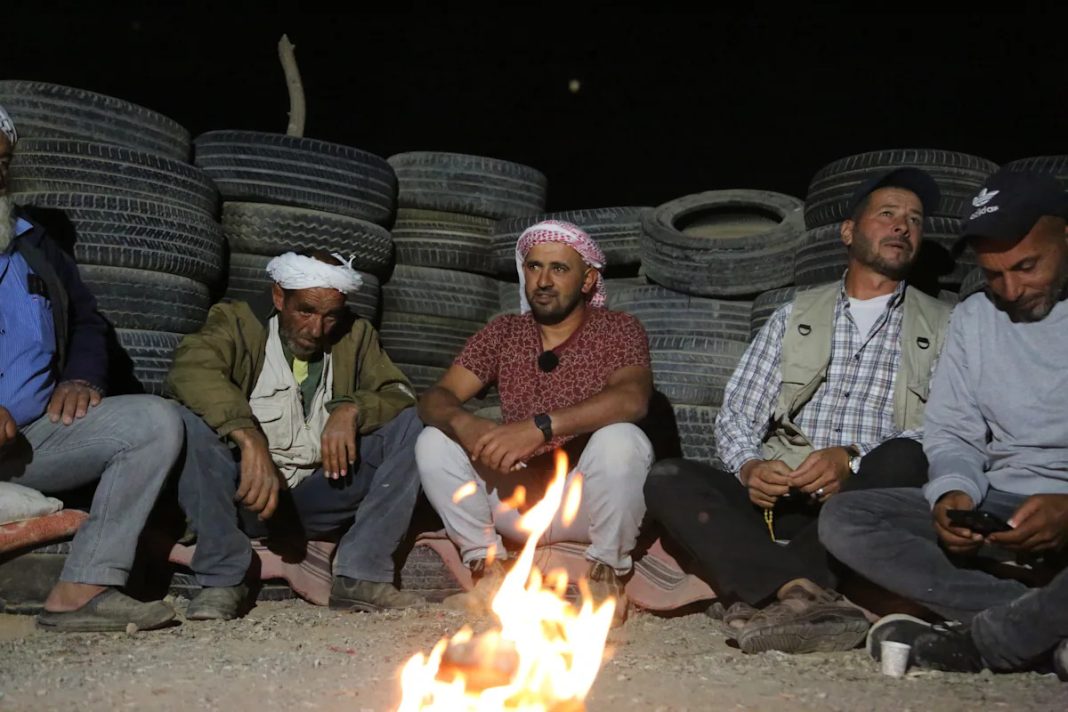
When the sun sets, their vigil begins as they gather on a high hill overlooking the village, where they sit surrounded by old tyres stacked to make a wall to protect them from the cold wind.
In their system, everyone has a job: Some carry the torches, others prepare dinner, and one man brews sage tea, which is always bubbling away on the fire, giving them warmth and energy through the long, cold night.
Their laughter pierces the darkness, but it cannot hide the fear that pervades the space.
“Our task isn’t easy, but it’s also not impossible,” one of them says.
“The night is ours, as long as we guard it.”
A village facing it alone
Al-Mufaqara is home to about 23 families comprising 220 people, including 50 children. Its inhabitants rely on herding, agriculture, and animal husbandry.
But this simple way of life is met with daily attacks from settlers and Israeli authorities, who have demolished their homes repeatedly, destroyed their agricultural lands, burned their dwellings, and even resorted to murder.
The latest victim here was a symbol of resistance, Awda al-Hathalin, who was shot by an Israeli settler.
Others have been injured, some even losing limbs, in other attacks.
It was this relentless danger that made the villagers decide to establish the Mountain Guardians Committee – a group of about 30 young men who spend the night on the hill overlooking the settlements and the village, taking turns to guard from sunset to sunrise.
The name comes from their elevated position overlooking the village and the settlements, where they observe nighttime movements and alert the villagers.
There’s a team of scout monitors, a team managing lights and alarms, a team that feeds everyone and makes hot drinks, and a support team, assisted by some elders who pass by with coffee or sunflower seeds for the watchers – the items as much symbols of solidarity and steadfastness as they are snacks.
Hamida, a mother’s fear and hope
Hamida Ali Hamamda is a 51-year-old mother of nine, ranging in age from 33-year-old Mufid to 20-year-old Bayan. She lives with her 53-year-old husband, Qassem Hamamda, in one of the village’s mud-brick houses.
“Life in al-Mufaqara was sweet and simple… We lived in safety, and the sheep grazed freely, until fear came,” Hamamda says, looking out of her window at the hills.
Hamida Hamamda in her yard with her grandchildren. Her granddaughters stand in the house, behind the metal grates they had to install to try to protect themselves from settlers [Mosab Shawer/Al Jazeera]
Life has changed since October 7, 2023, she explains, recounting how Israeli settlers break into homes with stones and insults, threaten residents with death and displacement and release their sheep onto Palestinian lands to destroy crops and trees, land that many Palestinian owners cannot access.
She describes an incident where four settlers approached their home after seizing a nearby cave, throwing the family that lives there out.
“They told my husband: ‘You have to leave here. This isn’t Palestinian land.’
“Life has lost its meaning… Everything has become hardship, with no comfort or security.”
Hamada dreams of an end to the danger posed by the settlements, and that her grandchildren can live in safety, going to school without fear.
Families in the village have resorted to simple protective measures for their homes, she says, like barbed wire on windows and dogs in the yard that bark at approaching danger.
But, she says: “If it weren’t for the guard committees, we wouldn’t sleep a wink… They are our first line of defence.”
The hand that feeds the guards
Hamamda does her part to help guard the village – every night, she asks a village woman who prepares homemade sweets, cakes and other treats to send some up to the young guards in the hills.
“They guard us, and we send them sweets… At least we share something small to ease their burden.”
Hamamda’s granddaughter, 11-year-old Asala, Mufid’s daughter, has grown up with more fear than she knows play.
Pointing to a hole in the ground, she explains: “When the settlers attack the village, we run here … to the cave.”
She describes it as their underground haven, the place where she and her younger siblings hide away from windows and doors.
“In my nightmares, I see them attacking us… I wish I could live my childhood and go to school without fear.”
On the outskirts of al-Mufaqara, Qassem Hamamda stands contemplating the new settlements crowding the horizon around his village.
Before October 7, 2023, the settlements of Avigail and Havat Ma’on surrounded it.
Today, settler encroachment is painfully clear, with five new outposts, illegal even under Israeli law, set up around the village.
Qassem tells the same story his wife told.
“They came after seizing a cave near my house and threatened to force me out. I told them, ‘You want me to just leave? How?
This is my land, inherited from my father and grandfather… I won’t leave it. I’ll die here.’”
He adds that the protection committee has made things better.
“I feel a little safer. The elderly and women sleep with relative peace of mind… but we need a tent to protect the young people from the winter cold.”

Some of the guardians are in charge of preparing food for the group, to keep everyone going all night [Mosab Shawer/Al Jazeera]
Watchful eyes of the night
Torchlight shines in the hand of Muath al-Hamamda, 32, a farmer, father of three, and one of the most prominent members of the protection committee.
“We keep watch all night because an attack while you’re asleep is much more dangerous than an attack while you’re awake,” he says, eyes darting around him at the hills.
He estimates that the presence of the mountain guards has reduced attacks by more than 80 percent, because the settlers no longer find the village unguarded.
When an attack occurs, the committee moves quickly.
One group rushes children and women to underground caves, another heads for the sheep pens to protect the villagers’ livestock, while a third confronts the settlers until reinforcements arrive.
“We all know that the settler is merciless,” Muath says. “But the Palestinian will not abandon his land. Even the children here know that the land is life.”
Near the guard post, Jalal al-Amour, 47, crouches near the fire, stirring a large pot, the aroma of chicken livers he prepared wafting from it.
The spot where he is cooking was his home, he says, pointing at a nearby cave with a Star of David at its mouth and an Israeli flag flying above it.
“I was born in this cave, I lived in it with my father and grandfather… until the settlers came, they forcibly evicted us, they destroyed everything.
“When we complained to the police, they said: ‘It’s a closed military zone.’”
Al-Amour cooks for the guards every night. “Every day we choose a different dish, trying to keep the place warm… Fire and smoke are all that remain of the scent of home.”
As dawn approaches, the lights fade over the hills.
Tired faces smile as they see the first rays of morning. The young men go home, some to their sheep, others to a short sleep before a new day.
Between moonrise and sunrise, the mountain’s guardians have done their duty, awake through the night to protect a village that wants to stay on its land.

The night guardians around their fire [Mosab Shawer/Al Jazeera]