
Amid high-profile arrests in its Spanish cell, the American-born and designated neo-Nazi terrorist group the Base – once a major preoccupation of FBI counter-terrorism efforts – has all but faded from US headlines. But a flurry of online activities shows the group is still active stateside and considers the US an operational nerve center.
Headed by Rinaldo Nazzaro, an ex-Pentagon contractor turned alleged Russian intelligence asset, the Base has been busy of late pursuing European expansion: besides its heavily armed members in Spain, its Ukrainian wing is linked to multiple acts of terrorism inside of the country and claimed the high-profile July assassination of an intelligence officer in Kyiv.
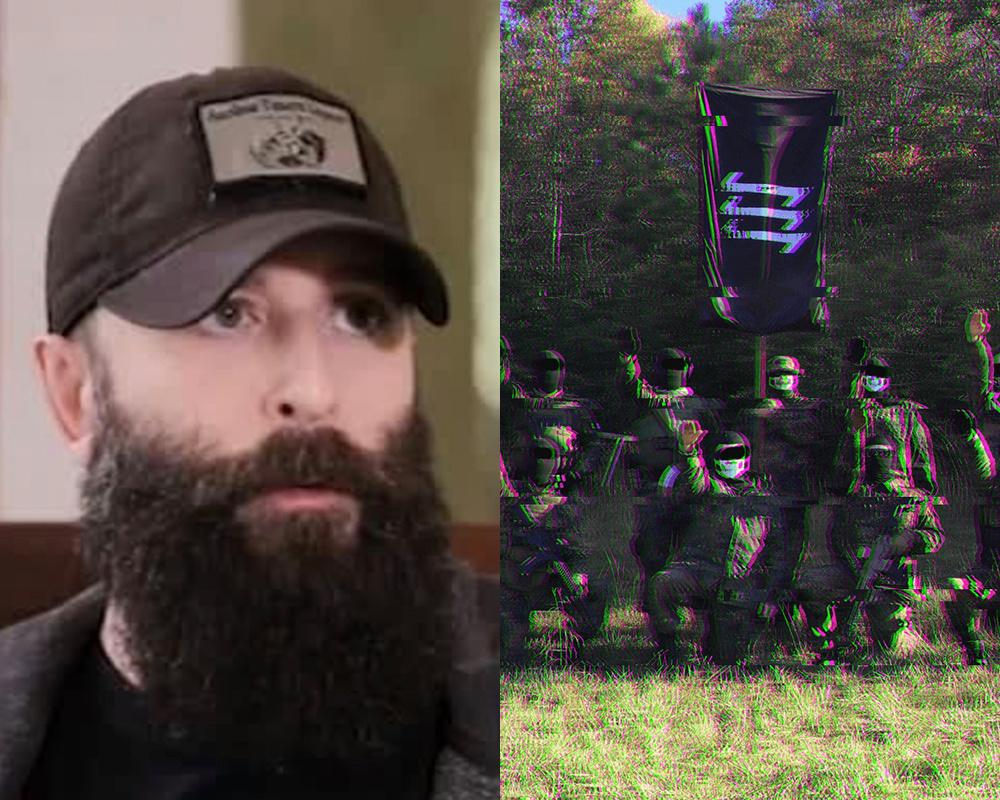
But the Base’s online footprint also paints a picture of a more careful, yet active, American presence: videos from November show masked men shooting military-style rifles and pistols in what they claim is an Appalachian forest.
Another June photo, from the same Appalachian cell, shows five armed men in skull masks, holding rifles and brandishing the Base’s black flag, while a cell from the mid-Atlantic captures three members performing “sieg heil” salutes, with another from the midwest showing two men firing pistols.
In the shifting political climate of the second Trump administration, where the FBI has openly rerouted resources away from investigations of far-right extremists, the Base appears free to organize and prepare for their stated objective of fomenting an armed insurgency against the US government.
At the same time, its recruitment has continued to funnel through a Russia email address and has not ceased since the 2020 FBI crackdown against it.
Nazzaro has also matched this new American law enforcement environment with emboldened rhetoric.
“Our long-term strategic goal is to accomplish something similar to what al-Qaida and IS accomplished in Syria,” bragged Nazzaro in an audio recording he released in early December over a Russian-controlled app, reviewed by the Guardian. “Form an organized, armed insurgency to take and hold territory. And establish a white homeland which we control and govern.”
Nazzaro concludes, in the same recording, how “only two traditionally white nations currently possess all of these necessary prerequisites … Ukraine and the United States”.
Steven Rai, an analyst at the Institute for Strategic Dialogue (ISD), who monitors the Base’s every online move, described with alarm how Nazzaro’s latest words and European actions illustrate its growing ambitions of openly fomenting new US operations.
“Nazzaro’s recent statements mark a troubling escalation that has been unfolding over the past several months,” said Rai, who pointed out that Nazzaro initially suggested over the summer Ukraine would be the only country where he was sanctioning attacks.
“More recently, however, he [Nazzaro] has explicitly expanded this endorsement of violence to other contexts, including the United States, where he has called for the establishment of so-called ‘acceleration teams’ aimed at destabilizing society and weakening government authority through attacks on critical infrastructure.”
In a post on VKontakte, the Russian knockoff of Facebook where it maintains an account, the Base was explicitly calling for cells to use “targeted attacks on essential infrastructure and resources” which could “contribute to the political fragmentation of the country over time if the attacks remain consistent”.
Its Ukraine cell is seen within the Base as a model of active insurgency against the Ukrainian government, which is more preoccupied with resisting the full-scale Russian invasion. In the US homeland, however, with “access to firearms” and “rugged wilderness terrain”, Nazzaro and the Base believe the same opportunity exists.
Europol and Spanish police, who executed the raid against the Spanish cell in early December, did not say if American authorities had any contact with them during or before their takedown of the Base.
Several sources have told the Guardian that the FBI under Kash Patel has intentionally looked away from far-right extremism, even openly mocking what is statistically the most dangerous domestic terrorist threat facing the US, as merely part of the “woke” agenda.
But Rai thinks Nazzaro’s calls for violence against Americans could act as a wake-up call to authorities, who might now have the legal space to crack down on what is designated a terrorist organization in several allied nations.
“[By] providing Base operatives in the United States with explicit strategic guidance centered around violence, Nazzaro may have inadvertently increased the group’s exposure to intervention by law enforcement,” he said.
There’s reason to believe the Base has also become a broader intelligence and security target in countries with capable spy agencies willing to devote resources at disrupting it. With legitimate questions surrounding its links to Russian sabotage operations – a top security concern among European nations –the Base is no longer considered an obscure American problem.
Along with Spain, there were recent arrests of members in the Netherlands, Belgium and the United Kingdom, with the European Union declaring it a terrorist group in the league of IS and al-Qaida.
Nazzaro’s recent audio clip also notably mentions how he saw the instability in “Canada or the European Union” as promising for the Base’s recruitment, in his first explicit mention of Canadian activities in years. The former Canadian cell leader of the Base, Patrik Matthews, is currently sitting in a US prison for his part in illegally entering the US and plotting a 2020 terrorist attack on a Virginia gun rights rally, meant to incite a neo-Nazi revolution.