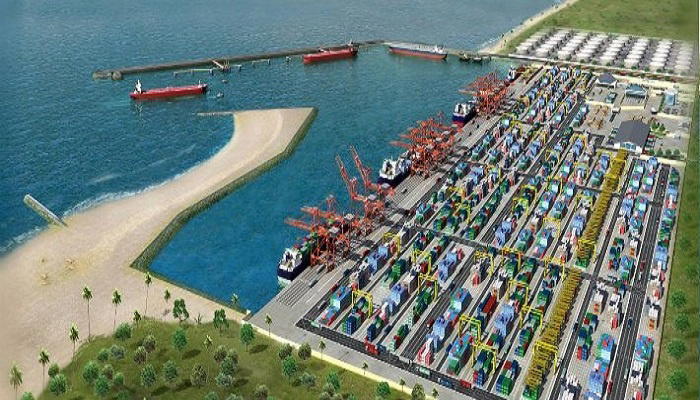

By Godwin Oritse
The management of Lekki Deep Seaport has disclosed that the port now operate at close to 50 per cent of its trade capacity, with steady month-on-month growth in container throughput since September, 2025.
This is just as a recentlt released data from Nigeria’s “Trade by Top 10 Posts/Ports of Operation,” between first and third quarter of 2025 revealed that Lekki deep seaport handle an estimated N13.46 trillion in total trade value, combining imports and exports, making it the country’s second-largest port by trade value ahead of Tin Can Island’s N9.31 trillion and Onne Port’s N6.76 trillion.
Speaking yesterday during an end-of-the-year media parley and your of the port with selected maritime journalists, the Managing Director/Chief Executive Officer of Lekki Port LFTZ Enterprise Limited, Mr. Wang Qiang, said the port has reached almost half of its designed operational capacity, reflecting increasing confidence by shipping lines and cargo owners.
He attributed it to the consistent improvement in the number of twenty-foot equivalent units (TEUs) handled monthly.
The trade data released showed that Lekki Deep Seaport recorded N7.39 trillion in imports and N6.07 trillion in exports.
A breakdown of the import quarterly data showed a consistent and accelerating trend as the port recorded N1.70 trillion in Q1, N2.51 trillion in Q2 and N3.18 trillion in Q3. While for export, Lekki port recorded N303.6 billion in Q1, N2.41 trillion in Q2 and N3.36 trillion in Q3.
Qiang stressed that efficient multimodal connectivity remains critical to sustaining and accelerating growth at the port, revealing that barge operations have become an important evacuation channel and currently account for about 10 per cent of cargo movement from the port.
He also noted that the ongoing Lagos–Calabar Coastal Road project would help ease congestion and improve access to the port, but stressed that rail connectivity remains essential, particularly given the scale of industrial activities emerging within the Lekki corridor.
“I believe the train option is something the government is concerned about, and with the level of industrial activities in this region, we expect that it will be provided,” he said.
Commenting on the new tax regime expected to take effect in 2026, he urged the government to adopt a simplified tax framework that supports ease of doing business.
He cited Germany and other countries where goods are cleared from ports with a 30-day window allowed for value added tax (VAT) remittance.
On his part, the Chief Executive Officer of Lekki Freeport Terminal (LFT), Captain Jedrzej Mierzewski also said that after only two years of operations, LFT has already become the number two terminal in the Nigerian market.
“We are the fastest-growing terminal in the country, combining modern infrastructure, operational excellence, and a clear ambition to become a leading transshipment hub for West Africa. Our growth supports the Nigerian economy by strengthening trade connectivity and helping to reduce the cost of foreign trade through efficient, reliable, and competitive port services,” he stated.
The post Lekki Port hits 50% capacity milestone amid strong cargo growth appeared first on Vanguard News.