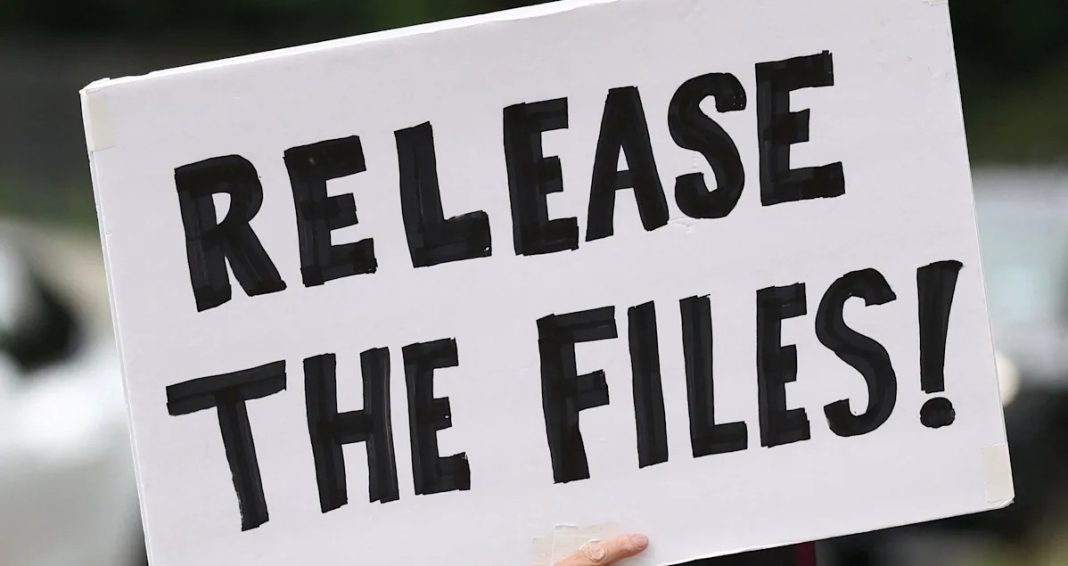

The Justice Department on Tuesday released thousands of new documents related to the investigation of convicted sex offender Jeffrey Epstein, after acknowledging that its initial release of heavily redacted material last week was incomplete.
The latest batch contains numerous references to President Trump, who was friends with Epstein in the 1990s and early 2000s. Trump has said he had a “falling out” with Epstein, and authorities have not accused Trump of any criminal wrongdoing in the case.
Documents posted by the DOJ on Tuesday include an email from a federal prosecutor in New York who states that Trump was listed as a passenger on Epstein’s private plane at least eight times between 1993 and 1996.
In a statement posted to X, the Justice Department said that some of the documents posted Tuesday “contain untrue and sensationalist claims” against Trump that were submitted to the FBI right before the 2020 election.
“To be clear: the claims are unfounded and false, and if they had a shred of credibility, they certainly would have been weaponized against President Trump already,” the DOJ said. “Nevertheless, out of our commitment to the law and transparency, the DOJ is releasing these documents with the legally required protections for Epstein’s victims.”
How we got here
After months of opposing it, Trump on Nov. 19 reluctantly signed into law a bill that required the DOJ to release all of its Epstein files within 30 days.
On Dec. 19, an “Epstein Library” containing publicly downloadable files sorted into multiple categories appeared on the DOJ’s website. Visitors initially encountered a waiting-room-type queue akin to what concertgoers see when they attempt to purchase tickets online.
In a statement, the White House said that the release shows how the current administration is the “most transparent in history.”
But many of the files — which included photos, call logs, grand jury testimony and interview transcripts — were heavily redacted. And according to the Associated Press, “at least some have already been in the public domain.”
In a letter to Congress, Deputy Attorney General Todd Blanche said the DOJ had identified 1,200 Epstein victims or relatives of victims and that it had redacted or withheld any materials that could reveal their identities. Blanche added that the department’s privacy review would continue and that the process would be “complete by the end of this year” — at which time the rest of the files would be released.
“They promised to release the files. They haven’t done it,” Democratic Sen. Adam Schiff of California argued in a television interview. “They could have been completely ready for this moment, and they’re not, or they’re just simply willfully withholding the materials.”
Epstein has long been the focus of unfounded conspiracy theories that claim the disgraced financier — who was found dead in his jail cell in Manhattan in August 2019 after his indictment on federal sex trafficking charges — was actually murdered to conceal the names of powerful people on a secret “client list.”
Now that at least some of DOJ’s investigative documents have been released, reporters, operatives and internet sleuths will start digging for dramatic revelations.
But we already know plenty about Epstein’s sordid past and high-profile connections. Plus the new law has some important loopholes that could limit what comes out.
Speaking to Fox News on Dec. 19, Deputy Attorney General Todd Blanche said to expect “several hundred thousand” documents by the end of the day, followed by “several hundred thousand more” over “the next couple weeks.”
“What we’re doing is we are looking at every single piece of paper that we are going to produce, making sure that every victim, their name, their identity, their story, to the extent it needs to be protected, is completely protected,” Blanche explained.
So will the release of the so-called Epstein files actually reveal anything new? Here’s what you need to know to make sense of this long-awaited moment.
Why is this happening now?
Trump had long opposed efforts to release the full Epstein files, lashing out at supporters for their interest in what he repeatedly referred to as a “Democrat hoax.”
But when four House Republicans — Rep. Thomas Massie of Kentucky, Rep. Marjorie Taylor Greene of Georgia, Rep. Nancy Mace of South Carolina and Rep. Lauren Boebert of Colorado — signaled last month that they would join with House Democrats to force a floor vote, the president suddenly reversed course, writing on his Truth Social network that “House Republicans should vote to release the Epstein files, because we have nothing to hide.”
“I DON’T CARE!” Trump added.
On Nov. 18, the House of Representatives passed the bipartisan measure known as the Epstein Files Transparency Act. The vote was near-unanimous: 427 to 1. A few hours later, the Senate agreed to pass the bill by “unanimous consent,” a procedure that allows legislation to proceed to the president’s desk without a formal vote as long as no senator objects on the floor.
The text of the law is clear: “Not later than 30 days after the date of enactment of this Act, the Attorney General shall … make publicly available in a searchable and downloadable format all unclassified records, documents, communications, and investigative materials in the possession of the Department of Justice … that relate to Jeffrey Epstein, including all investigations, prosecutions, or custodial matters.”
So Attorney General Pam Bondi had until Dec. 19 to comply.
What do the Epstein files actually consist of?
Blanche said to expect documents to come in “in all different forms: photographs and other materials associated with all of the investigations into Mr. Epstein.”
Beyond the investigative, prosecutorial and custodial documents referenced above, the law specifies eight additional categories of material that the DOJ had to release by Friday. To quote the law itself, that means anything in the department’s possession that relates to:
-
Ghislaine Maxwell [the Epstein partner and accomplice who was convicted of related crimes and is serving a 20-year prison sentence]
-
Flight logs or travel records, including but not limited to manifests, itineraries, pilot records, and customs or immigration documentation, for any aircraft, vessel, or vehicle owned, operated, or used by Jeffrey Epstein or any related entity.
-
Individuals, including government officials, named or referenced in connection with Epstein’s criminal activities, civil settlements, immunity or plea agreements, or investigatory proceedings.
-
Entities (corporate, nonprofit, academic, or governmental) with known or alleged ties to Epstein’s trafficking or financial networks.
-
Any immunity deals, non-prosecution agreements, plea bargains, or sealed settlements involving Epstein or his associates.
-
Internal DOJ communications, including emails, memos, meeting notes, concerning decisions to charge, not charge, investigate, or decline to investigate Epstein or his associates.
-
All communications, memoranda, directives, logs, or metadata concerning the destruction, deletion, alteration, misplacement, or concealment of documents, recordings, or electronic data related to Epstein, his associates, his detention and death, or any investigative files.
-
Documentation of Epstein’s detention or death, including incident reports, witness interviews, medical examiner files, autopsy reports, and written records detailing the circumstances and cause of death.
The FBI conducted two probes into Epstein: one that began in 2006 and ended in a controversial nonprosecution deal, then another that led to his 2019 indictment. According to CNN, those investigations generated “more than 300 gigabytes of [Epstein] data that lives within the FBI’s primary electronic case management system, called Sentinel,” and includes “videos, photographs, audio recordings and written records.”
In recent court filings, the DOJ has indicated that it possesses — and expects to release — materials obtained from FBI raids on Epstein’s homes in Florida, New York and Little Saint James, his private Caribbean island; hundreds of pages of memos from FBI interviews with witnesses; and “financial records, bank records, travel logs from commercial and private flights, materials subpoenaed from internet providers like Google, what’s referred to as ‘school records,’ information from law firms representing victims, arrest reports, depositions from related civil lawsuits, immigration records, documents from the Palm Beach Police Department and forensic reports from seized dozens of Epstein’s electronic devices,” according to CNN.
Federal judges have also paved the way for the DOJ to release grand jury materials from the Epstein indictment, the Maxwell trial and the related probe in Florida.
What materials might be withheld?
The law states that “no record shall be withheld, delayed, or redacted on the basis of embarrassment, reputational harm, or political sensitivity, including to any government official, public figure, or foreign dignitary.”
But it also gives Bondi permission to “withhold or redact” portions of records that fall under five categories, as long as she publicly explains every redaction within 15 days.
The exceptions, according to the text of the law, are documents that:
-
contain personally identifiable information of victims or victims’ personal and medical files and similar files the disclosure of which would constitute a clearly unwarranted invasion of personal privacy;
-
depict or contain child sexual abuse materials
-
would jeopardize an active federal investigation or ongoing prosecution, provided that such withholding is narrowly tailored and temporary;
-
depict or contain images of death, physical abuse, or injury of any person
-
contain information specifically authorized under criteria established by an Executive order to be kept secret in the interest of national defense or foreign policy
The attorney general could use these loopholes to limit what the DOJ releases.
Bondi has already cited concerns about identifying victims or disseminating images of child sexual abuse to explain why the Trump administration did not release more files earlier this year — concerns Blanche echoed on Friday.
Massie warned in an online video that there will be penalties if Bondi does not comply with the law.
“This is a case where the president who appointed the attorney general and for whom the attorney general works has signed the law and the ink is not even dry yet on his signature,” Massie said. “There’s nothing subject to interpretation.”
Investigative conflicts create another possible rationale for redactions. Last month, Bondi followed orders from Trump and immediately opened a probe into several Democrats who were mentioned in Epstein’s emails — even though the DOJ and FBI had previously declared that nothing in the Epstein files warranted further scrutiny.
Speaking at DOJ headquarters on Nov. 19 — the day Trump signed the Epstein Files Transparency Act into law — Bondi said new information obtained by investigators had prompted her to reverse her decision to close the case. She declined to say what that information was.
Bondi also sidestepped questions about when or how much material would be released, insisting she would “continue to follow the law … while protecting victims but also providing maximum transparency.”
What materials have already been released?
Over the last month or so, Republican and Democratic members of the House Oversight Committee have released multiple batches of files and photographs from Epstein’s estate. Last Friday, Democrats released roughly 90 images, including some of Donald Trump, Bill Clinton and the former Prince Andrew; another tranche followed, showing billionaire Bill Gates along with other wealthy philanthropists. One photo captures handwriting on a woman’s body that appears to quote from Vladimir Nabokov’s novel Lolita.
The committee did not accuse the men in the photos of wrongdoing.
As for the DOJ, it has released its findings from an internal investigation into Epstein’s 2008 nonprosecution, its inspector general’s report on Epstein’s death and hundreds of pages from its controversial interview with Maxwell earlier this year.
In February, the department dropped what it described as the “first phase of the declassified Epstein files” — 341 pages of material that was mostly available already, including flight logs from Epstein’s plane and a redacted version of his contacts book.