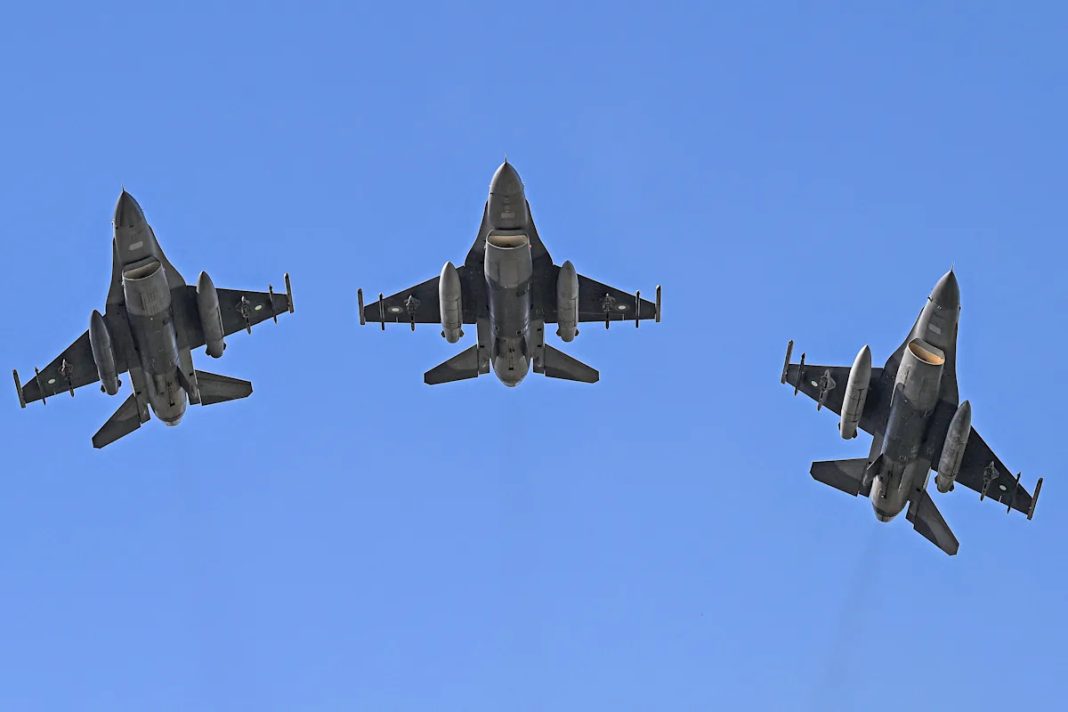

The United States has approved the sale of advanced technology and upgrades for Pakistan’s F-16 fighter planes worth approximately $686m.
The deal was struck amid simmering tensions between Pakistan and its neighbour, India, which engaged in a five-day war following a rebel attack in Indian-administered Kashmir in May this year. The US recently pressured Indian Prime Minister Narendra Modi to buy more weapons from it.
We take a closer look at the US-Pakistan F-16 upgrade deal and why this is significant now.
What has the US agreed with Pakistan?
Praveen Donthi, a senior analyst at the Brussels-based non-governmental organisation (NGO) International Crisis Group, told Al Jazeera that the latest approval is part of a 2022 maintenance deal the US agreed in 2022 to sustain Pakistan’s fleet of F-16s.
“The F-16 deal remains a key part of the broader US-Pakistan bilateral relationship, which is why there has been continuity from President Biden to President Trump, despite some delays. Both sides emphasise the fleet’s utility in joint counterterrorism operations in the region.”
The latest US deal is for the sale of technology, which will support and upgrade Pakistan’s existing F-16 fleet. It was confirmed in a report sent to the US Congress by the Defense Security Cooperation Agency (DSCA) on December 4.
Pakistan is believed to have 70 to 80 working F-16s. Some of these are older, but upgraded, Block 15 models, some are former Jordanian F-16s, and some are newer Block 52+ models.
The US offering comprises hardware and software updates for enhanced flight operations and aircraft electronic systems; the Advanced Identification Friend or Foe (IFF) system, which allows pilots to identify friendly aircraft from enemy ones; navigation upgrades; spare parts and repairs.
Alongside $649m-worth of support and upgrades for the F-16s, the US sale also includes major defence equipment (MDE), which are items of significant military equipment on the US munitions list, worth $37m. This includes 92 Link-16 systems.
The Link-16 is a secure military tactical data link network which allows real-time communication between military aircraft, ships and ground forces. It allows communication through text messages and images.
Six Mk-82 inert 500-pound (226.8kg) general-purpose bomb bodies are another type of MDE authorised to be sold to Pakistan. These are empty metal casings of an Mk-82 bomb, which are used for training or testing.
Instead of an explosive such as tritonal – a mixture of trinitrotoluene (TNT) and aluminium powder used in munitions – the casing is filled with a heavy material such as concrete or sand. The Mk-82 is an unguided bomb developed by the US. It can also be used as a warhead for precision-guided munitions.
What are F-16 fighters?
The F-16, also called the F-16 Fighting Falcon or the Viper, is a single-engine aircraft used for air-to-air combat and air-to-surface attack by the US and its allies.
The jets are currently manufactured by US defence and aerospace manufacturer Lockheed Martin, which took over production in 1995. It was originally developed by General Dynamics, a US industrial and technology company.
The jet was developed towards the end of the war in Vietnam, during which the Soviet Mikoyan-Gurevich (MiG) overwhelmed heavier and slower US fighter planes. It first flew in 1974.
The F-16 is now one of the world’s most widely used fighters. F-16s are operating in 29 countries, according to the Lockheed Martin website.
Besides Pakistan, some other countries which have F-16s are Ukraine, Turkiye, Israel, Egypt, Poland, Greece, Taiwan, Chile, Singapore, Belgium, Denmark, the Netherlands and Norway.
F-16s perform aerobatic manoeuvres during a rehearsal for Pakistan Day parade, March 16, 2024 [Aamir Qureshi/AFP]
What role did F-16s play in the May conflict between India and Pakistan?
On April 22, armed attackers killed 26 people in Pahalgam, a popular tourist spot in Indian-administered Kashmir. The attack was claimed by The Resistance Front (TRF), a separatist group designated a terrorist organisation by India and the US, and which New Delhi alleges is linked to Pakistan-based Lashkar-e-Taiba (LeT) – a claim Islamabad denies.
Following the Pahalgam attack, New Delhi scaled back diplomatic ties with Islamabad and suspended the Indus Waters Treaty, which ensures the appropriate sharing of the Indus River water between India and Pakistan.
On May 7, India struck nine sites in Pakistan and Pakistan-administered Kashmir with missiles, which Islamabad said killed dozens of civilians. Over the following three days, the countries engaged in a heated aerial war, using drones and missiles to target each other’s military bases.
During the aerial war, Pakistan deployed 42 “hi-tech aircraft”, including the F-16s, and Chinese-made JF-17s and J-10s, according to Pakistan’s Air Vice Marshal Aurangzeb Ahmed.
A ceasefire – for which US President Donald Trump took credit – was eventually brokered on May 10.
Is the US applying pressure to India?
Yes, for a couple of reasons.
The US approval for Pakistan’s F-16 upgrade comes as the Trump administration presses India to buy more weapons from it.
In August, New Delhi put its plans to buy US weapons and aircraft on hold, the Reuters news agency reported, quoting three unnamed Indian officials familiar with the matter.
This came just weeks before Indian Defence Minister Rajnath Singh had been scheduled to visit Washington to announce some weapon purchases. That visit was cancelled.
India-US relations have also been tense in recent months.
On August 6, Trump imposed an additional 25 percent tariff on imports from India as a punishment for buying cheap Russian crude oil. This was on top of the existing 25 percent tariff already levied on Indian goods, bringing the total levy on Indian imports to 50 percent.
Trump announced the tariff in an executive order, in which he wrote that Russia’s continued military actions in Ukraine constituted a “national emergency” and it was therefore “necessary and appropriate” to place heightened tariffs on India, a top consumer of its crude oil.
“I find that the Government of India is currently directly or indirectly importing Russian Federation oil.”
While pressure from the US has resulted in India slightly scaling back purchases of Russian oil, New Delhi plans to continue to buy from Moscow. It remains the second-largest consumer of Russian oil after China.
President Vladimir Putin met Prime Minister Modi for the annual Russia-India bilateral summit in New Delhi last week, during which he said: “Russia is ready for uninterrupted shipments of fuel to India.”
The announcement of the latest US deal to provide maintenance and upgrades for Pakistan’s F-16s is likely to be poorly received by India.
Donthi said New Delhi has previously opposed the defence cooperation between Pakistan and the US under which the two countries collaborate to maintain Pakistan’s F-16 fleet. India has claimed the F-16s are used against it.
“Washington pre-empted it this time by stating that the sale ‘will not alter the basic military balance in the region’,” Donthi said.
How much does the US sale strengthen Pakistan?
Donthi said that while the latest package from the US will help Pakistan maintain its fleet until 2040, it is China which has supplied more than 80 per cent of Pakistan’s weapons since 2020.
This statistic is also backed by Swedish think tank SIPRI in a report this year, which stated: “Pakistan used Chinese J-10 aircraft in the May conflict with India. Islamabad continues to balance between Washington and Beijing, benefiting from both.”