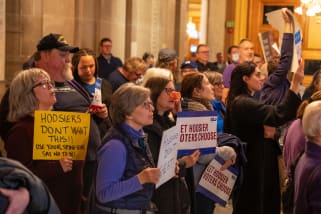

Indiana Republicans refused to be put in a gerrymandered box
The Indiana Senate’s Republican supermajority had a choice Thursday. They could acquiesce to the White House’s demands that they approve a new congressional map and potentially turn the state’s entire House delegation red. Or they could listen to their constituents and consciences. As their sweeping 31-19 rejection of the new map showed, they chose well.
This outcome was in no way a foregone conclusion. President Donald Trump had promised to a back primary challenger against any Indiana Republican lawmaker who vote against redistricting. Vice President JD Vance, Speaker Mike Johnson, R-La., and Indiana Gov. Dan Braun were all recruited to work the phones, meet with lawmakers and threaten dire consequences for any Republican who defied Trump’s wishes. Outside groups spammed everyday Hoosiers hoping to persuade them to pressure their representatives to support a new map. And still a majority of the state senate’s Republican caucus voted no.
The proposed gerrymandered map wasn’t even produced by state lawmakers or their staff.
Trump has been lobbying GOP state lawmakers hard this year to gerrymander their congressional districts to shore up the fragile Republican majority in next year’s midterms. Republicans hold seven of Indiana’s nine seats in the U.S. House. The new map would have doomed the two Democratic-held seats by carving up Indianapolis among four districts and splitting another blue stronghold near Lake Michigan over two districts.
The Indiana House voted last week 57-41 to support that aggressive gerrymander, but Senate President Pro Tempore Rodric Bray had long made it clear to the White House that the votes weren’t there in the Indiana Senate. And Bray gave no indication he was willing to strongarm his members to do Trump’s bidding. But Trump kept pushing until the legislature agreed to Braun’s request to hold a special session after Thanksgiving to consider the issue.
Importantly, as Indianapolis’ WFYI reported, the proposed gerrymandered map wasn’t even produced by state lawmakers or their staff. The National Republican Redistricting Trust provided the proposed borders to the bill’s main author, who said during a hearing last week: “I got it handed to me on paper.” NRRT executive director Adam Kincaid also helped draw up the gerrymandered map Texas lawmakers approved in August, designed to add five new Republican seats. That kicked off the ongoing tit-for-tat redistricting rush across the country.
But it turns out Hoosiers don’t look kindly on being told what to do. As CNN reported, speaking with voters across Indiana “underscored two political realities: Rank-and-file Republicans in this deep-red state generally haven’t soured on Trump. But they aren’t rushing into battle for him, either — and they don’t think this issue will be top of mind when they cast their votes in a state Senate primary.” Bray in particular received plenty of support from the Indiana voters CNN spoke with and has shrugged off the idea that he would be vulnerable to a challenger.
Many of Bray’s members showed that same stubborn indignation at the idea they’d listen to Washington’s aggressive tactics over their constituents. The Atlantic’s Russel Berman reported ahead of Thursday’s vote, that many Indianians he spoke to, Democrats and Republicans, “said that the push for mid-decade redistricting simply ran afoul of the small-c conservatism on which many Indiana Republican legislators still pride themselves.” There wasn’t only ideology at play though, as Berman noted, but a very pragmatic political reality at work:
Only half of the senators will be on the ballot next year, and a number of Republicans in the chamber have already announced their retirement. GOP senators also have reason to doubt that either Trump or his allies will follow through on promised spending in the coming years, particularly for those whose next election isn’t until 2028. “The idea that Trump would be spending political capital not just four months from now, but two and a half years from now, individually targeting Indiana senators who defied them on one vote? Just crazy,” [Indianapolis city council member Nick Roberts] said. By 2028, “they will have bigger fish to fry.”
Still, there was no guarantee that Indiana state senators would take that chance. There were multiple threats of political violence against state lawmakers who spoke against the redistricting plan before the vote. But as state Sen. Sue Glick said after she voted against the proposed map: “You have to know Hoosiers. We can’t be bullied, we don’t like it.”
In effect, gerrymandering envisions a world where elections are decided without a single vote being cast.
Gerrymandering is undemocratic at its core; it’s an attempt to pre-sort voters into supposedly safe and unsafe districts, effectively homogenizing the electorate. In effect, gerrymandering envisions a world where elections are decided without a single vote being cast.
Gerrymandered lines drawn up by lawmakers are bad enough, but having them drawn up, in this case, by people disconnected from the state, means that not even the concerns of Indiana’s Republicans were driving the process: only the national party’s concerns.
In the end, the Indiana State Senate rejected a map drawn up by a national group to further national Republican goals. A majority of the GOP caucus voted with every Democrat in standing firm against the proposal. In voting that Trump-backed map down, the Republicans voting no demonstrated that not all Republicans are the same and that even in a MAGA dominant era and that voters don’t appreciate being told that their vote won’t matter. Even if what happened in Indiana will be harder to replicate elsewhere, these lawmakers’ refusal to be shoved into a misshapen box is encouraging.
The post Indiana Republicans refused to be put in a gerrymandered box appeared first on MS NOW.
This article was originally published on ms.now