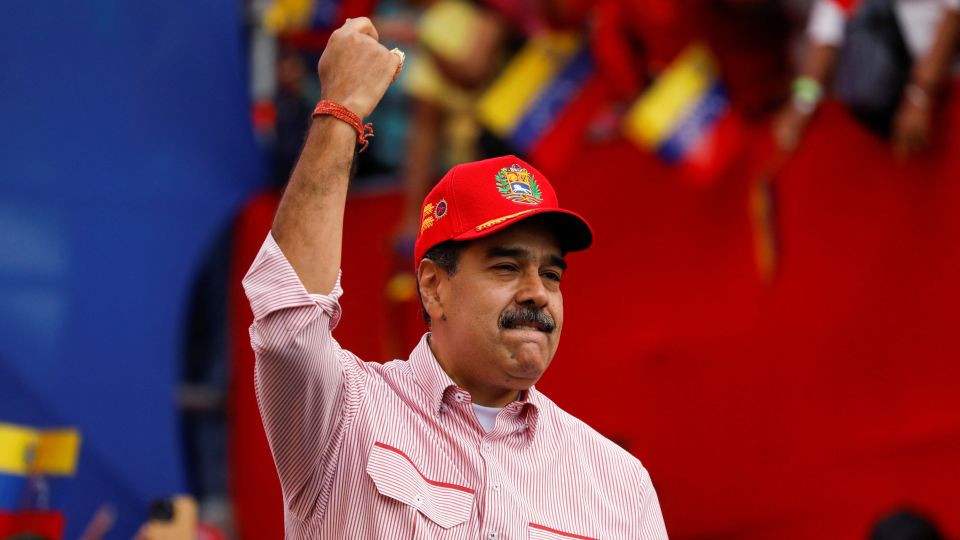

Nicolás Maduro believes that his predecessor and political father, the late Hugo Chávez, appeared before him in the form of a small bird and a butterfly. He also thinks that celebrating Christmas two months early – by presidential decree – helps “lift the spirits of Venezuelans.”
He confuses “gremlin” with “grinch,” invents words in Spanish, and often makes one linguistic slip after another. The decisions and statements of Venezuela’s president can be so eccentric that many Venezuelans and Latin Americans have a name for them: “maduradas.”
He has, however, proven for years that underestimating him can be a mistake for his critics.
Maduro greets the people after a vote on April 14, 2013, in Caracas, Venezuela. – Gregorio Marrero/LatinContent/Getty Images
Mockery of Maduro existed even before he took office as president of Venezuela in 2013, when he was just one among several potential successors to the cancer-stricken leader, despite having served as foreign minister and vice president. Maduro received only minority support from followers of the United Socialist Party of Venezuela (PSUV), and his circle, according to reports, was in strong tension with supporters of the influential Diosdado Cabello, then president of the National Assembly, for being the chosen one in a country dominated by uncertainty.
But, overwhelmed by illness, at the beginning of December 2012, Chávez put an end to internal disputes and unequivocally blessed Maduro to lead chavismo and Venezuela. The “son of Chávez” then inaugurated a government in which, year after year, he defied criticism of his electoral system, protests, sanctions, arrest warrants, possible rebellions, international isolation, and speculation about his future.
The leader mocked by some is now the longest-serving president in power in Latin America: 12 years and seven months. Maduro survived predictions and ridicule, but along the way, Venezuela lost millions of inhabitants, 72% of its economy, democratic legitimacy in the eyes of much of the world, and many of its most important international allies. The Venezuelan president says he now faces an “existential situation.” Will he be able to defy predictions again and survive the military and diplomatic pressure from US President Donald Trump?
The ‘son of Chávez’
“If some unforeseen circumstance should arise that prevents me from continuing as president of Venezuela, my firm opinion, as firm as the full moon, is that, in that scenario, which would require calling presidential elections, you should choose Nicolás Maduro,” said Chávez in December 2012, hours before traveling to Cuba to continue his treatment. The president would return to Caracas only to die, but the name of his heir was already clear.
Maduro himself says he does not know why Chávez chose him among several candidates because he never aspired to “be president.” “But he was preparing me,” he said shortly after Chávez’s death.

Venezuelan President Hugo Chavez gives his first press conference after winning national elections on October 9, 2012, in Caracas, Venezuela. – Gregorio Marrero/LatinContent/Getty Images
The son of a political activist from a traditional Venezuelan party, Maduro began preparing very early. As a student, he joined the Socialist League and began working as a bus driver for the Caracas Metro.
His activism made him a union leader, from where he jumped into politics. Union and political activity allowed him to meet two decisive people in his life: Cilia Flores and Chávez.
Flores was a young lawyer, and Maduro was a rising union leader. She was one of Chávez’s legal defenders over the 1992 coup attempt. Flores and Maduro visited him in Yare prison.
The path of love, politics, and loyalty began. Flores became Maduro’s partner and, eventually, the first woman to lead the National Assembly and the person many today see as the “power behind the throne,” Carmen Arteaga, PhD in Political Science and professor at Simón Bolívar University, told CNN. And he became the “son of Chávez.”
The mysteries of Cuban support
When Chávez was elected president in 1999, Maduro entered the National Assembly. As the then-president gained power inside and outside Venezuela, Maduro climbed the ranks, first in the National Assembly and then in government as “a good second, always obedient,” Ronal Rodríguez, researcher at the Venezuela Observatory at Colombia’s Universidad del Rosario, told CNN.
“Maduro was always an underestimated leader. There were many possible successors when Chávez fell ill. But none achieved what he did: on one hand, Cuban support, and on the other, distributing power within chavismo,” said Rodríguez.
Maduro’s relationship with Cuba spans decades and has various forms and mysteries. One of the few unauthorized biographies of Maduro – “De Verde a Maduro: el sucesor de Hugo Chávez” (a play on words, since “maduro” also means ripe; “From green to Maduro: The Successor of Hugo Chávez”) – says that the current president may have been trained in revolutionary politics on the island during his youth.
Neither he nor official biographies mention this alleged experience. But Maduro did build, first with the government of Fidel and Raúl Castro, and later with Miguel Díaz-Canel, a bond that is among the most important for today’s Venezuela. And that, according to former officials of Trump’s first administration, was decisive for the president to anticipate and contain, through Cuban security services, the opposition uprising of April 2019, among other things.
Maduro deepened his ties with the Castros when he became Chávez’s foreign minister in 2006, and became a “key player” in 2011, when the then-president fell ill and traveled to Cuba for treatment. From then on, he was the key link in managing the strategic relationship between the Castros and chavismo.
That relationship helped Maduro strengthen his position to be the successor to Chávez, who had the charisma and influence that none of his potential heirs possessed. And also to oil a narrative first perfected by Fidel Castro and then by Chávez himself – both leaders in the Latin American left. It was an anti-imperialist and anti-US narrative, amplified by geopolitical alliances with historic US rivals.
The start of the ever-returning cycle
Maduro leaned on that epic from the very start of his first administration. The “son of Chávez” received his blessing, but not all his votes. In the April 2013 elections to choose the late president’s successor, the chavista candidate defeated opposition leader Henrique Capriles by just 1.59% of the vote. Six months earlier, in the October 2012 presidential elections, Chávez had beaten Capriles by a margin of 9.5%.
Suspicious for years of the government’s electoral transparency, Capriles and the opposition refused to accept the results. Even chavismo itself, through Cabello, showed Maduro its dissatisfaction with the result and called for self-criticism.
He responded that it was a “legal, fair, and constitutional” victory and celebrated chavismo’s continued rule.
But there began the pattern that best defines the self-proclaimed defender of “popular and revolutionary democracy” to this day: contested elections, opposition in the streets, allegations of repression and persecution of dissent, and distribution of benefits within chavismo to avoid internal challenges and retain power. Outside Venezuela, the “Maduro model” relied on the support and “know-how” of the traditional US adversaries: China, Russia, and Iran.
From 2013 onward, all national elections were shrouded in doubts and controversies among the Venezuelan opposition, international organizations, and even allied governments: the 2017 constitutional elections, the 2020 legislative elections, and the 2018 and 2024 presidential elections. The 2015 parliamentary elections were, in fact, won by the opposition, but chavismo used political maneuvers to neutralize that victory. Time and again, elections were followed by opposition challenges and marches and, as documented by the United Nations in its reports, repression and death.
Maduro defended these processes as “transparent” and his electoral system as “reliable.” He resisted, clenched his fist, and overcame challenges even when many thought he would not. This happened, more than ever, in 2024, when not even Colombia and Brazil, governed by leftist presidents Gustavo Petro and Lula da Silva, recognized the results of the elections in which Maduro supposedly defeated the opposition of Edmundo González Urrutia and María Corina Machado and achieved his second re-election.
“The Maduro case is an unusual case of regime survival in a region where, faced with similar challenges, other regimes fell,” says academic and Amherst College professor Javier Corrales in his book “The Rise of Autocracy: How Venezuela Transitioned to Authoritarianism.”
The high cost for Venezuelans
For Venezuelans, the price of Maduro’s survival method was and is, however, high and measured in lives, exile, and poverty. Since 2017, several UN agencies and the International Criminal Court (ICC) have been tasked with enumerating that cost, sometimes even with the collaboration of the Venezuelan government itself, in an attempt to ward off the specter of an international arrest warrant for Maduro for crimes against humanity.
Year after year, reports described an increase in human rights violations, “coordinated in accordance with state policies and part of a course of conduct that is both widespread and systematic, thus constituting crimes against humanity,” as noted in a 2020 UN mission report. “The mission found reasonable grounds to believe that authorities and security forces have planned and executed large-scale human rights violations since 2014.”
“The evidence obtained by the mission during this investigative cycle confirms that the crime of persecution based on political motives continues to be committed in Venezuela, without any national authority showing willingness to prevent, prosecute, or punish the serious human rights violations that constitute this international crime,” concluded Marta Valiñas, rapporteur of the report.
Excessive force, arbitrary detentions of protesters and opposition leaders, sexual violence, torture, extrajudicial executions – all are present, according to UN reports, in Maduro’s manual for managing dissent.
In response to each accusation or international investigation, Maduro and his government resort, as they have from the beginning, to the well-known anti-imperialist narrative. “It is very concerning that the high commissioner gives in to the pressures of anti-Venezuelan actors and makes biased and untruthful statements, presenting ideologized speculations as facts,” Maduro’s government responded in 2021 to Michelle Bachelet, then UN High Commissioner for Human Rights.
Bachelet was Chile’s first socialist president since the return of democracy to the country. Maduro’s confrontation with Bachelet, then a UN diplomat, was a sign that the Venezuelan government was also beginning to lose the support of the Latin American left.
Poor management, war economy, exodus and sanctions
The anti-US crusade narrative was also used by Maduro and his government to justify Venezuela’s dire economic numbers.
These figures, typical of war economies in other countries, starkly expose the weak management of a Maduro who managed to get Venezuela to start growing only in 2021, eight years after taking power. Today, the Venezuelan economy is 28% of what it was in 2013, according to the IMF.

A man holds a grocery bag in front of a store displaying signs with dollar prices at the Quinta Crespo municipal market in Caracas on November 13. – FEDERICO PARRA/AFP/AFP via Getty Images
Behind this collapse is the decline of Venezuela’s main source of income over the past 50 years: oil. Targeted by power struggles, chavista disputes, and lack of investment, PDVSA, the company that controls oil production and marketing, collapsed. The general fall in oil prices since 2014 did not help either. Today, oil export revenues are just 20% of what they were in 2013, according to OPEC+ data.
Maduro and his government blamed and continue to blame US sanctions for the economic collapse. But it was only in 2019 that the Trump administration imposed sanctions on PDVSA; until then, the measures were aimed at punishing Maduro and his officials individually.
Unlike in other countries, poor economic management did not alter Maduro’s control over Venezuela. But it did change the country’s makeup. Overwhelmed by repression and poverty, which at its worst affected 90% of the population, millions of Venezuelans chose to leave for destinations where the future seemed possible. Venezuela’s exodus, along with Syria’s, is among the largest displacement crises worldwide: nearly eight million Venezuelans now live in other countries.
The key to the ‘Maduro model’ of survival
Maduro’s Venezuela is a succession of crises that forced Venezuelans into exile but, at the same time, strengthened the president, who blames sanctions for the exodus. “Maduro is more skillful than most people think; he always knew how to take advantage of circumstances and turn crises around,” says Rodríguez.
To do this, Maduro began building, as soon as his government started, a balance of power in which he became the guarantor. Essential in this map were, from the start, the Armed Forces, a sector with which Maduro had little relationship before being anointed by Chávez.
“Someone once explained this to me: with Chávez, the military thought they had to thank him for the prominence they had. With Maduro, it’s the other way around. He has to thank the military and give them concessions like positions or entire economic sectors, so they tolerate him. He turned Venezuela into a confederation in which he is the manager,” Amherst College academic Javier Corrales told CNN.
Also key in this power-sharing scheme, which Corrales compares to what the Castros imposed in Cuba, were the oldest chavista leaders, such as Cabello or the now disgraced Rafael Ramírez, former president of PDVSA, among other positions, or Tareck el-Aissami, former vice president of the country.
But, as in any closed power regime, some succumbed, under allegations of supposed corruption, and went into exile or ended up in prison. Many others continued and today are not only part of the balance of power and economic management but also of international justice investigations into alleged crimes against humanity.
Maduro distributed power, money, and responsibilities and, in doing so, ensured his survival.
In the “confederation” of actors that dominate Maduro’s Venezuela, paramilitary groups that, according to the UN, participated in the cycle of opposition repression during the most intense social unrest of recent years, also play a central role. The “colectivos” are also a key tool in Maduro’s balance of power and his future.
“They are a highly armed sector. They are the regime’s sheriffs. And they have a lot to lose if the government falls,” says Corrales.
The intense relationship with the US
Former Trump and Biden officials share Corrales’s assessment. There are so many legal and supposedly illegal actors involved in Maduro’s government, so many interests at stake, that the president’s sudden departure could unleash chaos and an even worse drama than what has been corroding Venezuela for years.
Almost thirteen years after Chávez proclaimed him his chosen one, Maduro faces another crisis, one that Trump’s second administration hopes will be the last.
With various tactics, the US policy of weakening Maduro has, in recent years, been as intense as the Venezuelan president’s anti-US rhetoric.
It spanned several administrations and included economic sanctions, exorbitant arrest warrants, detention of relatives for alleged drug links, arrest and release of the alleged “front man,” granting and canceling oil licenses, direct dialogue and secret talks, and even a plan to allow free, fair, and transparent elections that led, in 2024, to elections in which the opposition led by Machado surprised the world. Nothing worked, neither threats nor dialogue with a Maduro who also proved to be an expert in stalling and delaying negotiations.
The Venezuelan leader now faces the largest US naval and air blockade deployed in the Caribbean in decades. US and Trump’s military pressure is growing, and Maduro is once again trying to defy the odds. Will he succeed?
For more CNN news and newsletters create an account at CNN.com