
When Immigration and Customs Enforcement (ICE) set its sights on Chicago in September, Chicagoans sprang into action to protect their immigrant neighbors: teaching each other how to recognize and safely document ICE agents, setting up “know your rights” trainings, and distributing whistles en masse so people could loudly alert anyone in the vicinity when ICE was spotted.
In the months since, whistles have become a popular raid alert tool in other cities across the country – New Yorkers wear them around their necks to warn neighbors, the people of New Orleans blast them outside ICE facilities and Charlotte residents used them to ward off Customs and Border Protection officials. While strongly associated with Chicago, the tactic is actually one that city organizers learned in part from groups in Los Angeles. Its spread is illustrative of the many ways cities are helping inspire and equip one another in the face of often unlawful federal activities.
Rain Skau, a co-coordinator of the Fight Fascism campaign of the Democratic Socialists of America (DSA) Los Angeles, said Angelenos began to use whistles to alert neighbors about ICE presence when agents first started hitting the city in June. Despite the federal government’s claims that these raids were targeting hardened criminals, Skau described one of the first raids at a Home Depot as mostly snatching women vending food in the parking lot, stuffing them into vans as meat sizzled on the grills they left behind.
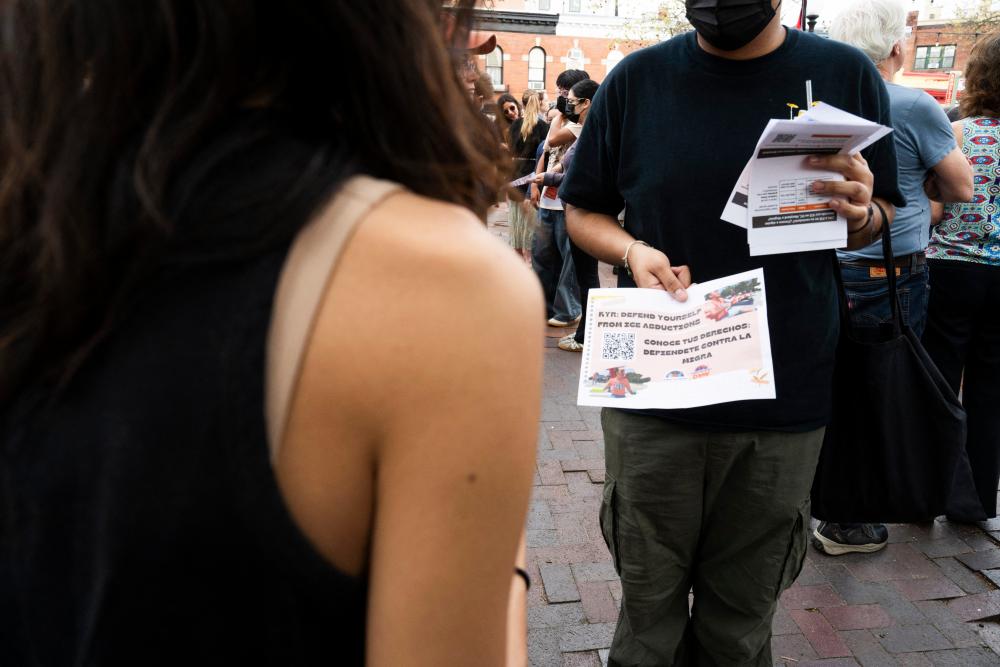
DSA and other grassroots groups in the city set up patrols of ordinary citizens to create a consistent presence at the Home Depots when day laborers and vendors were most likely to be out and about. (A September report by Rent Brigade found that Home Depot locations became “the most dangerous places in LA for immigrant workers”.) Volunteers passed out “know your rights” information, and when a tip came via a citywide hotline about an ICE sighting, the groups sent out patrols to document what was happening, collect belongings and get in touch with family members if someone had already been detained.
Related: ‘The holy family is in hiding’: nativity scenes at US churches push back on ICE
By the time ICE hit the streets of Chicago in the fall, organizers in Los Angeles felt like they had some wisdom to share. Members of DSA in LA began having informal conversations with those in DSA Chicago. “One comment that someone made was, ‘We’ve never done anything like this before,’” Rain remembered. “And what I said to them was: ‘We hadn’t either, before all this happened. We had never operated ICE watch patrols, but we were able to do it. And here’s the great thing: you don’t have to do it alone. You don’t have to figure out all of this from scratch, because we’re here to support you.’”
Sharing resistance tactics between cities
As ICE kidnappings spread across the country, so has this spirit of solidarity. Beth Davis, the communications lead for Indivisible NOLA, remembers getting an Instagram direct message in November from someone with Indivisible Chicago that she didn’t know. “I’ve heard rumors that ICE may be headed to New Orleans as early as Friday. Our chapters in Chicago are wondering if we can provide you with support and resources based on what we’ve been through,” the message read.
Though Indivisible is a national organization, this connection wasn’t orchestrated by national leadership – just organizers in one city taking initiative to reach out to those in another. “For an individual chapter that is eight states away to reach out is very unusual,” Davis said. “There just really hasn’t ever been a need before now.”
She quickly connected leaders from the Chicago chapter to those in New Orleans. Before long, Indivisible Chicago had sent whistle kits in the mail to the New Orleans chapter, along with an explanation of how best to use them, and Indivisible NOLA set up a “know your rights” training that the Chicago Indivisible chapter helped lead remotely via Zoom. About 800 people spanning a wide range of ages and ethnicities showed up at a music venue for the New Orleans training, pens and paper in hand for note-taking.
Another collaborator on the “know your rights” training was the American Civil Liberties Union (ACLU), where cross-city collaboration has long been a practice, sometimes orchestrated by national leadership. “It’s sort of a chain reaction,” said Sarah Whittington, the advocacy director for ACLU Louisiana. Lessons learned on the ground were passed from ACLU Chicago to North Carolina to Louisiana branches.
“Those relationships across state lines have been really important,” Whittington said. “We’re building depth and expertise. If Minneapolis-St Paul is the next place, I don’t doubt that we will be reaching out to Minnesota and saying: ‘Hey, here’s what we did.’”
It’s not just national groups like the ACLU that are leveraging longstanding relationships. Groups representing street vendors in different cities got connected in the early days of the pandemic as they faced similar health and safety challenges across the country, and many have stayed in touch since. This has turned out to be a boon as street vendors, many of whom are immigrants, find themselves increasingly under threat from ICE raids.
In New York, vendors have faced increased surveillance from the police and sanitation department under mayor Eric Adams. But while the guidance for dealing with local law enforcement is that vendors should show their identification, the guidance for dealing with ICE is to remain silent. As a result, it has become crucial for street vendors to be able to differentiate between city and federal agents. Carina Kaufman-Gutierrez, the deputy director of the Street Vendor Project, says the organization is preparing for the potential for increased raids by distributing whistle kits, based on advice from colleagues in Chicago.
“We’ve continued to be in touch throughout this time and build on those partnerships, just checking in with each other and asking: ‘What are you seeing on the ground?’” she said. “It’s also become like an emotional support group at times.”
Related: ‘There’s power in numbers’: New Yorkers are banding together to protect street vendors from ICE
Overcoming communication and surveillance challenges
These ongoing relationships and direct lines of communication are especially crucial because “the repression is so strong” that it can be hard to talk publicly about strategies and tactics via mainstream news broadcasts or social media, according to Phoebe Unterman, an organizer with the Echo Park local chapter of the Los Angeles Tenants Union.
While there was a burst of media coverage when ICE first began targeting Los Angeles, most of that (with the notable exception of independent outlet LA Taco) has dropped off even as the raids have continued, Unterman said, making it hard to stay on top of what is really happening in far-flung corners of her own city, much less another across the country. In LA, as in many cities, ICE hotlines where people can call in sightings have been crucial for dispatching volunteers quickly. But in places where that tip system is operating via large Signal groups or WhatsApp chats, infiltration by authorities is a risk.
You don’t have to do it alone. You don’t have to figure out all of this from scratch, because we’re here
Rain Skau, DSA Los Angeles
Tenant unions in LA and beyond have thus relied on existing relationships to share what they’re seeing directly with organizers in other places. A lot of what works, they say, is having decentralized “cells” of volunteers across neighborhoods who can respond to tips about ICE sightings and get on the scene right away, since federal agents often conduct their snatch-and-grab campaigns in minutes. “The thing in all cities that seems to actually interrupt raids the most is when a neighborhood kind of spontaneously erupts and people are coming out in support of people [being detained],” said Unterman. “That has really scared ICE.”
None of the responses can totally shut down ICE’s ability to operate or end the raids, and just as organizers’ responses are evolving, so are ICE’s tactics. But one thing the organizers can agree on is that they’re better equipped to handle it all when they band together.
“There is something going on here, with all of these cities coming together and protecting our democracy, in a way that I don’t know that I have witnessed in my lifetime,” said Davis of Indivisible. “These occupations will go on to other cities, but we are learning more with each city, and cities are becoming more united every step of the way.”