
How the Trump-Putin peace plan puts more than 1 million Ukrainian children at risk
At least 3,000 children have been killed or injured since Vladimir Putin invaded Ukraine in 2022. Some 3 million school-age children have experienced serious educational disruption, and more than 1 million other young people have incurred some degree of post-traumatic stress disorder, according to reports from UNICEF, the World Health Organization and other international rights and humanitarian groups.
In all the talk about proposals for peace, not enough attention is being paid to the horrors that Ukraine’s children have endured — and what more they might be asked to sacrifice.
If Moscow is allowed to retain these territories permanently, Ukraine may lose a generation of children to systematic Russification.
A case in point: If Ukraine is forced to give up territory illegally annexed or violently occupied by Russia’s army, what happens to the children of the 4 million to 6 million Ukrainians living in those areas?
Much is unknown about what is happening to children in Russian-controlled territory. But enough facts have been reported that we should be deeply concerned. While adults in occupied regions face intimidation and economic coercion, children are being targeted for something far more insidious: the aggressive erasure of their identity.
In the occupied territories of Crimea, Donetsk, Kherson, Luhansk and Zaporizhzhia, Russia has built a system designed to sever young Ukrainians from their culture, language and homeland. If Moscow is allowed to retain these territories permanently, Ukraine may lose a generation of children to systematic Russification.

A damaged kindergarten on Oct. 22, 2025, in Kharkiv, Ukraine, following a drone attack. Sergey Bobok / AFP via Getty Images
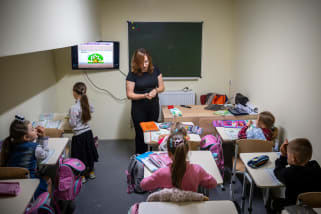
It starts with the schools — those that have not been damaged or destroyed. As Human Rights Watch and others have reported, every occupied region has been forced to adopt the Russian curriculum. Ukrainian textbooks have been removed and in many cases destroyed. Instruction is in Russian. Ukrainian history — including the country’s independence and the Maidan Revolution of 2013-14 — is dismissed as fiction or rewritten as a NATO-backed conspiracy. Patriotic lessons praising the Russian state are mandatory. Weekly ceremonies, flag-raisings and classroom “conversations about important things” mirror a nationwide Russian program that aims to instill loyalty to Moscow and normalize the invasion.
Teachers who refuse to collaborate can be fired, interrogated or replaced with educators brought in from Russia. Parents who try to keep their children enrolled in Ukrainian online schooling risk threats, fines or worse. Some families have been told their children cannot attend school unless at least one parent has a Russian passport.
To be clear, this is not the behavior of an occupying power managing a temporary military situation; it is the machinery of a state attempting to remake the identity of the children whose lives it controls.
Clinics and hospitals in occupied areas have been repurposed for military use, their supplies seized and access conditioned on the presentation of Russian documents. Many children are not receiving routine care, including lifesaving vaccines. Chronic diseases go unmana. A child with asthma or epilepsy living under occupation may find the nearest functioning clinic unavailable because of reduced capacity for civilian health care and political decisions that do not prioritize children’s health.
But the most chilling tactic is the forced relocation of Ukrainian children. The International Criminal Court has issued arrest warrants for Putin and Russia’s commissioner for children’s rights as war criminals for the unlawful deportation of Ukrainian minors into Russia.
More than 19,000 children have been identified as separated from their families, though the real number may be significantly higher, according to investigations by the Yale School of Public Health’s Humanitarian Research Lab. Some are placed in “summer camps” that function as reeducation centers. Others are adopted into Russian families and given new names, new documents and new identities. Fewer than 2,000 kidnapped Ukrainian children have been located and returned home. The trauma endured by those experiencing this identity erasure and by those around them is intense.
If Russia is allowed to consolidate control over these regions permanently, Ukrainian children in the occupied territories would be raised to believe they are Russian.
If Russia is allowed to consolidate control over these regions permanently, Ukrainian children in the occupied territories would be raised to believe they are Russian, taught to distrust their own country and in some cases trained toward future military service in the very army that invaded their homeland.
Over almost four years of conflict, my wife, Karen, and I have traveled to Ukraine many times as part of our work as co-founders of the Ukraine Children’s Action Project. We have been inspired by the bravery and resilience of young people who have endured systematic violence, displacement and trauma.
The United States and other Western nations must insist that no peace agreement ratify Russia’s claims to Ukrainian territory. To do otherwise would legitimize four years of documented war crimes, widespread destruction and a systematic assault on children’s rights, identity and well-being, prohibited under international humanitarian law.
Ukraine is a thriving democracy with the potential of becoming one of the most robust economies in Europe. That future depends on Ukraine securing its sovereignty, as well as protecting the identity, well-being and education of its children. They are Ukraine’s best hope for a prosperous future.
The post How the Trump-Putin peace plan puts more than 1 million Ukrainian children at risk appeared first on MS NOW.
This article was originally published on ms.now