
How anti-Israel rhetoric contributes to antisemitism and real-world violence
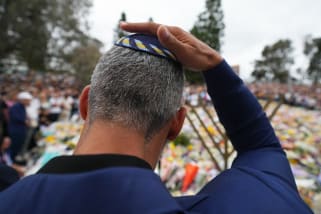
On Sunday, hundreds of Australian Jews gathered, as Jews have done for millennia, to light the Menorah on the first night of Hanukkah. At the same time, two armed men engaged in another historic custom: targeting Jews because they are Jews. Fifteen people were killed in the massacre at Bondi Beach, including a 10-year-old girl and an 87-year-old Holocaust survivor.
For Australia’s small but vibrant Jewish communities, this weekend’s tragedy was horrifying but, on some level, hardly surprising. Since the massacre of more than 1,000 Israelis on Oct. 7, 2023, antisemitic incidents in Australia have increased fivefold. Indeed, only two days after the worst mass murder of Jews since the Holocaust, a demonstration outside the world-famous Sydney Opera House led to chants of “F— the Jews.”
Since then, the litany of antisemitic incidents in the land Down Under will be all too familiar to Diaspora Jewish communities around the world.
For Australia’s small but vibrant Jewish communities, this weekend’s tragedy was horrifying but hardly surprising.
A synagogue was burned to the ground. Kosher restaurants were vandalized. Protests were launched at Jewish restaurants. A Jewish educational institution was spray-painted with antisemitic epithets, and swastikas showed up on the walls of local synagogues. That this unending cycle of intimidation, threats and provocation would eventually lead to violence should be a surprise to no one.
Indeed, why in the two years since the worst massacre of Jews since the Holocaust are Jewish communities in New York City, Manchester, London, Toronto, Los Angeles and Amsterdam under siege?
First, for more than two years, many anti-Israel activists have preached a message of “globalize the intifada” or “intifada revolution” and “from the river to the sea, Palestine will be free” — a statement that negates the existence of Israel. They’ve spoken of a “global struggle against Zionism,” be it in Israel or New York or Sydney.
Israel’s detractors will argue that such rhetoric is not antisemitism or even inflammatory. They will parse their language and claim that calls for an intifada are merely a demand that opposition to Israel should be globalized and that Western countries must end their support for Israel.
But the second intifada in Israel was a suicide bombing campaign that directly targeted Israeli civilians. Restaurants and nightclubs were attacked. A Passover Seder was targeted. Buses were destroyed. Thousands were killed and maimed.
Raising the specter of intifada and then arguing that such words do not provide a permission structure to those intent on violence is willful blindness.
The events at Bondi Beach were merely a logical extension of this inflammatory rhetoric — and as this language becomes normalized, the threats to Jews everywhere only increase.
Second, many pro-Palestine activists simply make no distinction between Israeli Jews waging war in Gaza and Jews in Diaspora communities around the world. For them, if you’re a Zionist (and the overwhelming majority of Jews identify as such), you are as guilty as the Israel Defense Force soldiers fighting in Gaza.
It’s why pro-Palestinian activists recently gathered outside a synagogue in New York’s Upper East Side, because of an event with an Israeli organization called Nefesh B’Nefesh that provides information to Jews interested in moving to Israel. Protesters claimed that the event was aimed at encouraging Jews to move to West Bank settlements, a claim that Nefesh B’Nefesh denies. But even if the protesters were correct, how does that justify chants such as “From New York to Gaza, globalize the intifada,” “Take another settler out” or “We need to make them scared”? And the city’s newly elected mayor, Zohran Mamdani, who has refused to condemn the term “globalize the intifada,” took great care to equally blame both those outside shouting antisemitic slogans and threatening congregants and those inside the synagogue.
Raising the specter of intifada and then arguing that such words do not provide a permission structure to those intent on violence is willful blindness.
It’s why any Jew who refuses to condemn Israel or deny their religious, cultural or tribal connection to the Jewish State will inevitably, at some point, be branded a supporter of genocide (and for those who don’t believe me, I invite them to check out my Twitter feed after this piece is published).
Whatever one’s view is on the war in Gaza, simply because one is Jewish, simply because one is a Zionist and simply because one feels a connection to Israel, does not make one culpable for Israel’s actions. But for many of the most radical voices in the pro-Palestinian activist community, a Jew believing that Jews should have the same right to self-determination as any other ethnic group is a scarlet letter.
It’s why antisemitic incidents have not just increased in Australia but practically everywhere Jews live. And it’s why Diaspora Jews feel increasingly under siege.
One might expect sympathy over this calamitous turn of events — and the vulnerability of minority Jewish communities — but instead, the opposite is true.
Indeed, for months Australia’s Jewish community warned about the increase in antisemitic incidents and potential for violence. They beseeched the government to take the issue more seriously. But to no avail.
Are American Jews at a similar inflection point? Polls routinely show that an overwhelming majority of American Jews feel less safe, particularly as antisemitic incidents continue to rise. Earlier this week, a Jewish man was allegedy attacked by two men on a crowded New York subway, shouting “F*** the Jews.” Antisemitic incidents in the city have dramatically increased since Oct. 7. But there are more subtle forms of antisemitism from the left that are growing increasingly mainstream.
Earlier this fall, the progressive hosts of “Pod Save America” gathered in Washington for their annual conference and included Hasan Piker as a speaker. Piker has, over the past two years, routinely attacked Orthodox Jews as “inbred,” denied that Israelis were sexually assaulted on Oct. 7 and suggested Zionism was synonymous with Nazism. If Piker had made similar derogatory comments about other members of a minority group or excused terrorism by those who target non-Israelis, it’s impossible to imagine a liberal-leaning group platforming him. But as Jews have learned since Oct. 7, the rules for them are different.
After the shooting at Bondi Beach, both Democratic and Republican politicians quickly condemned the tragedy and piously declared that antisemitism is bad and has no place in our society. These declarations have become the Jewish equivalent of “thoughts and prayers” after the latest mass shooting.
They are a tool for ritualistically condemning antisemitism without actually confronting the anti-Jewish hatred that increasingly finds a home within each political party and is particularly potent among young people.
Without action, without direct condemnation and the ostracizing of those who traffic in antisemitism — and without a recognition that a good amount of anti-Israeli rhetoric has morphed into anti-Jewish hatred — the bloodshed at Bondi Beach will be repeated. But next time, it could be much closer to home.
The post How anti-Israel rhetoric contributes to antisemitism and real-world violence appeared first on MS NOW.
This article was originally published on ms.now