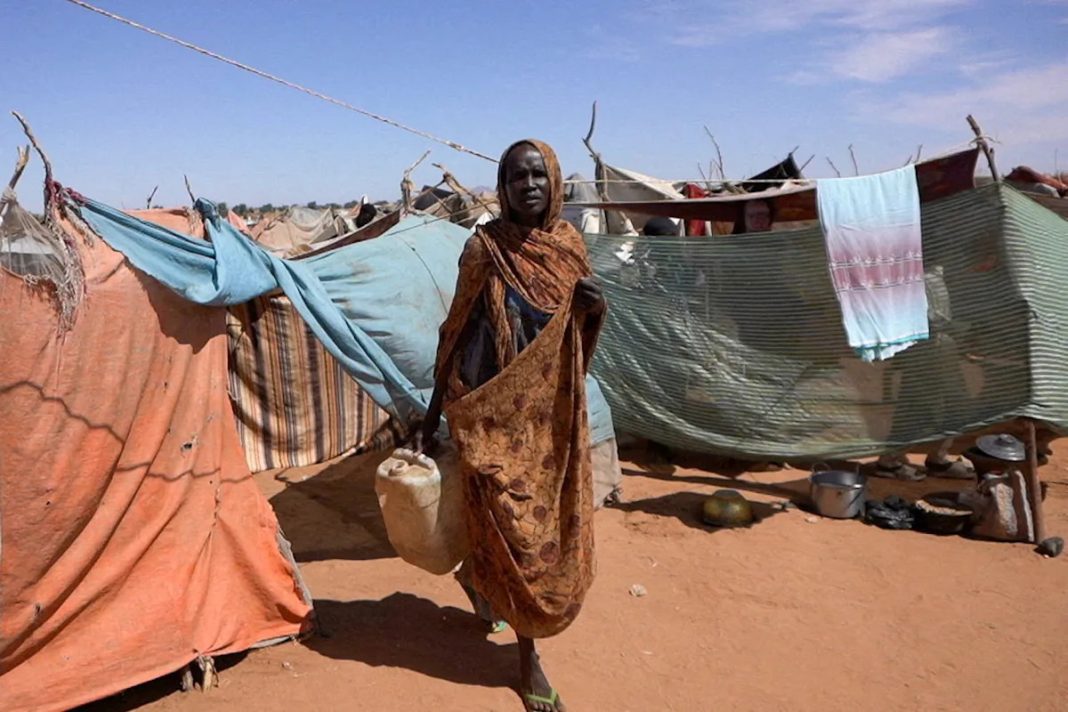

The European Union has launched an “air bridge” to bring eight planeloads of humanitarian aid into Sudan’s war-ravaged Darfur region.
The European Commission’s department overseeing overseas aid unveiled the measure on Monday and said the flights will carry 3.5 million euros ($4.1m) of “life-saving supplies” to the western region, where “mass atrocities, starvation and displacement” have left millions of people in urgent need.
The first flight left on Friday, delivering about 100 tonnes of aid from “EU humanitarian stockpiles and partner organisations”, the commission’s Directorate-General for European Civil Protection and Humanitarian Aid Operations said in a statement.
Further flights will continue throughout this month and January, it said, listing water, shelter materials, and sanitation, hygiene and health items among the supplies being transported to “one of the world’s hardest places for aid organisations to reach”.
It noted that the fall of North Darfur’s capital, el-Fasher, which was seized by the paramilitary Rapid Support Forces (RSF) in late October, marked a “major escalation of an already catastrophic humanitarian situation” and has made aid access even harder.
The RSF took control of el-Fasher after an 18-month siege that cut residents off from food, medicine and other critical supplies, prompting more than 100,000 people to flee, many to the town of Tawila, which has become the epicentre of the region’s spiralling humanitarian crisis.
Those who fled el-Fasher reported mass killings, kidnappings and widespread acts of sexual violence as the RSF raided the city. United Nations human rights chief Volker Turk accused the group of committing “the gravest of crimes”.
Growing fears of more atrocities
Sudan was plunged into chaos in April 2023 when a power struggle between the military and the RSF exploded into open fighting in the capital, Khartoum, and elsewhere in the country.
Since the RSF took control of el-Fasher, which was the military’s last stronghold in Darfur, fighting has moved eastwards to the Kordofan region as the RSF and its allies seek to take control of Sudan’s central corridor.
The paramilitary has now set its sights on Kadugli, the capital of South Kordofan State; Dilling, also in South Kordofan; and the North Kordofan State capital, el-Obeid. They lie on a north-south axis between the border with South Sudan and the national capital, Khartoum.
El-Obeid also lies on a key highway that connects Darfur to Khartoum, which the army recaptured in March.
The UN has repeatedly warned that the Kordofan region is in danger of witnessing a repeat of the atrocities that unfolded in el-Fasher.
With the RSF in control of all of Darfur’s major cities, Sudan in effect is split in two. The army holds the centre, east and north while the RSF and its allies control the west and parts of the south.