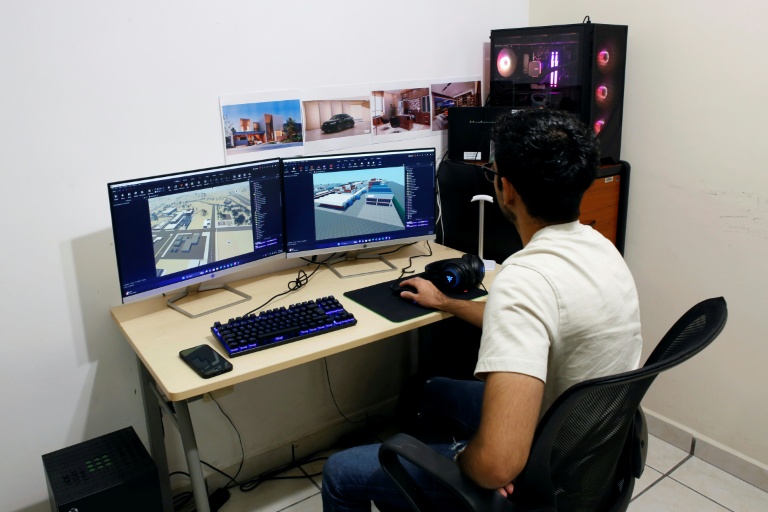

In violence-riddled Mexico, children as young as 13 are hooked on bloody video games that vividly recreate the horrors of the country’s narco war.
Some experts say it’s a way of coping. Critics, including President Claudia Sheinbaum, see it as monetized glorification of a genre known as “narco culture.”
With thousands of daily users, the games allow players to choose whether they want to be a cartel hitman, a police officer or a soldier.
There are wild chases and brutal shootouts, gold-plated pistols, personalized bulletproof helmets, and souped-up cars.
“It really draws me in, seeing things I’d like to have in real life — for example, who wouldn’t want to have a Lamborghini, or a big truck, a big house?” gaming fanatic Alan Crespo, a 24-year-old farmer from San Blas on Mexico’s Pacific coast, told AFP.
Crespo is on the older side of the player age spectrum, with most between 13 and 18 and hailing primarily from northern Mexican states like Sinaloa, Chihuahua and Baja California — synonymous with cartel violence.
This age group was born amid the wave of violence unleashed in 2006, when the Mexican government militarized the fight against drug trafficking — a strategy that has claimed nearly half a million lives.
– Hell’s Troop –
Dozens of war-like games can be found on online platform Roblox, which allows programming enthusiasts to design their own video games for others to play.
The most popular ones attract up to 1,000 users a day. The games are free, though players can purchase better weapons or uniforms with real money.
The more realistic and gruesome a game is, the more popular, developers say.
“Players aren’t interested in seeing made-up names of criminal groups,” said Angel Villaverde, a 19-year-old who designs games on his computer in Monterrey in Mexico’s northeast.
Users of the game “Tamaulipas Belico,” for example, can choose to play as a member of the Jalisco New Generation Cartel (CJNG) or of the Northeast Cartel (CDN).
Both have been designated “foreign terrorist organizations” by US President Donald Trump and are responsible for innumerable deaths, including of civilians.
Matches entail killing off one’s enemies to take control of buildings, usually gas stations or shops.
Opponents patrol in camouflaged army pickups or in vehicles decorated with a demon drawing and the number 666 — the insignia of the CDN’s Tropa del Infierno (Hell’s Troop) armed wing, known for its extreme brutality.
– ‘Apology for violence’ –
Mexico’s so-called “narco-culture” can also be found in music, films and fashion items glorifying the criminal life.
Sheinbaum rejects what she considers an “apology for violence” and has launched a campaign against the sub-culture, including an eight-percent tax on video games with violent content.
Behavioral scientists say that through gaming, young people may feel they have a sense of control over a violent reality that makes them anxious.
Student Alejandro Solorzano, 18, a game developer from Tijuana, notes that players are “fascinated by going around doing criminal activities.”
“It’s something warlike, it’s something grotesque, but it’s fictional at the same time” he told AFP.
Ainhoa Vasquez of Chile’s Federico Santa Maria Technical University, says gaming may also be a way of “making sense” of a violent society, of “transferring real anguish” to a fictional realm.
These experiences can be “a catharsis,” said Vasquez, who studies cultural representations of the drug trade.
The platform Roblox, which reported some 112 million daily users worldwide in the second quarter of this year, recently tightened its controls to protect minors.
Among other measures, it implemented a system to verify users’ ages to prevent harassment by adults on the platform.
str-ai/lp/mel/mlr/jgc