
By Ikechukwu Nnochiri
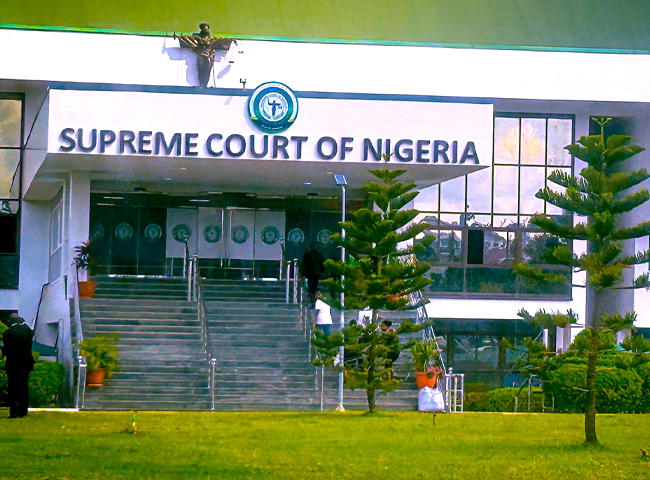
The Supreme Court, on Monday, affirmed the constitutional powers of the President to declare a state of emergency in any state of the federation to avert the breakdown of law and order.
A seven-member panel of the apex court, in a split decision of six-to-one, equally declined to fault the
suspension of elected officials in states under emergency rule.
However, it stressed that such suspension, though necessary to ensure that the prevailing situation in the state did not degenerate into chaos or anarchy, it must be confined to a limited period.
The judgement followed the dismissal of a suit that 11 states of the federation filed to challenge what they termed as President Bola Tinubu’s unconstitutional actions in Rivers State.
The states, which were controlled by the opposition Peoples Democratic Party, PDP, through their respective Attorneys-General, queried President Tinubu’s statutory powers to suspend a serving governor, the deputy governor, and members of the State House of Assembly, from office, after the proclamation of emergency rule.
They prayed the apex court to declare that based on provisions of sections 1(2), 5(2), and 305 of the 1999 Constitution, as amended, the president “has no powers whatsoever or vires to suspend a democratically elected governor and deputy governor of a state in the federation of Nigeria under the guise of or pursuant to the proclamation of a state of emergency in the state of the federation by the president, including the states of the federation represented by the plaintiffs.”
The plaintiffs equally prayed the court to declare that President Tinubu had no power to suspend a democratically elected House of Assembly of a state pursuant to Sections 192 (4) (6) and 305 of the Constitution of the Federal Republic of Nigeria 1999 (as amended).
As well as to declare that the suspension of Governor Siminalaye Fubara, his deputy and members of the Rivers State Assembly was unconstitutional, unlawful, illegal and utterly in gross violation of provisions of the 1999 Constitution, as amended.
Cited as 1st and 2nd defendants in the suit marked: SC/CV/329/2025, were the Attorney General of the Federation, AGF, and the National Assembly, NASS.
While deciding the case on Monday, the Supreme Court, in its majority judgement that was delivered by Justice Mohammed Idris, held that section 305 of the 1999, Constitution, as amended, imbued the president with the power to deploy extra ordinary measures with a view to restoring normalcy where emergency rule was declared.
It held that the said Section 305 was not specific on the nature of the extraordinary measures, thus, granting the President the discretion on how to proceed with any situation at hand.
Besides, the panel upheld preliminary objections the two filed to challenge the competence of the suit.
The apex court held that the plaintiffs failed to establish any cause of action that led to the activation of its original jurisdiction.
It maintained that the states failed to show that there was any actionable dispute between them and the federation to require the exercise of original jurisdiction by the Supreme Court.
More so, the panel stressed that the Supreme Court could only be called upon to adjudicate as a court of first instance, where there is a dispute between the federation and any state or states.
It held that the subject matter of the litigation did not qualify as a dispute between the federal government and any of the plaintiffs on record.
Consequently, it also dismissed the case for want of jurisdiction.
However, a member of the panel, Justice Obande Ogbuinya, gave a dissenting verdict.
Justice Ogbuinya held that upon his careful examination of the case of the plaintiffs, he was satisfied that it succeeded in part.
He held that though the president had the power to declare a state of emergency, however, he could not use such power as a tool to suspend elected officials of the state, including governors, deputy governors and members of the parliament.
Other members of the panel that distanced themselves from the minority judgement, were Justices Inyang Okoro, Chioma Nwosu-Iheme, Haruna Tsammani, Stephen Adah ans Habeeb Abiru.
It will be recalled that President Tinubu had on March 18, declared a state of emergency in Rivers state after he slammed governor Siminalayi Fubara, his deputy, and lawmakers in the state, with a six-month suspension.
President Tinubu appointed Vice Admiral Ibok-Ete Ibas to pilot affairs of the state within the period, as a Sole Administrator.
The president’s decisions received legislative backing from both the Senate and the House of Representatives.
Dissatisfied with the development, the PDP states lodged the case that was struck out on Monday.
The post Emergency rule: President can suspend elected officials – Supreme Court appeared first on Vanguard News.