
By Emmanuel Iheaka
Renowned industrialist and widely recognised Africa’s richest man, Aliko Dangote, seemed most prepared among participants at the Imo State Economic Summit held in Owerri on Thursday and Friday.
Clad in dark blue traditional kaftan-style outfit, loose-fitting and long-sleeved, with a matching embroidery patterned cap, and dark-framed glasses; Dangote walked up to the podium like one eager to make a transformational declaration. He did, of course.
As he commenced his speech, twice he suspected the microphone wasn’t working well, typical of one who never wanted any technical glitches to interrupt his message of hope to Imo. And twice he was assured and reassured by the hall filled to the brim that his voice was loud enough.
While previous speakers had dwelt more on eulogising Governor Hope Uzodimma and highlighting the need to explore the enormous investment opportunities in Imo State, Dangote opted to take the bull by the horn. Without much ado, he told Uzodimma, what a convener of such summit would want to hear, by offering the governor, whom he acknowledged has been a friend for decades, a blank cheque.
“We will be one of your biggest investors in Imo, so please tell me the area to invest and we will invest”, Dangote announced. With such offer coming from a man whose refinery is set to launch 1.4 million barrels per day capacity, the highest by any single refinery in the world; Uzodimma could not have wished for a better summit result.
Imo boasts of huge gas deposit, limestone, arable land for agriculture, and other minerals. The ball is therefore, now in Uzodimma’s court to direct Dangote to the area that would give the state the economic leap that had eluded it for nearly 50 years.
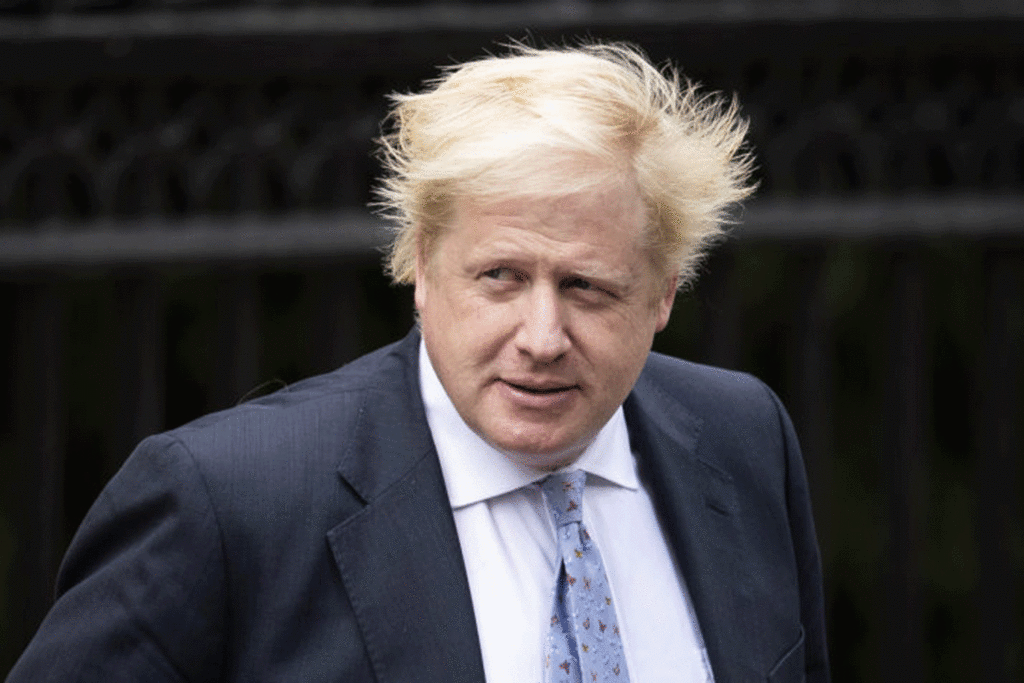
While Uzodimma was yet trying to contain his joy over Dangote’s gift, the former Prime Minister of United Kingdom, Boris Johnson took over the stage. Johnson appeared not to have come for any investment.
His overwhelming excitement and gratifying words portrayed a man who rather came to savour Imo, nay Nigeria, than bother about economic investment at the moment. Johnson, indeed, loves Nigeria deeply.
This, he confessed boldly. Though the erstwhile UK Prime Minister began with a story of how Nigeria has become the preferred destination for great investors, his admiration of Nigerians’ global excellence in various sectors such as economy, sports, entertainment, took the better part of his speech. He disclosed how happy he was when Uzodimma beckoned on him to come to Imo.
“When I decided to come to Owerri, I read some stuff and some people said there may be some security problems and I said, well I’m gonna go anyway, but we are here today in this conference and we are all feeling safe and secured, and I feel perfectly safe, thank you Governor Hope Uzodimma for what you are doing, there’s rule of law and safety on the streets of Owerri, absolutely and on infrastructure, that’s a fantastic job and your focus on electricity is absolutely right”, Johnson submitted.
It was more of an African summit than Imo, as many of the speakers projected that Africa will soon take over the economy of the world.
The President of Liberia, Joseph Boakai, was delighted to observe that his country shares cultural similarities with Imo State, in population size and production of palm oil. Boakai described Imo as an inspiration and highlighted the place of partnership and innovation in economic development of nations and Africa as a continent.
The president called for strong institutions and transparency in business regulation and processes, adding that such guarantee economic prosperity.
Erstwhile Secretary General of the United Nations, Ban Ki-moon stated that Africa needs technological support and emphasised the need for the world to switch fast from fossil fuel to green energy in order to save the climate. Ki-moon commended Uzodimma for his investments in energy, education, infrastructure, digitalisation and other sectors.
First female President of Mauritius, Ameenah Gurib-Fakim, described Nigeria as the power-house of talents and resources. Gurib-Fakim promised to drive to Imo investments in renewable energy and expressed optimism that Africa will soon become the world’s economic power.
President Bola Tinubu, represented by his vice, Kashim Shettima, lauded Uzodimma’s efforts in all sectors and pledged commitment to the industrialisation of Imo.
“The Igbo are geographically mobile, economically enterprising and educationally ambitious.
“This Nigerian nation is better with Ndigbo as part of the dispensation. Our duty as a government and as a people, is to give them the tools, the platforms and the competence to construct the platforms that await them.
“I dare say that Ndigbo are the greatest stakeholders in the Nigerian project. Half of Abuja is owned by Ndigbo. Half of the population of Lagos, is largely made up of Ndigbo.
“There is hardly any place in this country you will not see Ndigbo. If you don’t see them, you better run away from that place.
“The Federal Government stands ready to support Imo State, in this investment areas. Our role is to work with you, to unlock opportunities and to ensure that development gets to all communities.
“Imo is open for business. Nigeria is open for business. This government stands as your partner in progress”, Nigeria’s president assured. Earlier in his welcome address, Governor Hope Uzodimma said the unique and strategic location of the state comes with immeasurable commercial opportunities.
His words: “In the next two months, Imo State will be 50 years old. What this means is that it has come of age. It has witnessed unprecedented prosperity in these years.
“We have also produced the best entrepreneurs and entertainers all around Nigeria and the world. Yet the state that birthed these highly successful people is still grappling with challenges of primitive industrialisation.
“Our economy is still weak, largely agrarian, and underdeveloped. This explains why, in all these years, we could ill afford to host an economic and investment summit of this nature and calibre.
“Part of the problem is that, for nearly five decades, Imo State, like many Nigerian states, pursued development through a flawed model. “We attempted to incubate economic activity whilst standing on a foundation crippled by weak infrastructure, unreliable energy, and a land administration system so manual and prone to fraud that actively discouraged investment. That model was destined to fail, and it failed.
”So, when we came into office, we decided to go back to basics: to stop trying to do what the government cannot do well.
“To focus instead on what the government must do, and that is to create the perfect enabling environment for investment and development to thrive.
”I can proudly declare, without fear of contradiction, that almost six years down the road, the foundation for investment has been laid by providing basic safety nets, which embody infrastructure, power, security, and stability.”
While saying that infrastructure is the backbone of commerce, Uzodimma noted that his administration has constructed over 120 strategic and economically important roads and bridges that link the 27 local government areas and neighbouring states.
“But, like security, roads alone are not enough. You still need to address the single biggest bottleneck to industrialisation in Nigeria: power or energy, as some people prefer to call it”, he added.
If the potential gains of this summit are properly and thoroughly harnessed, then Uzodimma may be remembered as the economic liberator of Imo, a state presently taunted as one whose only industries are hotels situated at the average of one per half kilometre in Owerri, its capital.
The post Economic Summit: Boris Johnson declares Nigeria safe as Dangote’s open cheque raises hope for Imo appeared first on Vanguard News.