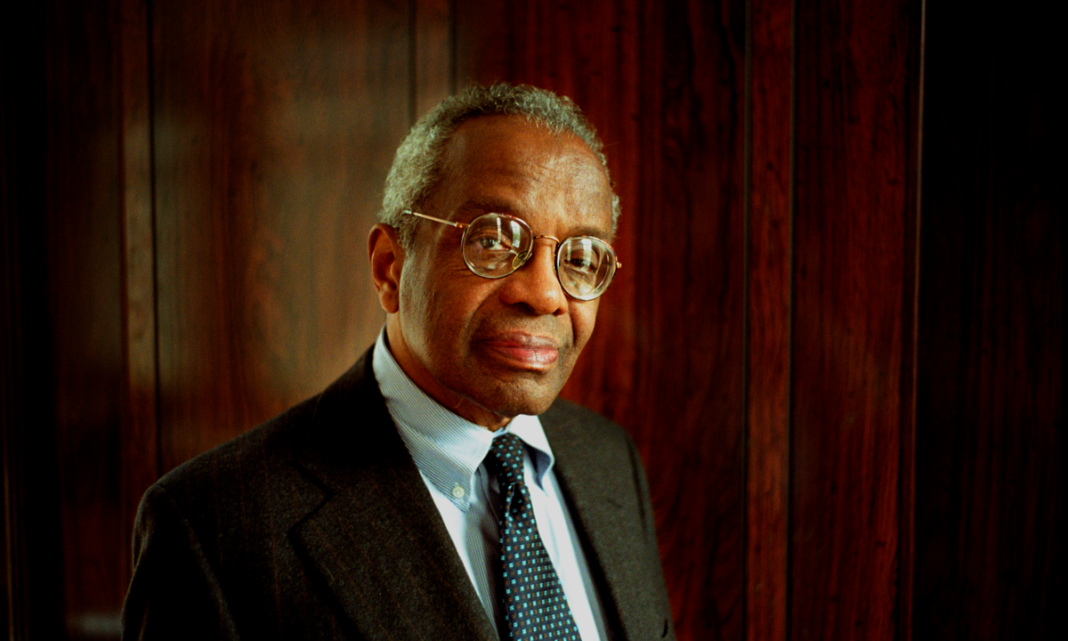

School choice — the idea that American education would function more efficiently and effectively if parents received public funding to send their children to private and religious schools — is commonly traced to an influential essay written in 1955 by conservative economist and Nobel laureate Milton Friedman. It has provoked animated debate between adversaries on the political right and the political left ever since. Less well known is that school choice also has roots in the work of Derrick Bell, considered by many the father of critical race theory.
In 1971, Derrick Bell became the first Black man to be awarded tenure at Harvard Law School. As part of his teaching load, he developed a civil rights course that focused on race. In order to meet its topical requirements, Bell wrote an accompanying textbook, Race, Racism and American Law, which is foundational in critical race theory. It holds that racism is an ordinary and permanent feature of American society. His claim was viewed by many colleagues at the time as a radical statement, and it remains so for many today. Yet, it carries forward a certain truth that the history of school choice persuasively illustrates.
Get stories like this delivered straight to your inbox. Sign up for The 74 Newsletter
Having served as a federal attorney litigating desegregation cases, Bell had grown skeptical about forced racial integration and whether it would actually improve student learning. The original edition of his 1973 textbook included a chapter outlining “Alternatives to Integrated Schools” by which “black children might receive the long-promised equal educational opportunity — in predominantly black schools.” The chapter included a discussion of tuition vouchers.
Bell argued that for vouchers to work, poor families would need to receive substantially larger grants than the more fortunate. He also mentioned “free schools.” These were small, private institutions in poor areas supported by foundation grants, fundraising and, sometimes, public dollars. Tuition was charged on a sliding scale, and students whose parents could not pay attended for free. Many of these schools began “deep in the black community.” For example, Bell mentioned a system of schools operated by the Black Muslims that emphasized racial pride, self-discipline and self–sufficiency. He explained that such virtues are not commonly celebrated in the neighborhood public schools Black students attended. He pointed out that students at the Muslim schools performed several grade levels above most Black teenagers who attended public schools.
As States Limit Black History Lessons, Philly Gets it Right, Researcher Says
Bell saw school choice as the culmination of a series of disappointments in the fight for educational equality. He understood it as a dramatic manifestation of the ways the Black community was losing confidence in its public schools. After numerous false starts to achieve desegregation and equalized funding, many Black activists turned to demands for community control. In 1968, a group of local parents and residents in Brooklyn’s Ocean Hill-Brownsville neighborhood wrested local control of their school board. When a similar eruption took place in Milwaukee in 1988, those involved issued a call to action — commonly referred to as the Milwaukee Manifesto — demanding that the state allow them to establish an independent school district.
To lend a helping hand, Bell traveled to Milwaukee and wrote an op-ed for the Milwaukee Journal. Published under the headline “Control Not Color: The Real Issue in the Milwaukee Manifesto,” it took issue with the better-off liberal activists who condemned the plan. “Can we whose children are not required to attend the inner-city schools honestly condemn the Manifesto writers and their supporters?” Bell wrote. “After all, when middle-class parents — black and white — lose faith in the administration of a public school, we move to another school district or place our children in private schools. Inner-city black parents who can’t afford our options seek as a group a legislative remedy that may after a long struggle enable them to do what we achieve independently by virtue of our higher economic status.”
Soon after, in 1990, the same Black activists in Milwaukee joined forces with their white Republican governor, Tommy Thompson, and his conservative legislative colleagues to pass the nation’s first school voucher law. The original Wisconsin vouchers were targeted at low-income students stuck in chronically failing public schools. Five years later, Wisconsin became the first state to expand its voucher program to include religious schools.
Bell revisited the topic of school choice in Silent Covenants (2004). By then, vouchers had been adopted in Cleveland and Washington, D.C., among other places. He acknowledged that vouchers were “probably the most controversial of educational alternatives to emerge in the last decade,” but that they were also growing in popularity. He understood that many opponents were liberal Democrats with long histories of civil rights activism. These critics alleged that minority parents were being duped, that the real beneficiaries of such programs were private religious schools gaining enrollment.
Bell recognized these criticisms but was also sympathetic to arguments by free-market advocates who believed that the competition fostered by choice would incentivize floundering public schools in Black communities to improve. He did not deny that the Catholic Church had become a major player in the choice movement to address its own declining school enrollments. But Bell was more impressed with how many Black and Hispanic parents chose Catholic schools over public schools because of their more disciplined learning environments and better academic outcomes. He cited one particular Catholic school in Milwaukee, where 80% of the students were not Catholic and the voucher covered most of the tuition.
Silent Covenants also delves into the topic of charter schools. Bell lauded them as innovative institutions that give options to all students, not just the wealthy who can afford private school tuition. He rejected claims by liberals that the institutions would become bastions for middle-class families who were better prepared to work the system, citing evidence that two-thirds of charter students nationwide were nonwhite and more than half were from low-income families. Critics had also raised concerns that charter schools would discriminate, become racially isolated and drain resources from regular public schools. Bell, unmoved by these claims, was more concerned that charters were receiving 15% less funding than other public schools.
‘You’re Debating Someone Else’s Child’: 30 Years Later, Milwaukee’s School Voucher Program Divides a City Whose Public Schools Struggle
Now, 30 years after the Milwaukee breakthrough, the school choice movement has taken off in a new direction. Republicans who once allied with Black advocates to demand better options for low-income students now rally behind appeals for universal choice, which provides such benefits to all students regardless of family income. Eighteen states have enacted such programs. When awards do not cover the entire cost of tuition, they end up subsidizing better-off families and neglecting those unable to make up the difference. As demands for private and religious schools grow, so does the competition for seats and the incentive to raise tuition. Yielding larger numbers of applications from a stronger pool of students, these initiatives can function more to enhance the choices available to school admissions officers than the most needy students.
A law that President Donald Trump signed this year allows a tax deduction of up to $1,700 for anyone who donates to an organization that gives scholarships for students to attend private or religious schools. Like the state-level universal choice programs, the federal initiative does not target low-income students. Assistance will be available to any family whose income is below 300% of the average for their area.
Here is the underlying political irony to the choice debate: For years, when programs were designed to help the most vulnerable students, the major opponents were activists who historically have identified with progressive causes. Now, conservatives are spending with abandon — in many cases, with limited public accountability — on programs that can create opportunities for students who need them the least. In either case, those who get hurt remain the same, and they are disproportionately under-resourced students of color. Derrick Bell would not be surprised.
Red States’ School Vouchers Mark Biggest Shift in U.S. Education in a Century
In 1980, Bell wrote an article for the Harvard Law Review advancing a concept referred to in the scholarly literature as the “interest convergence dilemma” that is fundamental to critical race theory. It holds, “The interest of blacks in achieving racial equality will be accommodated only when it converges with the interests of whites.” Not very trusting of white collaborators hailing from either the left or right, it deems political alliances temporary and subject to the competing priorities of all pertinent parties, anticipating eventual abandonment.
And so, that’s the way it is.