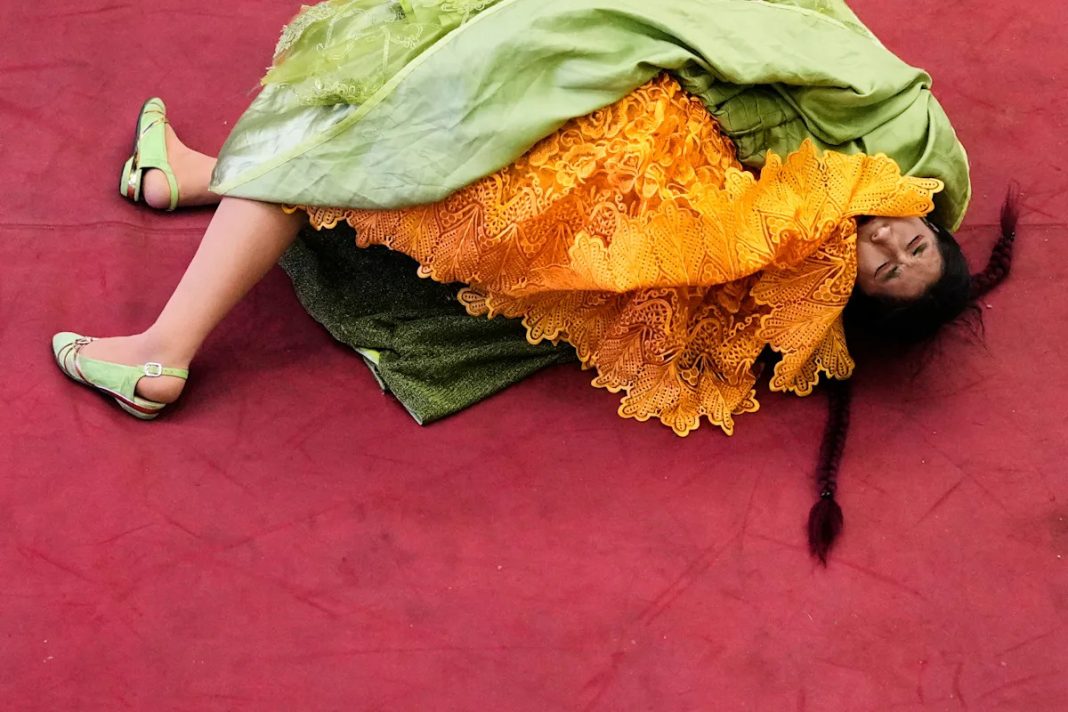

LA PAZ, Bolivia (AP) — Before setting out for the wide, white mountain, Ana Lia González Maguiña took stock of her gear: A chunky sweater to guard against the chill. A harness and climbing rope to scale the 6,000-meter summit of one of Bolivia’s tallest mountains. Aviator glasses to protect from the bright highland sun.
And most crucially, a voluminous, hot-pink skirt.
The bell skirt with layered petticoats — known as the “pollera” (pronounced po-YEH-rah) — is the traditional dress of Indigenous women in Bolivia’s highlands. Imposed centuries ago by Spanish colonizers, the old-fashioned pollera has long since been restyled with local, richly patterned fabrics and reclaimed as a source of pride and badge of identity here in the region’s only Indigenous-majority country.
Rather than seeing the unwieldy skirt as a hindrance to physically demanding work in male-dominated fields, Andean Indigenous women, called “cholitas,” insist that their unwillingness to conform with contemporary style comes at no cost to their comfort or capabilities.
“Our sport is demanding, it’s super tough. So doing it in pollera represents that strength, it’s about valuing our roots,” said González Maguiña, 40, a professional mountain climber standing before the snow-covered Huayna Potosi peak, just north of La Paz, Bolivia’s administrative capital. “It’s not for show.”
Skirt-clad miners, skaters, climbers, soccer players and wrestlers across Bolivia echoed that sentiment in interviews, portraying their adoption of polleras for all professional and physical purposes as an act of empowerment.
“We, women in polleras, want to keep moving forward,” said Macaria Alejandro, a 48-year-old miner in Bolivia’s western state of Oruro, her pollera smeared with the dirt and dust of a day toiling underground. “I work like this and wear this for my children.”
But many also described the current moment as one of uncertainty for pollera-wearing women in Bolivia under the country’s first conservative government in nearly two decades.
Center-right President Rodrigo Paz entered office last month as Bolivia’s economy burned, ending a long era of governance shaped by the charismatic Evo Morales (2006-2019), Bolivia’s first Indigenous president who prioritized Indigenous and rural populations in a country that had been run for centuries by a largely white elite.
Through a new constitution, Morales changed the nation’s name from the Republic of Bolivia to the Plurinational State of Bolivia and adopted the Indigenous symbol of the wiphala — a checkerboard of bright colors — as an emblem equivalent to the national flag. For the first time, pollera-wearing ministers and officials walked the halls of power.
But disillusionment with Morales’ Movement Toward Socialism party grew, especially under his erstwhile ally ex-President Luis Arce, who was arrested earlier this month on allegations that he siphoned off cash from a state fund meant to support Indigenous communities.
Some cholitas now wonder how far that change will go and fear it could extend to their hard-won rights despite Paz’s promises to the contrary.
They describe feeling neglected by a government with no Indigenous members. They worry about the implications of the army last month removing Indigenous symbols from its logo and the government deciding to stop flying the wiphala from the presidential palace, as was long the tradition.
“I feel like the government won’t take us into account,” said Alejandro, the miner. “We needed a change. The economy must get better. But it’s sad to see there are no powerful people wearing polleras. I see it as discrimination.”
But González Maguiña said she still had hope, given how far Indigenous women had come.
“We already have the strength and everything that comes with it,” she said. “We’re certainly going to knock on the doors of this new government.”
___
Follow AP’s coverage of Latin America and the Caribbean at https://apnews.com/hub/latin-america