
The United States and China are locked in a fierce competition — over trade, technology and influence. Both nations insist they can peacefully coexist. And perhaps, as with the U.S. and the Soviet Union during the Cold War, a direct military clash can be avoided.
But make no mistake: This is not simply an economic rivalry. It is a contest between two fundamentally different visions of humanity — one rooted in freedom, the other in control. Nowhere is that contrast clearer than in how each nation treats religion.
America’s story begins with people fleeing religious persecution. Its founders understood that without freedom of belief all other freedoms are hollow. That’s why, 250 years ago, they enshrined freedom of religion, and the separation of church and state, in the Constitution. It remains a foundation on which all our liberties rest.
China’s story could not be more different. Seventy-five years ago, the Chinese Communist Party established the People’s Republic of China in the image of the Soviet Union — an atheistic state that viewed religion as a threat.
While China’s model has adapted far beyond the old Soviet model, the party’s obsession with control has not changed. And the result is an ongoing tragedy.
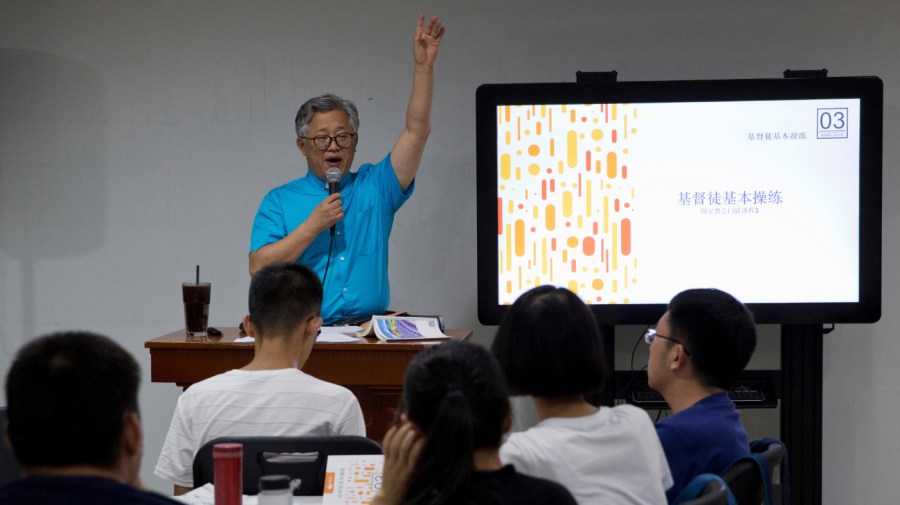
In October, Chinese authorities arrested more than 30 pastors and parishioners from the Zion Church network, simply for attending a Christian church. Most churches in China must operate underground, hiding from authorities to avoid harassment, imprisonment or worse. Even owning a Bible can invite punishment.
Tibetan Buddhists, Muslim Uyghurs and other religious practitioners suffer the same fate, imprisoned by the thousands merely because their faith points to a power higher than the Communist Party.
The CCP’s persecution doesn’t stop at its borders. It reaches across the globe, targeting exiled believers and their families abroad. Even those in America and elsewhere who speak out against repression often face intimidation, surveillance or threats to their loved ones back home. This transnational repression aims to silence criticism everywhere — even here in the United States.
Whether inside the PRC or outside, the stories are harrowing — families torn apart, holy sites destroyed, believers jailed for praying. Yet amid the darkness, their resilience shines. From underground Christian house churches to Tibetan monasteries and Uyghur mosques, faith persists despite the CCP’s efforts to erase it.
This struggle matters to all of us. More than 70 percent of Americans identify with a religion. If the world’s most powerful country ignores the CCP’s war on faith, it risks normalizing oppression and eroding the very freedoms we hold dear.
Freedom of religion is not just an American ideal; it’s a universal one. When a regime that governs nearly 20 percent of humanity seeks to stamp it out, it weakens freedom everywhere.
The U.S. and its allies must lead, not only by calling out these abuses, but by standing with those who suffer for their beliefs. Religious leaders should speak out, journalists should report on these abuses, government officials should ensure that human rights remain central to China policy, and all citizens — people of all faiths and none — should refuse to look away.
In defending the right to believe, we defend the very idea of freedom itself.
Adam J. King is the regional director for East Asia and Pacific at the International Republican Institute, a nonprofit, nonpartisan organization dedicated to promoting freedom and democracy worldwide.
Copyright 2025 Nexstar Media, Inc. All rights reserved. This material may not be published, broadcast, rewritten, or redistributed.
For the latest news, weather, sports, and streaming video, head to The Hill.