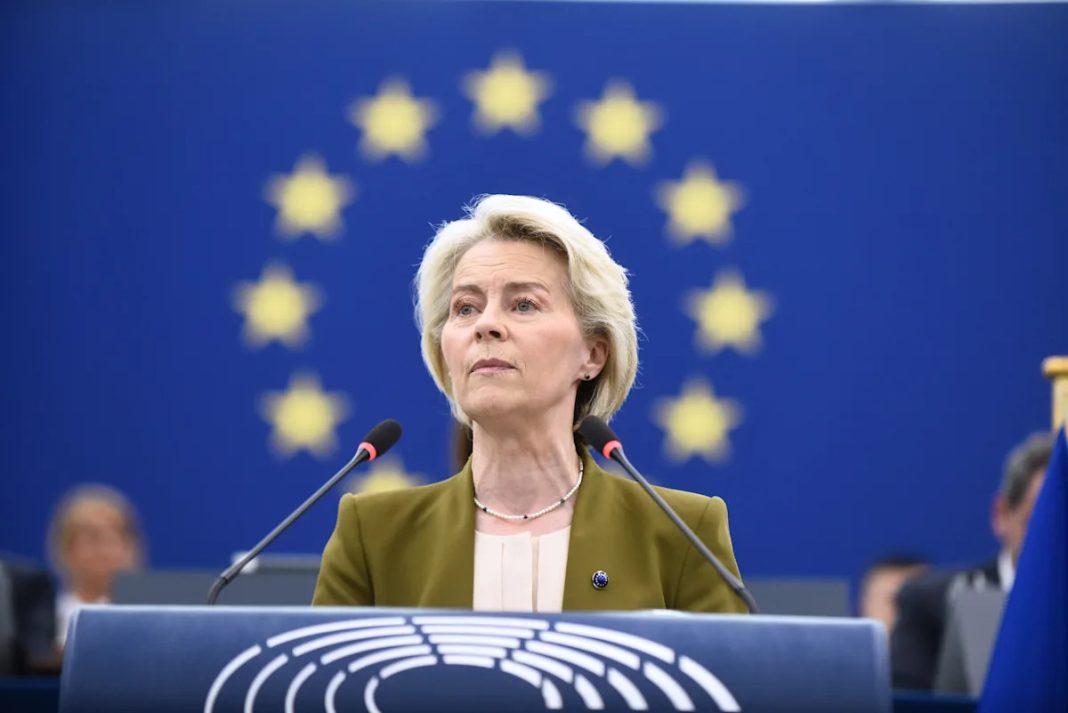

Only a few days ago,President Donald Trump lashed out at Europe in an interview with POLITICO as a “decaying” group of countries with “weak” leaders. In public at least, it didn’t ruffle European Commission President Ursula von der Leyen.
“I have always had a very good working relationship with the presidents of the United States, and this is also the case today,” von der Leyen said in an interview at this year’s POLITICO 28 event. “From the bottom of my heart, I’m a convinced transatlanticist.”
Now in her second term leading the EU’s lawmaking body, von der Leyen also acknowledged that Europe’s relationship with the United States is in flux, and not just because of Trump.
“Of course, our relationship to the United States has changed. Why? Because we are changing,” she said. “And this is so important that we keep in mind: What is our position? What is our strength? Let’s work on these. Let’s take pride in that. Let’s stand up for a unified Europe.”
The question of European unity is front of mind as Russia’s war on Ukraine grinds on and Trump pushes harder for Ukrainian President Volodymyr Zelenskyy to accept a peace deal.
In her interview with POLITICO, von der Leyen emphasized the need for a “just and lasting peace” with real security guarantees. “This peace agreement should be such a solid peace agreement that it does not sow the seeds for the next conflict immediately,” she said.
The Russian threat also goes beyond Ukraine, of course. How long until Europe is fully able to defend itself? “That’s a good question,” von der Leyen said. “We have not the luxury of time.”
This conversation has been edited for length and clarity.
I want to start with a question very much on the minds of the people in this room: Will there be a funding agreement by next week for Ukraine to keep the fight up against Russia?
We’re working intensively towards a just and lasting peace. And I emphasize “just and lasting” because this peace agreement should be such a solid peace agreement that it does not sow the seeds for the next conflict immediately.
The negotiations about the agreement are moving forward. That is good, and the 20-point plan is taking more and more shape. I think the most difficult topics are, on one hand, the territories, and this is something which can only be decided by President Zelenskyy and the people of Ukraine.
The second most important topic is the security guarantees. These have to be very robust security guarantees. As I said, they have to make sure that there is lasting peace. And we always speak about the “steel porcupine” that Ukraine has to be so that it is indigestible for any potential invader.
The third topic is the immobilized Russian assets, which we are working intensively on to make sure that we can take the cash balances, and then to Ukraine as a loan, for financing for Ukraine for the next two years. And Ukraine only has to pay back these loans if Russia pays reparations.
We’re going a step forward now tomorrow, for the first step in dealing with this topic, that we will secure the immobilization of the Russian assets, which is an important point because we need the certainty that these Russian assets will work for the reconstruction of the reparation of Ukraine.
This development, does that mean that we’ll see something around the assets? Not looking to the plan B or C of eurobonds — that your focus right now is on using those assets, and that’s what you’re pushing towards?
The first step that we are going to take, hopefully tomorrow, is indeed to secure the immobilization. That is very important. But so far, the Russian assets were immobilized for six months, and every six months we had to renew this immobilization by unanimity. There’s quite a risk that all of a sudden these assets are gone, and therefore the step tomorrow is to make sure that we secure these assets so that the cash balances can work for Ukraine, can fund Ukraine and can be invested in the reconstruction.
A second step is, then, how are we going to use these cash balances? And indeed, as you said, the financing of Ukraine. This is going to be decided in the following week at the European Council.
We have quite advanced, very innovative, qualified majority voting that we have to do there. We have to take into account — and we are working intensively — in dividing or distributing the risks that go along with that. At the moment, Belgium is carrying on broad shoulders the whole of the European Union [as it holds a financial depository with more than $150 billion in frozen Russian assets Europe would like to seize]. But this is the second step.
What’s your level of confidence right now that Belgium will come around?
It is day and night with Belgium, I must say, it is a very constructive work. This is not trivial. This is absolutely innovative. It’s never happened before.
Of course, we understand the concerns of Belgium, and it’s just intense work. I think we’ve advanced quite a lot already, taken in their concerns and respected them in the proposal. But the next days will show whether we come to a final agreement.
Let me ask you, the European leaders, if you fail to reach an agreement next week, do you worry that President Zelenskyy in Ukraine will be forced into accepting a peace deal? Or some sort of peace deal that is not favorable to them?
I think it is extremely important, as I said, that this peace agreement does not sow the seeds for the next conflict. I mean, we’ve seen this in 2014. We’ve seen that the peace agreement and the security guarantees were not holding, were not robust enough, and that the peace agreement was only giving time for Russia to regroup, to reorganize, and the next invasion then came in 2022.
This time, it is of utmost importance that this peace agreement is for just and lasting peace. Here, the security guarantees play an enormous role.
You started your most recent State of the European Union speech on a pretty urgent note, saying Europe is in a fight. You also asked whether Europe had the stomach for the fight and the political will to compromise. You’re now three months on. It’s been a pretty eventful, some would say pretty tough, three months trying to get to a place where you can keep Ukraine in the fight. I’m wondering, are your fellow European leaders falling short of what you think this moment demands?
No. The opposite is the case. I mean, if you just go one step backwards and look at the overall picture of the six years now that I’m in office, it started with a pandemic.
The pandemic was barely over. We had, in 2022, the invasion of Russia in Ukraine, a severe energy crisis followed, and now we are really focusing laser-sharp on improving our competitiveness. We have to have a huge surge in defense we are working on and we have to reduce our dependency. So it’s a whole program. And here, I must say, the leaders for all of us, it’s very clear. None of these challenges or none of these crises could have been managed by a member state on its own.
But at 27 — that’s the fantastic part about the European Union. At 27, we can move mountains. We have proven this with the vaccines. We have proven this with the energy crisis.
We are working together intensively on the capital market now to improve our competitiveness, innovation, digitalization, all these topics. At 27, we can move mountains.
On Ukraine itself, though—
Ah, your question was focused on Ukraine.
I was focused on Ukraine. And how would you explain this inability to get to this point? We had Mark Rutte today with pretty urgent words as well, that Europe needs to prepare for a war with Russia. Do you agree, that this continent is on the cusp of that?
Looking at Ukraine, Russia invaded Ukraine in February 2022 with a goal to take Kiev in three days and Ukraine in three weeks. Putin completely failed.
Now we are in the fourth year, and in the last 12 months, he advanced by 1 percent, 1 percent only, of the territory. We are in the fourth year of a war of attrition. He’s maneuvered himself in Ukraine, which had no defense at the very beginning, has withstood thanks to the bravery and the courage of the people, but also the ingenuity, the innovative spirit and the support of the European Union.
Because Europe, of all these years, has supported Ukraine financially: 185 billion euros, 66 billion of this is military support. It is amazing to see how this country was able to withstand — and the unity of the European Union. We should not forget. I mean, it’s Russia that invaded Ukraine, and the war will be over at the moment Russia stops fighting.
On that issue of defense readiness, I’m wondering: You’ve warned that Europe is not quite prepared for the security environment it faces. Obviously, you’re doing a lot with things to move to that place. I’m wondering how many years it will take for Europe to be fully capable of defending itself.
That’s a good question. We have not the luxury of time.
How much time do we have?
As we cannot foresee in the future what will happen, I can only say we have an enormous urgency, and we have to be faster and faster and faster.
I mean, if you look at the last year when it comes to defense. During the last year, more has happened than during the last decades in the European Union. For the first time ever, we have a full time commissioner for defense. For the first time ever, we have a white book. But I think even more important is the financing. If you look at the last decade, 8 billion have been invested in defense on the European level. During the last year, we enabled an investment, a surge of defense investment of 800 billion until 2030. And I think the most successful is the 150 billion of the SAFE instrument. It is so oversubscribed by the member states that some are calling for a second SAFE instrument.
So all this, you’re right. We do it with an enormous sense of urgency, not only for defense, but because we know it is about our freedom, it is about our prosperity, and it is about our democracy that we have to defend.
I do want to turn my gaze back to the United States just a bit, and ask you a question. To bring up our interview with Donald Trump and also the National Security Strategy that was released last week.
Donald Trump and his National Security Strategy, part of it is to say that the policy of the United States is now to “cultivate resistance” on this continent to the EU. How do you respond to what is now U.S. policy towards the EU?
Look, in general, it is not on us when it comes to elections, to decide who the leader of the country will be, but on the people of this country. That’s very clear. That’s the sovereignty of the voters, and this must be protected.
This is one of the reasons, for example, why we have proposed democracy shield now, because this is a phenomenon that we see all over the place — that we really have to shield our democracy and make sure that elections are fair and free. That’s the crown jewel of our democracies. In general, for anybody, it’s the voters who decide who is the leader, and nobody else is supposed to interfere, without any question.
It’s kind of remarkable to talk about the democracy’s shield when I ask a question about the United States. How does that sit with you? Hearing what you’ve heard this past week, the critique of the leaders of this continent.
You know what? I have always had a very good working relationship with the presidents of the United States, and this is also the case today. From the bottom of my heart, I’m a convinced transatlanticist.
But, what is so important? Important is that we position ourselves, that we take pride in being the European Union, that we look on our strength and that we deal with the challenges that we do have. If we keep this in mind, of course, our relationship to the United States has changed. Why? Because we are changing. And this is so important that we keep in mind: What is our position? What is our strength? Let’s work on these. Let’s take pride in that. Let’s stand up for a unified Europe. This is our task, and not always in the mirror of others, but look at ourselves and be proud of ourselves.
I do want to ask you before we move on, just look ahead to 2026. What is the one thing that you absolutely want the Commission to deliver on next year?
Well, if I would not be serious, I would say I would love it if the Commission enables it so that I have a little bit more sleep.
On a very serious note, if you ask about the Commission, then as the guardian of the treaty, it is competitiveness, prosperity, democracy. But if you look at the wider topic there, from the bottom of my heart, I am wishing for peace, peace in Ukraine. I often think of these poor people, for four years now, every day, every night, this harassment and this terror that they experience and the incredibly steadfastness that these people have proven. So peace is what I’m wishing for in 2026.