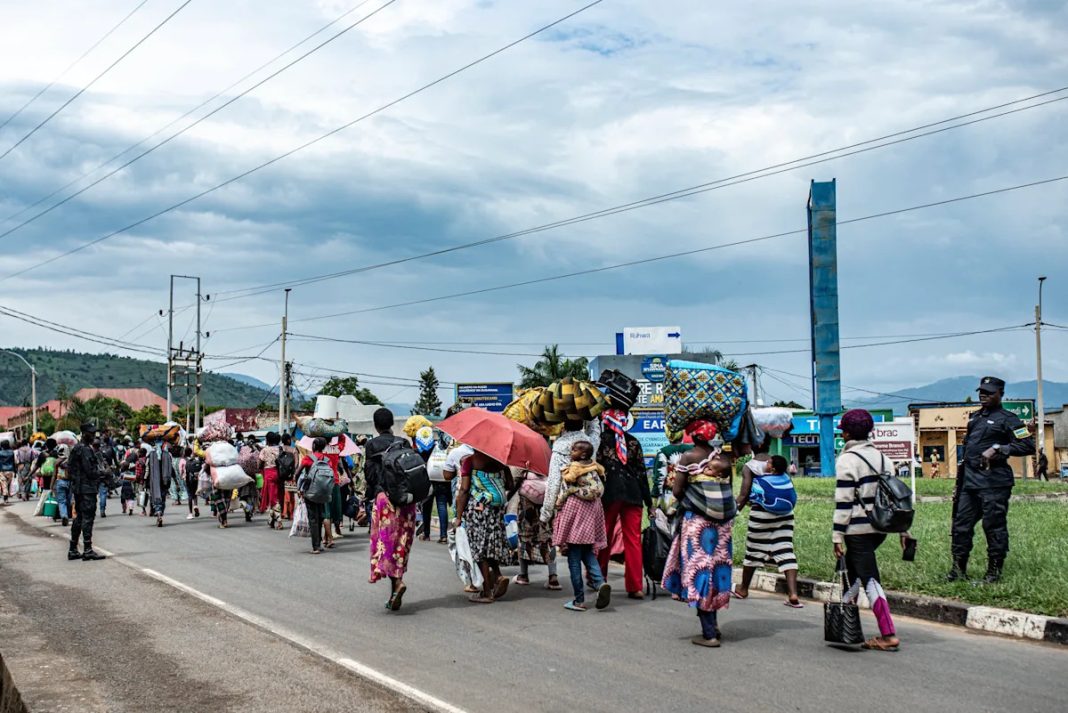

About 200,000 people have fled their homes in the eastern Democratic Republic of the Congo (DRC) in recent days, the United Nations says, as Rwanda-backed rebels swarm a strategic town just days after a United States-led peace effort, which now appears under severe threat.
The M23 armed group pushed into the outskirts of the strategic city of Uvira in South Kivu province on Tuesday, local authorities said, as part of a new offensive in which at least 74 people had been killed, according to the UN.
The latest fighting comes despite a US-mediated peace agreement signed last week by the Congolese and Rwandan presidents in Washington, DC. The accord did not include the rebels, who are negotiating separately with the DRC and agreed earlier this year to a ceasefire that both sides accuse each other of violating, but it obliges Rwanda to halt support for armed groups.
Despite the renewed fighting just beginning on Monday, the M23 has managed to capture several strongholds, including Uvira now, “a big gain”, said Al Jazeera’s Alain Uaykani, reporting from Goma, the biggest city in the eastern DRC.
Uvira has not just been a military base but also the administrative place for the government since they were chased out from the town of Bukavu in January, he said.
“So it was almost like a stronghold of the government position, from where they reorganised themselves,” Uaykani said, adding that it was also a place the government was hoping to chase out the rebels from.
“There is no DRC army in sight because the majority of them took the boat yesterday to cross into the neighbouring province of Tanganyika, and the majority of them are still making their way forward,” he added.
Gunshots were heard in the morning in the key city, and the army looted the governor’s office while leaving the town, Uaykani said.
Uvira is a strategic site because the city borders Burundi, and the Burundian army has been supporting the DRC for the last two years, he explained.
The M23 group is battling Congolese troops and other local groups, known as Wazalendo, in villages north of Uvira.
Marafiki Masimango, a representative of Uvira civil society, said late on Tuesday that rebels were pushing south into South Kivu. He said residents were panicked.
A senior Congolese army officer also confirmed to The Associated Press news agency that soldiers were fleeing the rebel offensive and heading south and east towards Burundi.
Corneille Nangaa, leader of the Alliance Fleuve Congo (AFC) rebel coalition, urged fleeing soldiers not to abandon the town.
“You are Congolese … and Wazalendo soldiers. Do not flee Uvira. Wait for us to free you,” said Nangaa of the AFC, a broad coalition of which M23 is a part.
Back to the negotiating table?
In Washington, DC, the International Contact Group for the Great Lakes (ICG), an informal monitoring group of several countries, including the US and the European Union, late on Tuesday voiced “profound concern” over the renewed violence, the ICG said in a joint statement.
It said the new M23 rebel offensive “has a destabilising potential for the whole region”.
Despite the group’s intention to advance on Uvira, M23 leader Bertrand Bisimwa reiterated the group’s support for Qatari-led peace talks in Doha, where representatives from the two sides signed a framework agreement last month for a peace deal aimed at ending fighting in the eastern DRC.
“Even if we counterattack, we said that there are no other solutions in the current crisis than the negotiating table, and we want to bring Kinshasa to the negotiating table,” Bisimwa said.
Rwanda denies supporting the rebels in the DRC, although Washington and the UN say evidence of Rwandan backing is clear. Before the latest surge in fighting, the conflict had already displaced at least 1.2 million people.
In a speech to lawmakers on Monday, DRC President Felix Tshisekedi accused Rwanda of violating the commitments it made in the US.
A senior Trump administration official said Washington was monitoring the situation, working with the DRC and Rwanda, and that “the president has made clear to both sides that implementation is what he will judge, and as he stated, he is expecting immediate results”.