
By Bayo Wahab
Nigeria’s military operation in the Benin Republic, following Sunday’s failed coup attempt, has sparked questions among Nigerians about whether President Bola Tinubu had the legal right to deploy fighter jets into a neighbouring country.
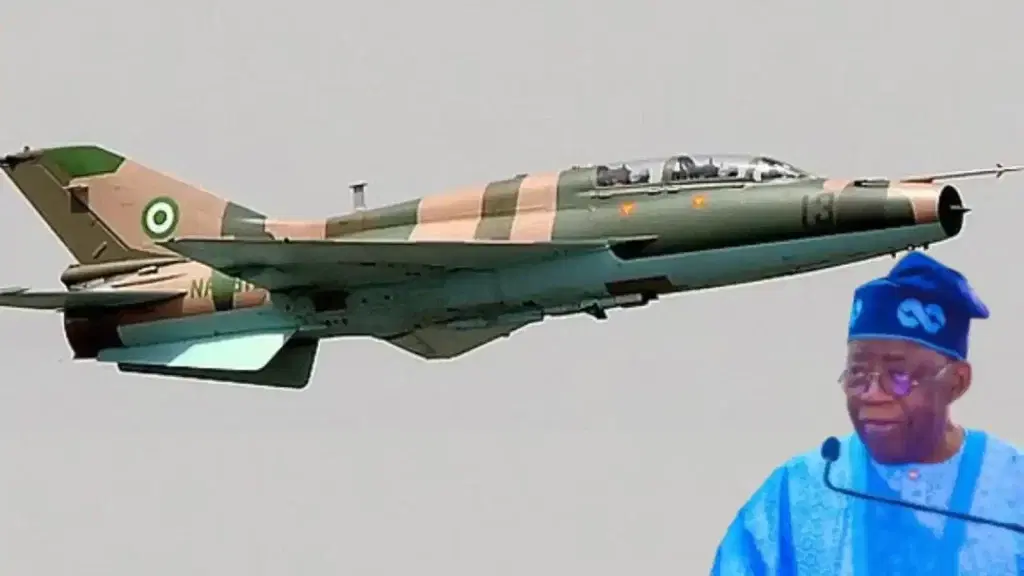
Nigeria’s fighter jets took over Beninoise airspace after a group of soldiers calling themselves the Military Committee for Refoundation appeared on national television claiming to have seized power and removed President Patrice Talon.
The coup collapsed within hours, with authorities confirming that 13 soldiers, including the masterminds, were arrested.
But as news of Nigeria’s involvement spread, social media claims alleged that President Tinubu “bombed” Benin on the orders of French President Emmanuel Macron, who was reported to have spoken with Nigeria’s President earlier on Sunday.
Benin Requested Nigeria’s Assistance — Presidency
Contrary to the social media claims, the presidency said Nigeria’s action in Benin was not haphazard.
In a statement signed by presidential spokesperson Bayo Onanuga, the Federal Government said it acted strictly on the Benin Republic’s official request for immediate military support.
The statement read in part: “Acting on two separate requests from the Government of Benin, President Tinubu ordered Nigerian Air Force fighter jets to enter the country and take over the airspace to help dislodge the coup plotters.”
Onanuga said Benin’s Ministry of Foreign Affairs sent a note seeking urgent air support “to safeguard constitutional order and ensure the security of the population.”
“In the second request, the authorities in Benin requested the deployment of Nigerian Air Force assets within Beninoise airspace for surveillance and rapid intervention operations under Benin-led coordination,” the Presidency said.
According to the statement, the Benin government also requested Nigerian ground forces, “strictly for missions approved by the Beninese Command authority in support of the protection of constitutional institutions and the containment of armed groups.”
So, was Nigeria’s intervention legal?
Generally, under international law, a country cannot deploy military assets in another sovereign state except under specific conditions.
Article 51 of the United Nations Charter recognises the right of self-defence as a fundamental right.
The article states: “Nothing in the present Charter shall impair the inherent right of individual or collective self-defence if an armed attack occurs against a Member of the United Nations, until the Security Council has taken measures necessary to maintain international peace and security.
“Measures taken by Members in the exercise of this right of self-defence shall be immediately reported to the Security Council and shall not in any way affect the authority and responsibility of the Security Council under the present Charter to take at any time such action as it deems necessary in order to maintain or restore international peace and security.”
Furthermore, another legal basis for military intervention is enshrined in Article 25 of the Lomé Protocol of the Economic Community of West African States. (ECOWAS).
This legal framework allows ECOWAS to intervene militarily in its member States in a number of situations, including the case of military coups.
The article also implies that among ECOWAS States, the use of military force is permissible when a State invites another State or the regional organisation to use force on its territory.
Under what circumstances can a country invade another nation militarily?
While Article 51 of the UN Charter provides a legal basis for states to use force in self-defence, Article 25 of the Lomé Protocol specifically grants ECOWAS the legal basis to militarily intervene to maintain peace and order.
However, experts generally outline three scenarios under which a country can invade another country militarily.
1. Intervention by invitation
A sovereign state may request external military assistance. Once such a request is made, the assisting country is legally permitted to operate within its territory.
2. War
During a declared war between two countries, a military invasion is justified, though it would come with significant diplomatic consequences.
3. United Nations authorisation
The UN Security Council can mandate military intervention in cases of threats to international peace.
In this case, both Nigeria and the Republic of Benin are ECOWAS members, and both countries agreed to the Lome Protocol signed in Togo in December 1999.
Nigeria’s military operation in the francophone country falls under the intervention by invitation framework, since the Benin Government officially invited its support to repel the coup attempt.
This makes the deployment lawful under international norms and bilateral security cooperation frameworks between ECOWAS states.
Whether Nigeria’s intervention in the Republic of Benin has moral foundation, given the security situation at home, is another matter entirely.
The post Explainer: Did Nigeria act legally by sending fighter jets into Benin? Here’s what the law says appeared first on Vanguard News.