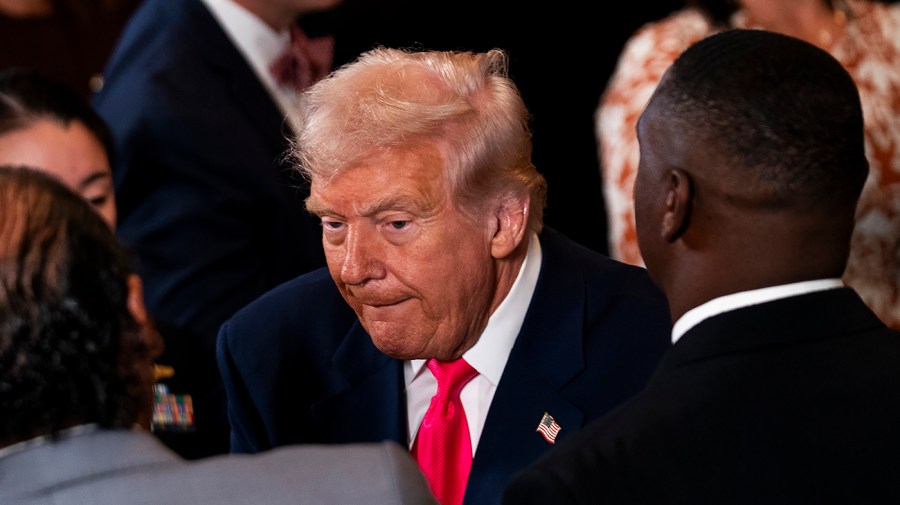

President Trump’s use of his clemency power is drawing criticism as he grants pardons and commutations that at times appear to contradict his agenda and focus largely on people charged or convicted during the Biden administration.
Trump has spent much of his term criticizing former President Biden’s use of the pardon power, at times suggesting Biden’s pardons are “null and void” because of allegations Biden used an autopen to sign them.
At the same time, Trump has leaned into his own use of the pardon power to benefit Republicans and his allies. And Trump has frequently appeared motivated by anger over his own indictments during the Biden administration, insisting those he has pardoned were similarly victimized.
Trump began his second term by granting clemency to nearly all defendants connected to the Jan. 6, 2021, attack on the Capitol.
Since then, he has granted clemency to multiple Republicans who had been convicted of crimes and pardoned the founder of the cryptocurrency exchange Binance, which has business ties to the Trump family.
Most recently, Trump has attracted criticism from Democrats and Republicans over his decision to pardon Juan Orlando Hernández, the former president of Honduras who had been convicted of narcotics crimes last year in a case first started during Trump’s first term. Even some in the GOP have questioned Trump’s decision given his administration’s very public campaign to target drug-carrying vessels with military strikes.
“The pardons Trump is handing out are a huge, growing scandal that not enough people are talking about,” Sen. Chris Murphy (D-Conn.) said this week. “This is a money making operation – for Trump, his family, his crypto pals, and the Trump-affiliated lobbyists and grifters who the pardon seekers pay.”
Trump has been defiant in the face of criticism and questions about his decisions on whom to pardon. The president and White House officials have frequently defended Trump’s pardon decisions by arguing that they are a counter to what they view as a weaponized Justice Department during the Biden administration.
“President Trump has exercised his constitutional authority to issue pardons and commutations for a variety of individuals. And the only pardons anyone should be critical of are from President Autopen, who pardoned and commuted sentences of violent criminals including child killers and mass murderers– and that’s not to mention the proactive pardons he ‘signed’ for his family members like Hunter on his way out the door,” White House spokesperson Abigail Jackson said in a statement.
Trump’s pardons reentered the spotlight this week when he pardoned Hernández, who was convicted in June 2024 of conspiring to distribute more than 400 tons of cocaine and accepting millions of dollars in bribes from traffickers to facilitate the shipment of those drugs.
“He was the president, and they had some drugs being sold in their country, and because he was the president they went after him. That was a Biden horrible witch hunt,” Trump said of his decision.
The pardon drew rebukes from both sides of the aisle, including from lawmakers who questioned whether it sent contradictory messages given the Trump administration’s military campaign targeting alleged drug trafficking boats in the Caribbean.
“I hate it. It’s a horrible message,” Sen. Thom Tillis (R-N.C.) told reporters this week. “It’s confusing to say on the one hand we should potentially even consider invading Venezuela for drug traffick[ing], and on the other hand let somebody go.”
White House press secretary Karoline Leavitt argued Trump’s pardon was not at odds with his broader agenda.
“I think that President Trump has been quite clear in his defense of the United States homeland to stop these illegal narcotics from coming to our borders, whether that’s by land or by sea,” Leavitt told reporters. “And he’s also made it quite clear that he wants to correct the wrongs of the weaponized Justice Department under the previous administration.”
It was the latest instance of the White House going on defense over Trump’s use of his pardon power in recent weeks.
Trump drew scrutiny for his pardon of Binance founder Changpeng Zhao and later attempted to downplay the move by suggesting he did not know who Zhao was when he issued the pardon.
As was the case with the Hernández pardon, the White House at the time argued that Trump was correcting a case of over-prosecution during the Biden administration.
The White House made the same argument this week when asked about Trump’s decision to commute the sentence of David Gentile, a former private equity executive who had been convicted of fraud in 2024.
“At trial, the government was unable to tie any supposedly fraudulent representations to Mr. Gentile,” Leavitt said at a press briefing. “This is another example that has been brought to the president’s attention of the weaponization of justice from the previous administration, and therefore, he signed this commutation.”
Trump again pointed to allegations that the Biden administration acted unfairly when he announced this week that he was pardoning Rep. Henry Cuellar (D-Texas) and his wife, Imelda, who last year were indicted on charges related to allegedly accepting nearly $600,000 in bribes and laundering the funds.
While some pundits questioned whether the pardon could help the Texas Democrat keep his seat in a tough election next year, Trump made clear his motivation was undoing what he saw as a politically motivated indictment brought by the Biden administration
“Sleepy Joe went after the Congressman, and even the Congressman’s wonderful wife, Imelda, simply for speaking the TRUTH,” Trump posted on Truth Social.
Cuellar became the latest lawmaker who had faced charges related to bribery, fraud or corruption to receive a pardon.
The president earlier this year commuted the sentence of George Santos, the former Republican representative who was expelled from the House and who had pleaded guilty to wire fraud and aggravated identity theft. He also pardoned former Republican Rep. Michael Grimm (N.Y.), who had been convicted of felony tax fraud. And Trump pardoned former Illinois Gov. Rod Blagojevich, a Democrat who has become an outspoken Trump supporter after serving time in prison on corruption charges.
A White House official pointed to comments Leavitt made last month, when she told reporters the administration treats pardons “with the utmost seriousness.”
“He’s the ultimate, final decision maker,” Leavitt said of Trump. “And he was very clear when he came into office that he was most interested in looking at pardoning individuals who were abused and used by the Biden Department of Justice, and were over prosecuted by a weaponized DOJ.”
Copyright 2025 Nexstar Media, Inc. All rights reserved. This material may not be published, broadcast, rewritten, or redistributed.
For the latest news, weather, sports, and streaming video, head to The Hill.