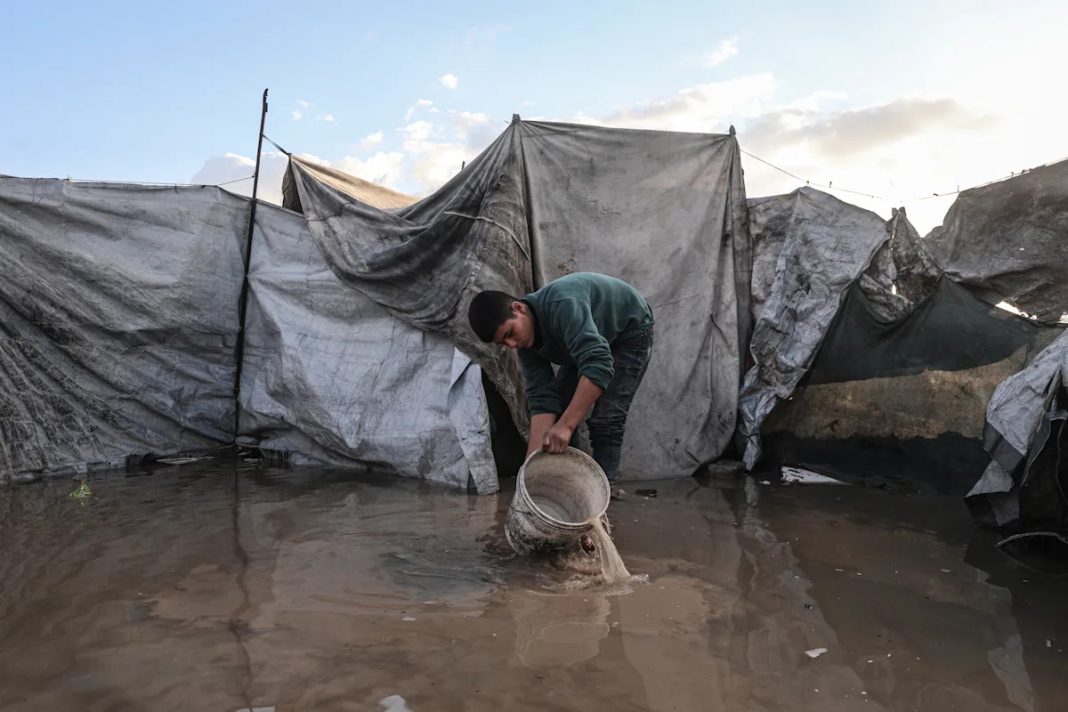

Tens of thousands of displaced Palestinians in Gaza, surrounded by tents and debris, are suffering through more winter rains after two years of Israeli bombardment destroyed much of the Strip.
A polar low-pressure system accompanied by heavy rain and strong winds swept across the Gaza Strip on Saturday. It is the third polar low to affect the Palestinian territory this winter, with a fourth low-pressure system forecast to hit the area starting on Monday, meteorologist Laith al-Allami told the Anadolu news agency.
Many families have been living in tents since late 2023, for most of the duration of Israel’s genocidal war on Gaza.
The enclave is imminently facing freezing temperatures, rain and strong winds, as the authorities warn the downpour could intensify into a full-blown storm.
Mohammed Maslah, a displaced Palestinian now in Gaza City, told Al Jazeera in his rugged tent that he did not have a choice but to stay there.
“I could not find anywhere to live in Gaza, except Gaza Port,” he told Al Jazeera. “I’m forced to stay here because my home is under Israeli control. After just a few hours of rain, we were soaked.”
In Deir al-Balah, Shaima Wadi, a mother of four children who was displaced from Jabaliya in the north, spoke to the Associated Press. “We have been living in this tent for two years. Every time it rains and the tent collapses over our heads, we try to put up new pieces of wood,” she said. “With how expensive everything has become, and without any income, we can barely afford clothes for our children or mattresses for them to sleep on.”
The heavy rains earlier this month flooded tents and makeshift shelters across Gaza, where most of the buildings have been destroyed or damaged by Israeli attacks.
So far in December, at least 15 people, including three babies, died from hypothermia following rains and plunging temperatures, with several buildings collapsing, according to the authorities in Gaza. Aid organisations have called for Israel to allow more shelters and other humanitarian aid into the territory.
Ibrahim Abu al-Reesh, head of field operations for the Civil Defence in the Gaza Port area, said that his teams responded to various distress calls as weather conditions got harsher in places where displaced people set up fragile tents.
“We worked hard to cover some of these damaged tents with plastic sheets after they were flooded by rainwater,” he told Al Jazeera.
Al Jazeera’s Ibrahim Al Khalili, reporting from Gaza City, said that winter has been adding to the suffering of tens of thousands of displaced Palestinians who do not have safe shelters.
“The same misery repeats as each rain fills neighbourhoods with muddy water,” he said.
Ceasefire talks
As Palestinians face dire conditions in Gaza, Israeli Prime Minister Benjamin Netanyahu is expected to visit Washington, DC, in the coming days while negotiators and others discuss the second stage of the ceasefire that took effect on October 10.
The progress in the peace process has been slow. Challenges in phase two of the ceasefire include the deployment of an international stabilisation force, a technocratic governing body for Gaza, the proposed disarmament of Hamas and further Israeli troop withdrawals from the territory.
So far, the agreement has partially held despite Israel’s repeated violations.
Since the ceasefire went into effect, more than 414 Palestinians have been killed and 1,142 wounded, according to Gaza’s Ministry of Health.
It also said the bodies of 679 people were pulled from the rubble during the same period, as the truce makes it safer to search for the remains of people killed earlier.
The ministry on Saturday said that 29 bodies, including 25 recovered from under the rubble, had been brought to local hospitals over the past 48 hours.
The overall Palestinian death toll from Israel’s war has risen to at least 71,266, the ministry said, and another 171,219 have been wounded.