
Marco Rubio is using real censorship to fight fake censorship
The U.S. government just banned five people from entering the country because it doesn’t like their speech. This ban, according to the State Department, is necessary to protect free speech.
If that sounds insane to you, congratulations on your reading comprehension.
On Tuesday, Secretary of State Marco Rubio’s State Department announced the “Announcement of Actions to Combat the Global Censorship-Industrial Complex,” which will take “decisive action against five individuals who have led organized efforts to coerce American platforms to censor, demonetize, and suppress American viewpoints they oppose.” The five — former European Union Commissioner Thierry Breton, Center for Countering Digital Hate (CCDH) CEO Imran Ahmed, Global Disinformation Index (GDI) cofounder Clare Melford and HateAid leaders Anna-Lena von Hodenberg and Josephine Ballon — are now blocked from getting U.S. visas.
Never mind that the abuse was prevented. Never mind that the system self-corrected. The State Department wants to punish him again — for his speech.
That theory relies almost entirely on fabricated or grossly misrepresented evidence. When subjected to actual scrutiny — including three years of litigation in Murthy v. Missouri and congressional investigations — it collapsed. Courts found no evidence of coercion. Platform executives testified under oath that they never felt compelled to moderate based on government requests. The whole thing was nonsense, but has become gospel in MAGA circles.
I’ve been a longtime critic of the EU’s Digital Services Act — a sweeping attempt to regulate social media that relies on vague definitions and subjective determinations. I’ve also specifically called out both Breton for trying to twist the DSA to claim authority over platform speech he never had, and Ahmed for producing shoddy research that overstates social media risks. But the U.S. government is now punishing them for their speech, which is precisely the kind of government suppression of speech that the First Amendment exists to prevent.

Former European Commissioner for the Internal Market Thierry Breton attends the funeral of the late French journalist Philippe Labro at the Saint-Germain-des-Pres church in Paris on June 13, 2025. Thomas Samson / Thomas Samson/AFP via Getty Images
The most instructive case here is Breton himself. He did, in fact, try to abuse the DSA to suppress speech. In August 2024, he sent Elon Musk a threatening letter suggesting that Musk’s planned livestreamed interview with then-candidate Donald Trump could violate the DSA. It was a blatant attempt at censorship.
And here’s what happened: The EU rejected him. Completely. EU officials went on record condemning the letter, his fellow commissioners distanced themselves from his threats, and within weeks he resigned to avoid being fired. As EU free speech experts noted in a recent open letter: “Politically, the EU’s checks and balances worked.”
The U.S. government’s response to this? Ban him from the country for trying to suppress speech. Never mind that he was already punished for it. Never mind that the abuse was prevented. Never mind that the system self-corrected. The State Department wants to punish him again — for his speech.
The justification for all this is even worse. Under Secretary Sarah Rogers claims these five Europeans engaged in “Murthy-style speech suppression.”
Rogers is referring to the Murthy v. Missouri case mentioned above, where two states and a collection of angry social media influencers sued the Biden administration, claiming social media platforms censored content at the government’s direction. The Supreme Court rejected those claims 6-3, with Justice Amy Coney Barrett’s opinion finding the plaintiffs had no standing because there was no evidence the government suppressed anyone’s speech. The platforms, Barrett noted, were simply enforcing their own rules.
Even worse, in a damning footnote, Justice Barrett highlighted that the lower court’s finding that there was censorship was based on a “clearly erroneous” reading of the evidence.
So the State Department is citing a case that disproved government censorship as evidence of government censorship. That’s not even creative lying — it’s just citing your own loss as precedent.
Besides Breton, none of the other four people being sanctioned even held government positions that would allow them to suppress speech. CCDH uses its speech — admittedly often inaccurately and misleadingly — to call for companies to change their content moderation policies. That’s advocacy. That’s their own free speech, attempting to persuade companies to make different decisions.
HateAid’s leaders were sanctioned for being “trusted flaggers” under the DSA, which sounds sinister until you understand what it means: They can report content to social media platforms, just like anyone else can. The “trusted” part just means platforms review their reports first because they tend to be more accurate than random reports.
Platforms still decide for themselves whether to remove anything. It’s the same content moderation process that the Supreme Court, in Murthy, found was not government censorship.
So here’s where we are: The U.S. government is blocking people from entering the country because those people advocated for content moderation policies the government doesn’t like. It’s defending this by citing a Supreme Court case that rejected claims of government censorship. And it’s doing this in the name of protecting free speech.
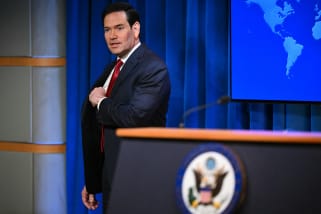
The only actual government suppression of speech here is coming from Marco Rubio’s State Department. Everything else — all the censorship they claim to be fighting — is either private companies making their own decisions, or has already been rejected and punished by the systems it supposedly threatened.
If you want to be vigilant against government suppression of speech, you don’t ban people from your country for their opinions about content moderation. You especially don’t do it while pretending you’re the one protecting free speech.
The post Marco Rubio is using real censorship to fight fake censorship appeared first on MS NOW.
This article was originally published on ms.now