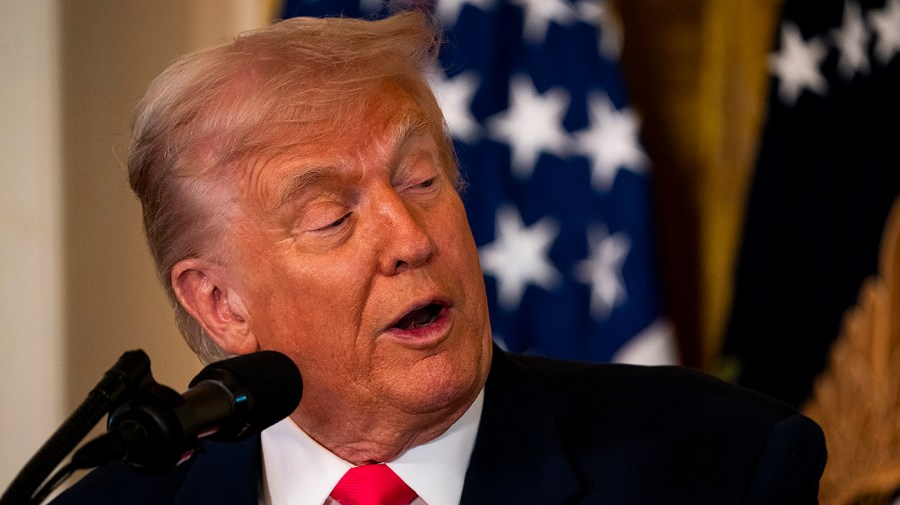

President Trump is putting his endorsement strength to the test ahead next year’s midterms as he wades into a number of Republican House primaries.
Last week, the president rolled out his first endorsements in non-incumbent races, backing candidates supported by the National Republican Campaign Committee (NRCC).
While Trump’s backing will likely hold sway in any Republican primary, his endorsement’s force will face a test in what is expected to be a tough election year for Republicans seeking to defend the House.
“If the Republicans are going to hold the House of Representatives, Donald Trump is going to have to take them and put them on his back to carry them to victory,” said Republican strategist Ford O’Connell.
According to the latest polling average from The Hill’s partners at Decision Desk HQ, Democrats led Republicans by roughly 6 points on the generic ballot. Meanwhile, Trump has seen his approval ratings dip since taking office in January, but his approval rating in the DDHQ average increased 3.5 points since last month.
“I’d rather have it than not,” one Republican strategist told The Hill.
“Whether he endorses you or not, you’re going to be tied to the successes and failures of the president and the Republican Congress,” the strategist added.
In three Truth Social posts on Thursday, Trump backed former Maine Gov. Paul LePage (R) in Maine’s 2nd Congressional District, along with former Stockton, Calif., Mayor Kevin Lincoln in California’s 13th Congressional District, and Army veteran Eric Flores in Texas’s 34th Congressional District.
In a statement to The Hill, National Republican Congressional Committee Chair Richard Hudson (R-N.C.) touted the “all-star recruitment class” the committee is building “in close coordination with the White House and our leadership team.”
“President Trump understands the kind of candidates we need to win in key districts and I am grateful for the close working relationship the NRCC has built with the President and his team,” Hudson said.
Prior to Rep. Jared Golden’s (D-Maine) announcement he would not seek reelection next year, Maine’s 2nd District was considered a toss-up. However, Republicans’ chances of winning in the district have since increased, with the nonpartisan Cook Political Report labeling the seat as “likely Republican.” LePage, a longtime Trump ally, will face at least one primary challenger in the Republican primary following James Clark’s entrance into the race. However, the former governor is widely favored to win the intraparty contest.
In Texas, Flores is facing a much more crowded primary in the state’s newly redrawn 34th Congressional District. Ten Republicans, including staunch Trump support and former Rep. Mayra Flores (R-Texas), are vying to challenge incumbent Rep. Vicente Gonzalez (D-Texas) in the district. Cook has dubbed the district as “lean Republican.”
Further west in California, Lincoln is seeking to challenge Rep. Adam Gray (D-Calif.) in the Golden State’s 13th Congressional District. Cook has labeled that district as “toss-up.”
Strategists point to the timing of primaries and redistricting as factors that likely impacted Trump’s decision to endorse when he did, particularly in Texas.
Texas and California each went through midcycle redistricting earlier this year. The White House worked with Texas to push state lawmakers to redraw that state’s congressional lines in an effort to add more Republican seats ahead of the midterms. Earlier this month, the Supreme Court gave Texas the green light to use the redrawn, GOP-friendly map.
California then pursued redistricting efforts in an effort to counteract Republican efforts in Texas.
Additionally, Texas has one of the earliest primaries next year on March 3, narrowing the window for the president to endorse. However some strategists note there could be some risk to early endorsements.
“The real tough thing for [Trump] is going to be Texas in particular,” the unnamed Republican strategist said, citing the early nature of the state’s primary.
“And so if he has some losses here, which is one of the reasons why I don’t think he endorses Cornyn, is he realized that if he took losses in Texas early on, it could have a cascading effect on the impact of his endorsements elsewhere,” the strategist said, referring to the state’s contested Senate GOP primary.
The White House has signaled it plans to make the midterms a referendum on Trump, with the president’s chief of staff Susie Wiles saying earlier this month the president will campaign like it’s 2024 again in an effort to turnout low propensity voters.
“If he’s at the top of the ballot in swing states and they believe that they’re voting for Donald Trump, then Donald Trump is going to have a higher turnout. He wants people to think that he’s at the top of the ticket,” O’Connell said.
The economy was boosted by surprisingly a strong 4.3 percent economic growth rate on Tuesday, arguably a boon for the White House and Republicans up and down the ballot going into an election year.
“American consumers are spending, and American exports are surging. President Trump built the greatest economy in the world in his first term, and he’s in the process of doing it all over again. Americans can count on benefitting from a historic economic boom in 2026,” White House spokesman Kush Desai said in a statement following the news.
Copyright 2025 Nexstar Media, Inc. All rights reserved. This material may not be published, broadcast, rewritten, or redistributed.
For the latest news, weather, sports, and streaming video, head to The Hill.