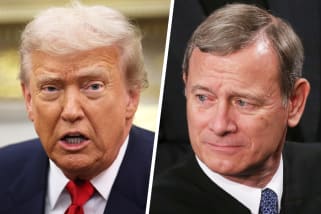

In a term that has been largely defined by its acquiescence to President Donald Trump, the Supreme Court issued a rare bit of good news for democracy Tuesday. A majority of justices refused to block a lower court’s decision barring Trump’s deployment of the National Guard to Chicago. Even though the Supreme Court didn’t rule on the merits of the case, it’s still hard not to read its opinion as a rare warning shot reminding the administration of the limits of presidential power.
First, some background: U.S. District Judge April Perry ruled in October that the administration hadn’t proved its claims that protests outside of immigration centers in Chicago warranted federalizing the National Guard. U.S. Solicitor General John Saur wrote in his petition for an emergency stay of that ruling that violence against federal immigration officers and property warranted Trump’s use of a statute allowing the National Guard to be called up whenever “the President is unable with the regular forces to execute the laws of the United States.”
In this case, he argued, federal agents were “met with prolonged, coordinated, violent resistance that threatens their lives and safety and systematically interferes with their ability to enforce federal [immigration] law.”
The court’s decision vehemently disagreed with Sauer’s premise:
We conclude that the term “regular forces” in §12406(3) likely refers to the regular forces of the United States military. This interpretation means that to call the Guard into active federal service under §12406(3), the President must be “unable” with the regular military “to execute the laws of the United States.” Because the statute requires an assessment of the military’s ability to execute the laws, it likely applies only where the military could legally execute the laws.
Since the Posse Comitatus Act blocks the use of the military in most domestic situations, the court concluded, the statute on which the administration was leaning likely can’t be applied to Chicago. It’s a sound bit of reasoning that still made three of the conservatives on the court very upset. Justice Samuel Alito railed in his dissent that the decision went far beyond the relatively narrow question at hand of whether to issue a stay. His major gripe seems to be that he was on the losing side this time and that the majority had the temerity to explain its decision.
The court put its foot down in a way that leaves little doubt about how an application for a final ruling on the statute’s use might be received.
Alito has something of a point when he argues that the majority drifted past the question at hand— but his argument lacks self-awareness. Time and again this year the court has used the so-called shadow docket to make broad rulings, avoiding the lengthy process of ruling on the merits. Often the court has issued or upheld a stay that essentially gave the Trump administration a greenlight to keep up its authoritarian streak.
This time, though, the court put its foot down in a way that leaves little doubt about how an application for a final ruling on the statute’s use might be received. While there’s still a chance that the administration tries invoking the Insurrection Act to justify future deployments of the military and National Guard, the court seems to have effectively shut off this legal avenue.
The opinion is unsigned but by process of elimination, we can determine that the majority included Chief Justice John Roberts. (Justice Clarence Thomas joined Alito’s dissent while Justices Neil Gorsuch and Brett Kavanaugh penned their own dissent and concurrence, respectively.) It’s telling, then, that Roberts, one of the chief proponents of the executive branch’s sweeping powers, chose to sign off on this opinion. In siding with Justice Amy Comey Barrett and the court’s liberals, Roberts seems to have found some limit to how far he’ll let Trump go. That’s good news for the country, in that the majority’s decision is likely to make the White House think twice about any future deployments out of concern that they won’t be well received by the court.
The post The Supreme Court sent Trump a warning shot over deployments appeared first on MS NOW.
This article was originally published on ms.now