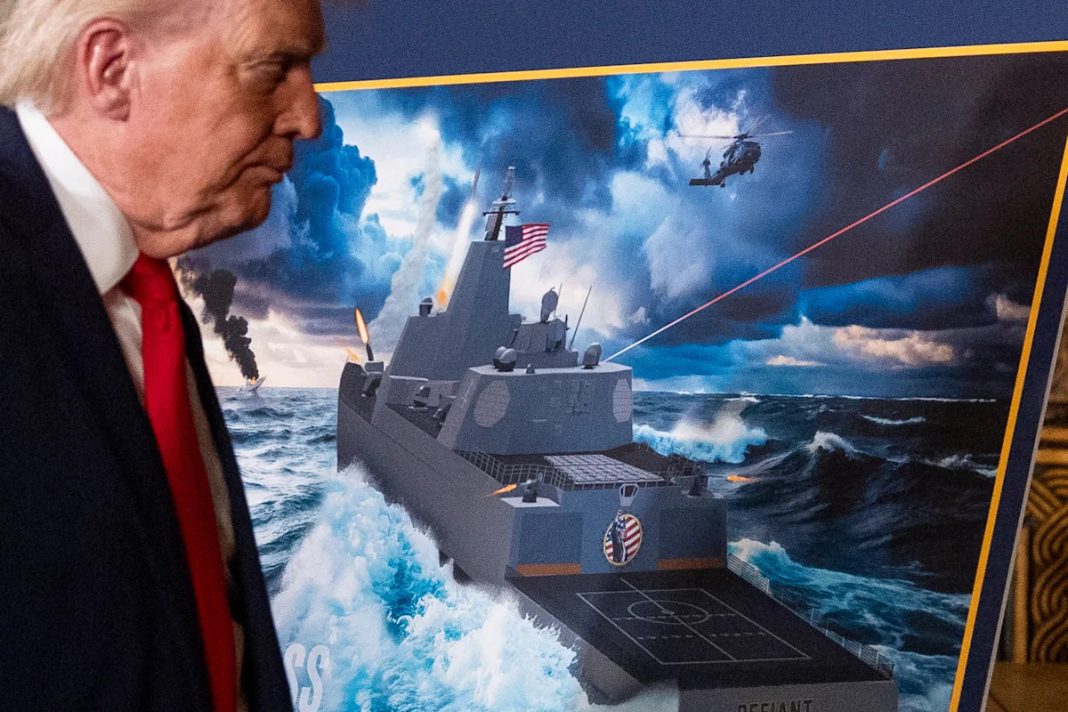

President Donald Trump unveiled plans for a “Trump-class” battleship on Monday that will carry nuclear-armed cruise missiles — the first time a surface ship will be armed with such weapons since the Cold War.
During an announcement from his Mar-a-Lago resort in Florida ahead of the winter holidays, the president also said his administration would build a new class of aircraft carriers — another massive industrial undertaking that would cost tens of billions to design and build and take years of planning to kickstart.
There is no funding in the current Pentagon budget for either program, making it unclear when and how the work would start on either effort.
While it normally takes years to plan and build new complex weapons like these, the announcement is a clear reminder that Trump remains focused on beefing up the nation’s military, and with it the defense industrial complex. And if he can get sufficient buy-in from lawmakers, weapons of this size and scope — and the tens billions or dollars that are required to make them — can generate substantial momentum in a Congress looking to add American jobs.
The president said there would be at least 25 Trump-class battleships constructed in the coming years and they will be the “largest we’ve ever built.” He called for an ambitious timeline that would deliver the ship in “two and a half years.”
That schedule would likely be next to impossible to meet, given the lack of engineering plans for the ship, according to two people familiar with the process who were granted anonymity to talk about strategic weapons decisions.
Defense industry analyst Roman Schweizer of TD Cowen wrote in a note to investors after Trump’s remarks that “we see the plan as extremely ambitious and, in some ways, running counter to the trend in unmanned and robotic maritime systems,” that the Navy had said it was focusing on.
The Navy has long struggled to build ships on schedule and on budget. Currently, every Navy ship under construction is at least a year behind schedule. Shipyards have for years struggled to hire and retain enough employees to work their production lines, an issue that Trump and Navy Secretary John Phelan did not discuss during their Monday press conference.
Asked how he would build these ships with the current overworked and understaffed shipyards in the U.S., Trump said he will meet with defense company CEOs next week to tell them to cut executive compensation and stock buybacks and pump that money into building new plants and factories. “They’re going to start spending money on building airplanes and ships and the things that we need, not in 10 years and 15 years, we need them now,” the president said.
The scope of work envisioned by the president seemed unrealistic to many in the defense industrial complex.
It would be “a massive life cycle maintenance challenge — the cost of maintaining supply chains, maintenance support and system training for a large number of small ship classes will break the Navy’s [operational] budget for decades,” said Mark Montgomery, a retired Navy officer now with the Foundation for the Defense of Democracies.
Ranking member of the House Seapower and Projection Forces Subcommittee, Rep. Joe Courtney (D-Conn.) called the plan “vague” and said the “proposal to bring back battleships raises many questions for Congress to scrutinize.”
“There is a reason that the Navy stopped building battleships in 1944 and that President Ronald Reagan’s 600 ship fleet didn’t bring them back,” Courtney added.
The new battleship would include multiple technologies that have never been put aboard a single ship all at one time, according to the two people familiar with the early plans.
Not all of the new technologies will likely be incorporated immediately, but the ships will be built with the ability to add them later. Initial plans call for the ship to weigh about 30,000 tons — making it bigger than the Navy’s workhorse Arleigh Burke destroyers, with a crew of over 500 sailors, compared to the destroyer’s 300-plus crew.
The cost of building a new class of ship with so many complex and mostly untested technologies would be huge, said Bryan Clark, a retired Navy officer now at the Hudson Institute, even if the Navy does need a ship larger than the current destroyers to keep pace with China.
Budgetarily, “there isn’t enough money downstream to pay for all of the ships,” without retiring existing ships early, Clark said, while also funding the F/A-X — the new carrier-based fighter plane — “and the operations, maintenance, and personnel to run the resulting fleet.”
Early plans call for the new ships to be able to launch hypersonic missiles, in addition to having the power generation capabilities to employ laser weapons while also being equipped with electromagnetic rail guns that will give it the ability to fire munitions hundreds of miles.
China and Japan have made strides in equipping some ships with rail guns while the U.S. Navy has struggled with the technology in recent years.
Trump on Monday was joined by Defense Secretary Pete Hegseth, Navy Secretary John Phelan, and Chief of Naval Operations Adm. Daryl Caudle. The Wall Street Journal first reported some of the details of the plan.