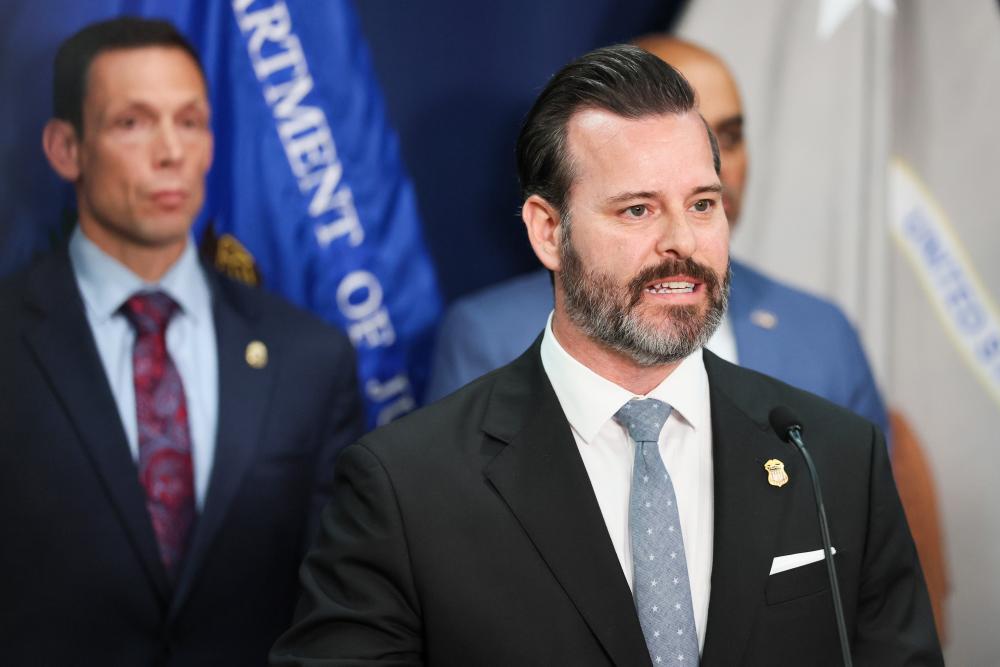

A Maga loyalist US attorney in Miami is expanding an investigation of ex-FBI and intelligence officials who incurred Donald’s Trump’s wrath with an inquiry into how Russia helped him win in 2016, despite the US justice department suffering stinging recent court rejections of indictments of two foes of the US president.
Former prosecutors and legal experts call the Miami-based inquiry, which has issued some two dozen subpoenas so far, a “fishing expedition”. The investigation’s apparent focus is to identify ways to criminally charge ex-FBI and intelligence officials who have already been investigated and effectively exonerated by two special counsels and a Republican-led Senate panel, which mounted exhaustive inquiries into Russia’s efforts to boost Trump in 2016.
Led by Jason Reding Quiñones, the Trump-appointed US attorney for the southern district of Florida, who is close to attorney general Pam Bondi and other key Maga allies, the inquiry accelerated with a flurry of subpoenas in November and new prosecutors to expedite what has been dubbed a “grand conspiracy” investigation.
Among others, subpoenas have reportedly gone to ex-CIA director John Brennan, who led the 2016 Russia inquiry, James Clapper, the ex-director of national intelligence, Peter Strzok, a former FBI counter-intelligence agent who helped lead the Russia inquiry, and Lisa Page, an ex-FBI lawyer.
Concerns about the Miami investigation’s direction and tactics, which initially seemed aimed at Brennan, has prompted two young prosecutors who were assigned to the inquiry to resign, according to multiple reports.
Former DoJ inspector general Michael Bromwich, who represents Andrew McCabe, the former No 2 at the FBI in 2016 who has been subpoenaed, is scathing in assessing the Miami inquiry.
“There is simply no factual basis for this investigation. It violates both DoJ and FBI standards that require a factual predicate. It is a fishing expedition where it has been clearly established – by two prior independent counsel investigations and a congressional investigation led by the current Secretary of State – there are no fish,” he said.
Bromwich added: “The government has refused to provide the basis for venue in Florida, nor has it been willing to describe the statutory violations it is pursuing. That is unprecedented in my 40 plus years of federal criminal practice.”
Other ex-prosecutors offer strong critiques of Miami’s sprawling inquiry.
The Russia investigations have already been probed and “ended with a whimper”, said Barbara McQuade, an ex-US attorney for eastern Michigan who now teaches law at the University of Michigan. “The idea that Trump loyalists are now going to investigate again should make us all suspicious of their motive. If evidence sufficient to support criminal charges existed, we would have seen it by now.”
In a similar vein, Jeffrey Sloman, who previously spent two decades in the US attorney’s office that is leading the probe and ran it during part of the Obama administration, emphasized: “Our laws and traditions forbid federal prosecutors to use their awesome prosecutorial powers to conduct a grand jury investigation for the sole purpose of vanquishing a political enemy of the president.”
Trump has often decried the 2016 Russia inquiry as a “witch-hunt”, even though the report by special counsel Robert Mueller in 2019 concluded that Moscow interfered in the 2016 election “in a sweeping and systematic fashion” to help Trump win; Mueller’s report did not find evidence of coordination between Russia and Trump’s campaign.
Trump’s animosity to Brennan was palpable in January 2023 when Trump reposted an image on Truth Social that showed Brennan, Clapper and other ex-intelligence officials behind bars. The image featured a suggestive headline: “Now that Russia collusion is a proven lie, when do trials for treason begin?”
Under Reding Quiñones, a premium seems to have been placed on loyalty to Trump and recruiting new prosecutors to pursue the Trump-style revenge probe into the origins of the 2016 Russia inquiry, with a focus on a 2017 intelligence assessment that the Kremlin intervened to help Trump win the election.
Notably, Reding Quiñones was the first US attorney to be confirmed by the Senate this year in August, and picked Bondi to administer the oath of office, bucking the regular practice of having chief judges for Florida’s southern district swear in US attorneys in Miami.
At his August swearing-in, Reding Quiñones pledged to “restore impartial justice” – in an apparent swipe at the office’s previous direction.
Before Trump tapped Reding Quiñones to be a US attorney this year, he had done stints as a federal prosecutor in the same office and as a state judge.
Some of the probe’s direction and momentum seems fueled by rightwing attorney and Trump loyalist Mike Davis, who has strong ties with Reding Quinones and Trump’s justice department.
Last month, Davis wrote on social media that “justice is coming”, accompanied by his own photo next to Reding Quiñones. Davis reportedly had a role in pushing the justice department to use Florida prosecutors to pursue conspiracy cases against Trump foes.
Davis’s combative legal style was honed in Trump’s first term, when he helped guide Trump’s supreme court nominees through their Senate confirmations. Now Davis leads the Article III Project, a rightwing outfit that boasts of helping “fight leftist lawfare to defend the rule of law”.
In Marchm a few weeks prior to Trump picking Reding Quiñones for his Miami post, he and Davis were featured together at a conservative legal confab on a panel entitled “Modern Lawfare and the American Democracy”.
The panelists voiced bitterness over special counsel Jack Smith’s investigations of Trump and their view that the justice department had been weaponized in the Biden administration.
During the talk, Davis suggested that Trump’s justice department should launch a sweeping inquiry that would charge those who investigated Trump with a conspiracy to deprive him of his civil rights, according to reports and Davis’s public comments. Such conspiracy charges usually involve misconduct by police and protecting minority civil rights.
“There must be severe consequences,” Davis told the audience. “There has to be severe legal, political and financial consequences for this unprecedented republic-ending lawfare.”
The Miami probe grew out of another one by a US attorney in Pennsylvania that reportedly focused on Brennan, but it was transferred in September to Reding Quiñones, who has widened it to include a new grand jury in Fort Pierce, Florida, which is slated to begin in January.
In October, Davis told conservative podcasters that the grand jury would explore whether to bring criminal charges against a slew of ex-officials that he suggests conspired over a decade to hurt Trump – from the Russia investigations to the criminal cases against Trump for trying to subvert his 2020 election loss and hoarding classified documents at Mar-a-Lago after he left office.
In an October interview on the rightwing The Charlie Kirk Show, Davis boasted that his “buddy” Jason Quiñones had moved to empanel a grand jury after Davis “pushed very hard” to investigate what he claims has been a conspiracy against Trump.
Further, Davis told conservative commentator Benny Johnson in October: “I’ve been publicly calling for this for three years. I’m going to make damn sure that these ‘lawfare Democrats’ go to prison during the four years of President Trump’s second term.”
In October too Trump urged prosecuting some former officials Davis alleged used “lawfare” against Trump.
“They cheated and rigged the 2020 Presidential Election,” Trump wrote on social media. “These Radical Left Lunatics should be prosecuted for their illegal and highly unethical behavior!”
Although the statute of limitations would usually preclude charging crimes involving the 2017 intelligence assessment, Davis has suggested that prosecutors may try to prove it was part of much longer conspiracy by federal officials to take away Trump’s rights.
Former prosecutors offer blistering comments on the Miami inquiry.
McQuade stressed that the Miami investigation “feels like what Ed Martin, the head of DoJ’s ‘weaponization working group’, calls ‘name and shame’: that is, to publicly smear people even if criminal convictions are not possible. That philosophy violates legal ethics and DoJ policy, which permit a prosecutor to pursue charges only when it is probable that the evidence is sufficient to obtain and sustain a conviction. The statute of limitations alone seems like a bar to conduct occurring in 2016. Most crimes have a five-year statute of limitations.”
Sloman said that “according to published reports, two bright young people at the US attorney’s office in Miami who bravely refused such an assignment recently resigned after they expressed reservations about working on such an investigation.
Unfortunately, it appears as though there are others who remain who are intimidated enough to accept this assignment. As a 20-year alumnus of the Office, I call on its current leadership to reverse course, end this reported investigation, and begin to restore trust and integrity to this once proud institution.”
While the Miami inquiry is facing fire from ex prosecutors , other DoJ cases to convict two of Trump’s long time enemies – former FBI director James Comey and New York attorney general Letitia James – have been undermined by recent court rulings.
Last month, a judge threw out criminal indictments of Comey over alleged lying to Congress and obstructing Congress in 2020, and of James over alleged bank fraud and making false statements.
The judge’s ruling stressed that Lindsey Halligan, the Trump-promoted interim US attorney in eastern Virginia who brought the charges without any prosecutorial experience, was installed improperly after the veteran prosecutor leading the office, opted not to bring charges and resigned under pressure.
Although the Miami investigation, unlike the Virginia cases, is expanding, legal critics say both seem to exemplify a Trump strategy to publicly tar foes with charges, even if they can’t ultimately be convicted of crimes.
“It’s been clear for months that Trump cares about the law only to the extent he can use it as a weapon to make the lives of his enemies miserable, which he can,” said NYU law professor Stephen Gillers. “A grand jury investigation and a trial can do that even if there is no conviction. Conviction would just be icing on the dessert.”