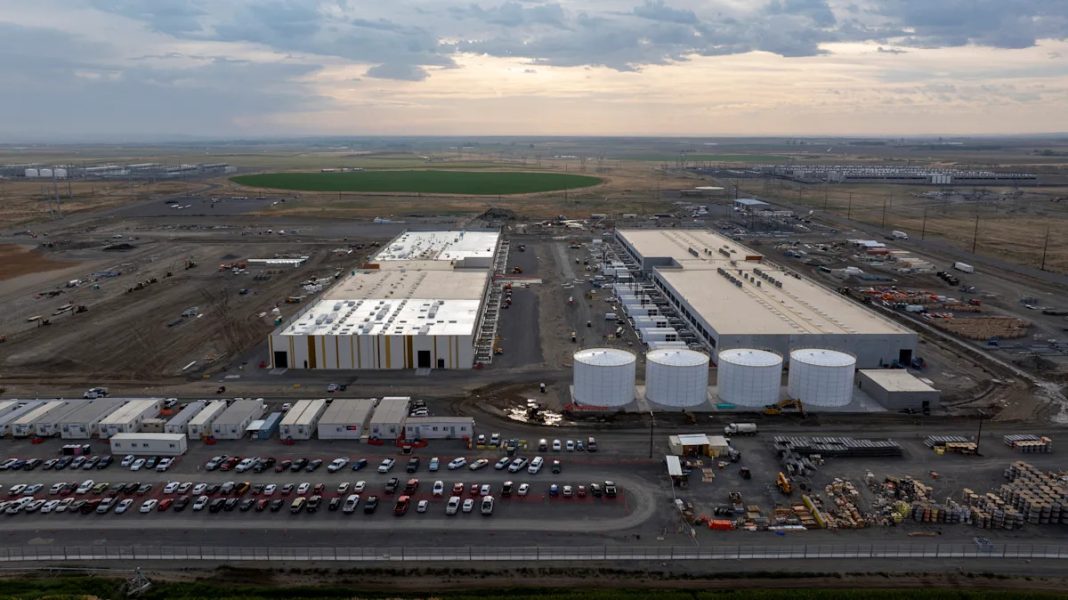

Tech companies and lobbyists are investing millions of dollars to tackle a new political problem for the industry: Data centers, the lifeblood of the growing AI economy, are becoming toxic with voters.
Alarmed by elections that candidates won by campaigning against new data centers, the industry is taking out ads and funding campaigns to flip the narrative and put data centers in a positive light — spinning them as job creators and economic drivers rather than resource-hungry land hogs.
The new campaigns mark a sharp change for an industry that has long relied on tech’s image as an engine of growth and development. They signal how concerned the tech sector is becoming about data centers in the 2026 midterm elections.
A new AI trade group is distributing talking points to members of Congress and organizing local data center field trips to better pitch voters on their value. Another trade association, the Data Center Coalition, nearly tripled its lobbying spend in the third quarter of this year from the previous quarter, according to U.S. lobbying disclosures.
The social media giant Meta, with billions invested in its own fleet of data centers from Stanton Springs, Georgia, to Richland Parish, Louisiana, has been running a multimillion-dollar ad campaign depicting data centers as a boon to agricultural towns in Iowa and New Mexico. It has spent at least $5 million nationally in the past month on TV ads plugging Meta’s $600 billion pledged investment in tech infrastructure and jobs.
“There’s a very bad connotation around data centers. And this is something that, frankly, the data center industry needs to figure out,” said Caleb Max, president and CEO of the National Artificial Intelligence Association, a new trade group established in January to accelerate AI infrastructure development.
November’s election results were bleak for the companies that need data centers to thrive. Abigail Spanberger in Virginia and Mikie Sherrill in New Jersey both won governor’s races in part by campaigning to force data center operators in their states to make upfront payments to upgrade the aging electrical grid.
The issue is likely to grow more acute: The number of data centers is expected to grow by more than a third within the next five years, and will account for as much as 21 percent of global energy demand by 2030 — far higher than the 1 to 2 percent of energy demand in 2024.
Since this summer, NAIA has been making the rounds to offices of House members from critical states such as Georgia, Ohio and Texas to craft talking points on the benefits of data centers, Max told POLITICO. “What’s the positive pro-data center campaign message for elected officials, for businesses, for current lawmakers who are going to be up for reelection in 2026?”
The issue is turning local voters against the national figures trying to lobby for the industry: Last week, the city council of Chandler, Arizona, rejected a plan for a massive new data center backed by Meta, Microsoft and former Sen. Kyrsten Sinema, who had portrayed it as a Trump goal.
The industry is hitting back on multiple fronts. Meta’s 30-second TV spots, featuring small-town imagery of farming equipment and mom-and-pop diners, have been aired in D.C. and nine state capitals — suggesting that policymakers might be Meta’s real target audience, rather than the rural Americans impacted by these energy-hungry server hubs. Meta did not respond to POLITICO’s request for comment.
NAIA is planning to expand its congressional campaign next year into a tour series open to Capitol Hill staff and policymakers, taking them to see the inner workings of massive server farms humming along in their districts.
Other tech lobbyists are sharpening their messaging around who should shoulder the burdens of ballooning energy bills that politicians and local officials are blaming them for.
“We really want to make clear that when it comes to consumer costs, that data center growth is not the prime driver,” Paul Lekas, executive VP of global public policy at the Software & Information Industry Association, told POLITICO.
Lekas said his group wants to convince the public that the story is more nuanced, and aging infrastructure is one of the largest drivers of rising energy costs. “I would call it a myth to say that data centers are really the drivers of energy costs based on the research that we’ve done,” he said.
The DCC, a Northern Virginia-based group that counts AWS, Google, Meta and Oracle as members, is going a step further, promoting research that shows data centers may actually lower the cost of power.
“New data and analysis from the Lawrence Berkeley National Laboratory also show that adding data centers and other large load to the grid has even helped lower energy costs for other customers,” said Dan Diorio, VP of state policy for DCC, in a statement to POLITICO.
Analysts have taken issue with this representation of the research, pointing out the study shows those reductions overwhelmingly go to commercial customers rather than residents.
Meanwhile, politicians of all persuasions are capitalizing on what looks like anti data-center momentum from the election. In November, a group of Senate Democrats, including Richard Blumenthal (D-Conn.) and Bernie Sanders (I-Vt.), demanded answers from the Trump administration over surging utilities to “prevent consumers from being forced to subsidize the cost of data centers.”
Florida Republican Gov. Ron DeSantis proposed new limits on data centers this month as part of a state “AI bill of rights.” Rep. Marjorie Taylor Greene (R-Ga.) warned that rushed AI data center build outs will have “massive” consequences down the line. And Sen. Josh Hawley (R-Mo.) has vowed to prevent what happened in Virginia from repeating in his own state.
Sen. Ron Wyden (D-Ore.), a signatory of the Democratic letter, put soaring energy costs, including those associated with AI data centers, at the heart of voters’ top issues next year. “This is going to be a major issue, this is right at the heart of a small set of choices — health care, energy, housing — where people feel like they’re getting hit by a wrecking ball,” he told POLITICO.