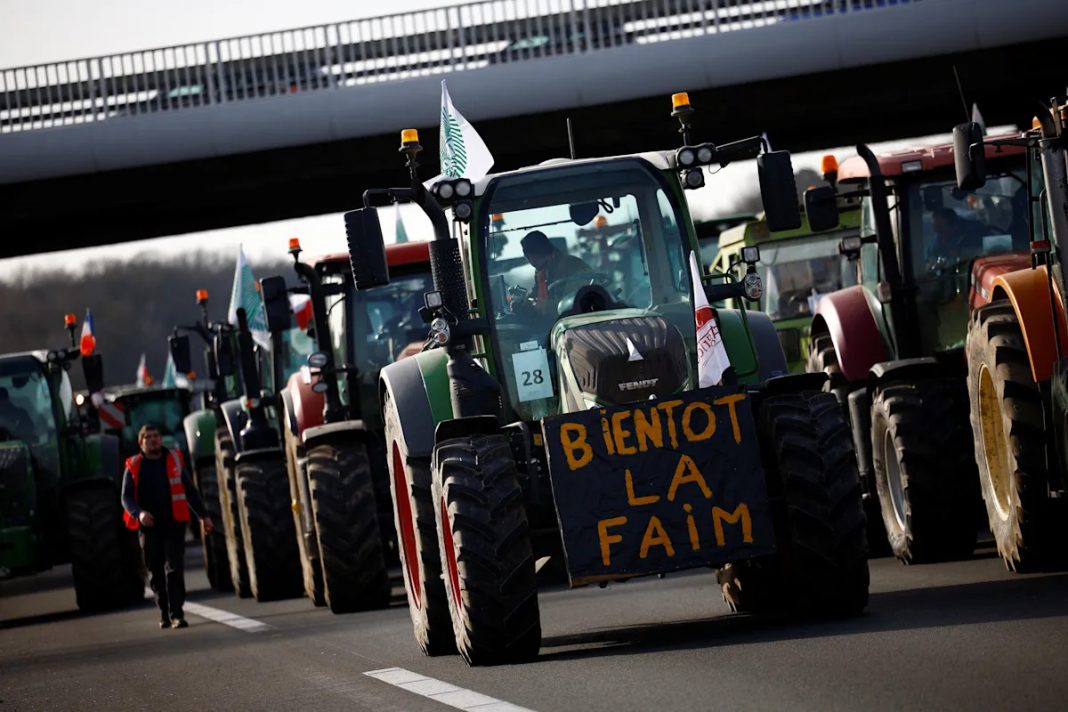

France is pushing to postpone a European Union vote to ratify a trade deal with the Mercosur bloc of four South American countries, citing concerns about its effects on farmers and ongoing protests at home. The move risks derailing an accord that has been 25 years in the making.
The EU’s trade agreement with Mercosur, which comprises Argentina, Brazil, Paraguay and Uruguay, was concluded a year ago but still awaits ratification. It is intended to expand access to overseas markets for European exporters struggling with tariffs imposed recently by the United States and rising competition from China.
However, the pact has met strong opposition from farmers across Europe, who worry that a flood of cheap agricultural imports produced under the more relaxed environmental and agricultural standards of some South American countries will put them under too much pressure.
Securing a resolution to this is viewed by some as a test of Europe’s ability to act as a unified bloc, shortly after US President Donald Trump hit out at EU leaders for being “weak” and warning of “civilisational erasure” across the bloc.
What is in the EU-Mercosur trade deal?
Once ratified, the trade deal between the European and South American blocs would be the largest free-trade agreement brokered by Brussels in terms of tariff relief.
While talks initially began in 1999, progress has been repeatedly stalled by competing interests. For years, EU farmers voiced concerns about excessively cheap agricultural imports, while environmentalists have raised objections over deforestation in the Amazon.
Designed to cut tariffs and boost trade in goods and services between the two blocs, Mercosur would allow the EU to export more vehicles, machinery and wines to South America, in exchange for easing the entry of beef, sugar, soya beans and rice from the region into Europe.
At present, tariffs between the two blocs are high – Mercosur levies up to 35 percent on EU cars, machinery and food, while the EU imposes steep duties of up to roughly 15 percent on South American farmed goods.
This agreement would phase out most of these tariffs over time, but not all. Several key agricultural products would be managed through quotas and partial tariff reductions. Still, critics worry that it gives away too much to the Mercosur countries and would flood Europe’s markets with cheap South American commodities.
The EU is Mercosur’s second-largest trading partner in goods, with exports worth 57 billion euros ($67bn) in 2024, according to the European Commission. The EU is also the biggest foreign investor in Mercosur, with a stock of 390 billion euros ($458bn) in 2023.
European Commission President Ursula von der Leyen is due to travel to Brazil on Monday next week to sign the agreement and create the world’s largest free-trade area.
Why is France hoping to delay ratification?
France, the EU’s largest agricultural producer, has been trying to rally other EU member states to form a blocking minority against the deal. It wants more robust safeguards for farmers added to the accord.
Meanwhile, as many as 10,000 farmers are expected to descend on Brussels, the Belgian capital and the de facto capital of the EU, to protest against the deal during the bloc leaders’ summit on Thursday and Friday.
The European Commission proposed protective measures, such as the suspension of Mercosur imports if inbound goods volumes rose by more than 10 percent or prices fell by the same amount. However, France describes these safeguards as “incomplete”.
On Sunday, in an interview with the German financial daily Handelsblatt, French Economy Minister Roland Lescure said the treaty, as it stands, “is simply not acceptable”.
The same day, French Prime Minister Sebastien Lecornu called on the EU to delay a vote planned in Brussels, ahead of von der Leyen’s visit to Brazil on December 20, where she is expected to sign the agreement.
The timing of the Mercosur vote coincides with efforts by Lecornu’s minority government to secure parliamentary approval for a budget, including suspending President Emmanuel Macron’s controversial pension reform, before the end of 2025.
It also follows an outbreak of lumpy skin disease – a highly contagious livestock virus – in France over the summer, which has resulted in animal culls and protests by cattle farmers against what they see as overly strict measures.
Opposition to the trade deal is deeply rooted in France, with both far-right and far-left parties presenting it as evidence that Paris is yielding to Brussels at the expense of rural communities.
France has set out three conditions for approving the agreement: safeguard mechanisms allowing imports to be stopped in cases of dumping, “mirror clauses” requiring Mercosur products to comply with EU rules on pesticides, and tighter food safety inspections.
But if France’s terms are not met, it could try to block the agreement altogether.
How could the deal be blocked?
By voting it down.
Denmark, which currently holds the EU’s rotating presidency under which member states take turns setting the collective agenda, will have to decide whether to press ahead with a vote this week as planned.
If Denmark defies the dissenting countries, the agreement could be shot down. A blocking minority requires support from at least four member states representing 35 percent of the EU’s population. Ireland, Poland, Hungary and Austria have openly opposed the Mercosur deal.
Together with France, this group of countries represents more than one-third of the EU’s population – enough to form a minority bloc.
What are other EU member states saying?
Elsewhere in Europe, reactions reflect existing splits. Poland, Hungary, Austria and Ireland have voiced support for France’s position. “Any postponement is a very good signal,” said Polish Agriculture Minister Stefan Krajewski.
The Netherlands has yet to declare its position.
European Commission deputy chief spokesperson Olof Gill told reporters on X: “In the view of the Commission signing the deal now is a matter of crucial importance economically, diplomatically, and geopolitically, but also in term of our credibility on the global stage.”
Echoing that sentiment, Volker Treier of the German Chamber of Commerce, DIHK, said: “The EU must not miss the opportunity to strengthen ties with key trade and raw material partners in South America and to reduce existing trade barriers.”
Responding to France’s stance, the European Commission said it still expects to sign the deal by the end of the year. “In the view of the Commission, signing the deal now is a matter of crucial importance – economically, diplomatically and geopolitically,” it said in a statement.
Have EU members objected to the deal on other grounds?
Yes. Several EU members have also objected to the deal on environmental grounds, arguing that Brazil has failed to do enough to protect the Amazon rainforest. Critics point to recent spikes in deforestation rates and forest fires, and warn that boosting beef exports could lead to more land clearing.
At the Group of Seven summit in Biarritz, France, in August 2019, the then‑European Commission President, Donald Tusk, said: “It is hard to imagine a harmonious process of ratification [of the deal] … as long as the Brazilian government allows for the destruction of the green lungs of Planet Earth.”
France, Austria and others have also said they will not back the deal without stronger, enforceable safeguards on climate and biodiversity. In response, the EU has sought additional assurances and side instruments committing Mercosur countries to uphold the 2015 Paris climate agreement, to which nearly all United Nations member states are signatories.