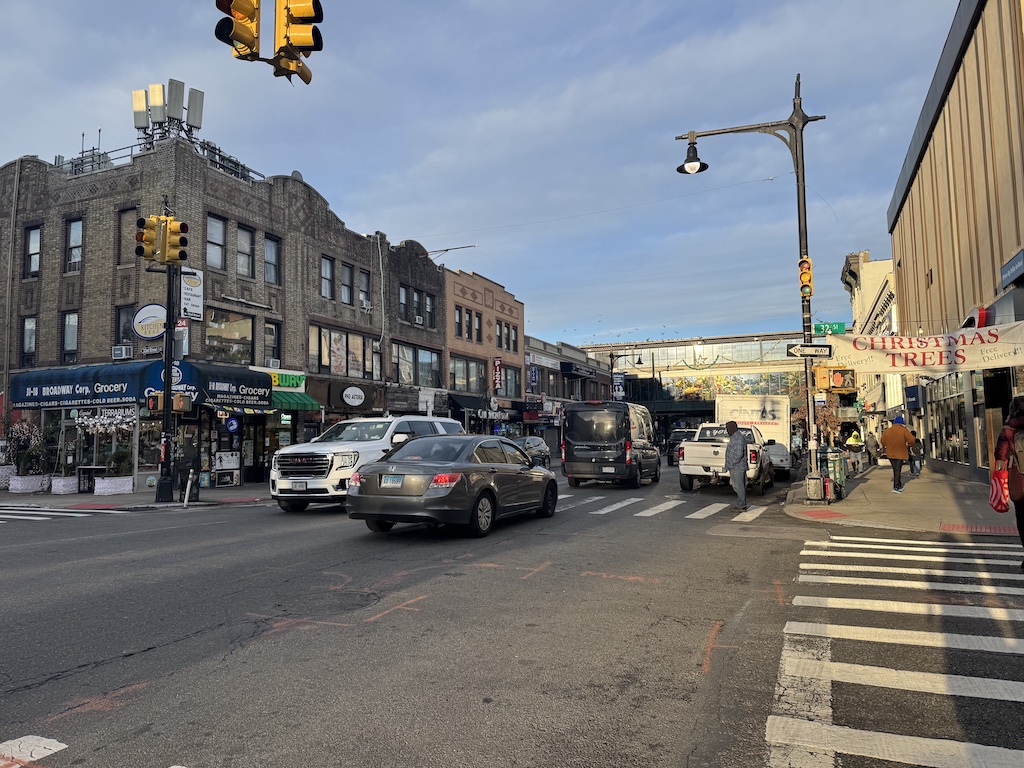

Vehicles zoom down Broadway as a pedestrian waits to cross the street in the Astoria neighborhood of Queens, N.Y., this month. Lawmakers in some states, including New York, are taking steps to curb aggressive driving. (Photo by Shalina Chatlani/Stateline)
NEW YORK — On a frigid December morning along busy Broadway in the Astoria neighborhood of Queens, New York, pedestrians walk rapidly toward the subway. Cars and e-bikes speed along a busy two-lane road and blast through sharp turns during the early rush to get to the office.
In recent years on this stretch of Broadway, cars have struck and killed pedestrians, crashed into businesses, and collided with parking meters, ripping them out of the ground.
For nearly 50 years, John Arvanitis has owned the Omonia Café on Broadway. He said he doesn’t see much enforcement of traffic laws.
“They have a sign that says ‘25,’ but sometimes people go fast. They’ll go past the light,” said Arvanitis, 70. He added that motorcycles and bikes speed down the street too.
John Arvanitis, owner of the Omonia Café in the Astoria neighborhood of Queens, N.Y., said he doesn’t see much enforcement of traffic laws. (Photo by Shalina Chatlani/Stateline)
One of his diners, 58-year-old Gail Grigaux, chimed in to say that she often sees vehicles buzzing through red lights — and even barreling down the sidewalk.
“There’s all these mopeds and e-bikes that are really dangerous. Just walking on the street and all of a sudden they zoom right by you,” Grigaux said. “It’s really frightening because I’m helping my elderly mother, and she can’t respond that quickly to get out of the way.”
Between 2013 and 2022, the number of traffic-related deaths in the United States increased by nearly 23%, from 32,893 to 42,514, according to a March report by the federal Centers for Disease Control and Prevention. Pedestrian deaths increased by 50% during the same period, the most recent for which numbers are available.
The CDC noted that the U.S. fared poorly compared with 27 other high-income countries, where all road-related deaths decreased by a median of more than 19% and pedestrian fatalities declined by a median of nearly 25%.
State legislators have noticed.
This year, Virginia and Washington enacted laws requiring the installation of speed limiting devices in the vehicles of drivers with multiple speeding or reckless driving violations. New Hampshire and Wisconsin are considering similar legislation to stop so-called super speeders.
So is New York. Democratic state Sen. Andrew Gounardes, the sponsor of New York’s bill, said in an interview that the state has increasingly used automated enforcement tools such as speed cameras in school zones and red-light cameras, but that “it became clear that there was a stubborn subset of drivers who continued to pose a problem because of their repeat recidivism and recklessness.”
Gounardes’ bill would require the installation of a speed limiting device if a driver accumulates 11 or more points on their driving record during a two-year period, or receives six or more speed camera or red-light camera tickets in a year.

Gail Grigaux said she often sees vehicles buzzing through red lights and even barreling down the sidewalk in the Elmhurst neighborhood of Queens, N.Y. (Photo by Shalina Chatlani/Stateline)
This year’s legislation in New York and other states comes after a flurry of activity last year, when nine states (Alabama, California, Florida, Georgia, Maryland, New York, Ohio, Pennsylvania and Utah, plus Washington, D.C.) enacted 19 measures to curb aggressive or reckless driving, according to the National Conference of State Legislatures, a bipartisan policy research group.
In New York, the state Senate approved Gounardes’ bill in June and sent it to the Assembly, where it is stuck in committee. He said that while nobody in either party supports dangerous driving, it can be difficult to push through legislation to curb it. He said some of his colleagues seem to believe that “drivers are entitled to special treatment and that any efforts to hold drivers accountable impinges upon that God-given American right to be free behind the wheel.”
Nevertheless, he said he is confident that the legislation eventually will become law.
But Dawn Riendeau, who lives in Queens, knows how difficult it can be to get New York lawmakers to place any limits on drivers. In 2008, her 14-year-old daughter, Angelica Nappi, was killed when a driver with several license suspensions ran a red light and struck the vehicle she was in. For 16 years, Riendeau urged state legislators to approve a law to keep high-risk drivers with multiple license suspensions off the road. It finally went into effect last year.
“I was back and forth with Albany, many of the assemblymen and the senators — they didn’t like the way the law was worded. They thought it was too harsh,” Riendeau told Stateline. “It’s just a stepping stone, and there’s definitely much more work that has to be done in order to make our roadway safer, and legislation more punitive.
“Driving is a privilege, and when you get behind the wheel of a car, you have to be very conscious of the decisions that you make,” Riendeau added. “You really can cause a lot of lifetime damage to people.”
Officers pulling back
Jessica Cicchino, senior vice president of research at the nonprofit Insurance Institute for Highway Safety, said dangerous driving worsened during the COVID-19 pandemic, when roads emptied and people were under tremendous stress.
“We saw a lot of changes in risky behavior nationwide, more broadly, during the pandemic,” Cicchino said. “We saw people behaving in risky ways, even outside of their cars.”
But Cicchino noted that traffic enforcement also declined during the pandemic, as officers were encouraged to social distance and to limit unnecessary interactions with residents.
Even before the pandemic, there was rising pressure on police to scale back traffic enforcement. Critics said police disproportionately pulled over Black and Hispanic drivers, and noted that many instances of police misconduct took place during traffic stops. Many officers, increasingly wary of being accused of abuse or racism — or being involved in deadly encounters — were happy to pull back.
As a result, the number of traffic stops and citations issued declined precipitously, according to a July report by The New York Times. In some places, the newspaper reported, traffic enforcement still hadn’t returned to pre-pandemic levels by 2023.
In New York City, for example, the number of traffic citations issued in 2023 was still 37% lower than in 2018. Between 2019 and 2022, the number of traffic-related deaths in New York rose by 11%.
In other cities where the number of traffic stops or traffic citations lagged post-pandemic, there was an even greater spike in traffic-related deaths: In Memphis, Tennessee, deaths increased by 74%, in Philadelphia they increased by 58%, and in Seattle they were up 39%.
Scott Hall is the owner of the comedy club Grove 34 in Astoria, where he also lives. He said that in his neighborhood, “It’s literally organized street racing all night. They do doughnuts in the intersections.”
“Anything past 11 o’clock at night is very dangerous to be walking around,” said Hall, 34. He said he believes that if the police were present, “it just wouldn’t happen.”

Scott Hall, who owns the Grove 34 comedy club and lives in Astoria, N.Y., said that he’s seen street racing in some parts of the neighborhood. (Photo by Shalina Chatlani/Stateline)
Another Astoria resident, 39-year-old Jill Wurzburg, started an online petition calling on the local police to step up traffic enforcement after a woman in her neighborhood mothers’ group was nearly hit by a car in June while walking with her toddler. A stroller was mangled in the incident but nobody was harmed. The petition has garnered more than 660 signatures so far.
“In the last five years, enforcement of traffic violations has dropped. Ignoring moving violations gives tacit permission to drivers to continue bad behavior, and every parent has noticed how reckless and aggressive drivers in our neighborhood have become,” the petition says.
“As long as there are no consequences for driving recklessly, drivers will continue to do it.”
The petition notes that a 7-year-old girl was struck and killed by a car in 2023. As the mother of a small child, Wurzburg said she feels unsafe walking around the neighborhood.
“There’s just this culture in Astoria, it seems, of prioritizing drivers over everybody else. And I’m someone who drives to work every day,” she said. “I think that the driving culture here is very dangerous to pedestrians, cyclists and drivers.”
The power of technology
But it’s difficult to establish a direct causal relationship between traffic enforcement and traffic deaths — in some cases, aggressive traffic enforcement can increase the danger by precipitating high-speed chases. In New York City, for example, police-involved car crashes spiked last year.
Some advocates see the greater use of technology, such as speed limiters, as a powerful solution.
Cathy Chase, president of Advocates for Highway and Auto Safety, a group that lobbies for laws to create safer roads, said the group wants to see more state laws mandating speed assistance technology. She said the group also wants more use of speeding and red-light cameras.
“If people know that they might get a ticket for running a red light or speeding, they’re less likely to engage in that behavior,” Chase told Stateline. “These automated enforcement systems should be in use in all localities where aggressive and reckless driving is an issue.”
In Washington, state Rep. Mari Leavitt, who sponsored the speed limiter bill signed into law this year, said the measure passed quickly with broad bipartisan support — notable because new traffic safety laws are often contentious. The new law mandates the installation of speed detection technology in the vehicles of repeat offenders or under a judge’s order.
“People are dying. In Washington state the top two reasons people die on the roads is because of DUIs and excessive speeding,” said Leavitt, a Democrat. “This is a really effective tool that is new and innovative that will save lives.”
Other jurisdictions, including Queens, believe that engineering changes can make a huge difference.
In November 2024, the New York City Department of Transportation touted the completion of a nine-year-project to improve Queens Boulevard — once known to residents as the “Boulevard of Death” because of its high number of traffic fatalities. The changes include parking-protected curbside bike lanes; pedestrian islands to shorten crossing distances and encourage drivers to make slower, safer turns; and adjustments to traffic signal timing to give pedestrians more time to cross before lights turn green for drivers.
“Now, thanks to changes to the street’s design, traffic injuries and fatalities are down and the street is safer for everyone,” Ydanis Rodriguez, the city’s traffic commissioner, said in a statement at the time.
The project, Rodriguez said, “serves as a reminder that our street redesigns save lives — regardless of whether you are biking, driving, or walking.”
Stateline reporter Shalina Chatlani can be reached at schatlani@stateline.org.