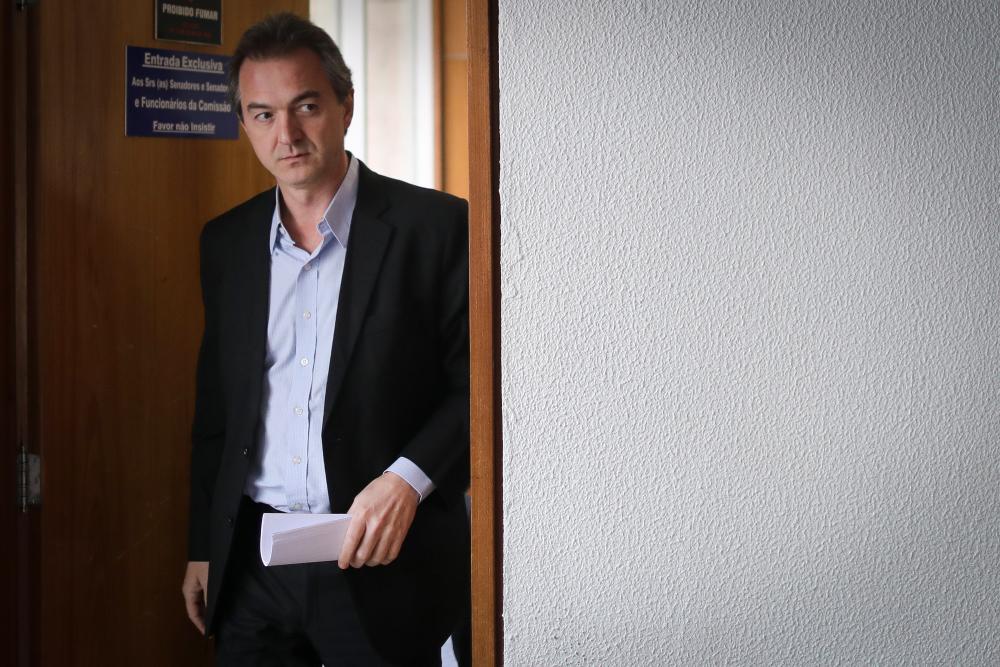

Six international airlines had suspended flights to Venezuela over the risk of possible US military strikes when an ultra-long-haul executive jet from São Paulo, Brazil, landed calmly in Caracas.
On board that flight on 23 November was the Brazilian meat tycoon Joesley Batista – twice jailed for corruption and whose companies have a long record of environmental violations. After a meeting with the Venezuelan dictator Nicolás Maduro, he returned to Brazil the following day.
Three days earlier, Donald Trump had demanded Maduro step down, and Batista’s aim was to convince the Venezuelan to do so.
The Brazilian billionaire’s efforts apparently had no effect, since the dictator remains in power and tensions with the US have escalated further, including the seizure of an oil tanker off the Venezuelan coast and the expansion of US sanctions.
But the revelation of Batista’s trip to Caracas has left many wondering why, amid the possibility of an unprecedented US intervention, a Brazilian businessperson with a chequered past could serve as an unofficial Trump “emissary”.
Batista’s whirlwind visit to Venezuela was his first foray into diplomacy hower – the businessman is credited as a major force behind the rapprochement between Trump and the Brazilian president Luiz Inácio Lula da Silva.
After Lula endorsed Kamala Harris Trump’s second term began with essentially no relationship with Brazil. The US then imposed an additional 50% tariff on Brazilian imports, in retaliation for a supposed “witch-hunt” against the former president Jair Bolsonaro, who was convicted of attempting a coup.
After months in which Brazilian diplomats and senior government officials had tried without success to contact their counterparts in the White House, everything changed after the UN general assembly in New York, when Trump unexpectedly praised Lula.
It later emerged that, before that, Brazilian business leaders had been lobbying the US administration to ease the tariffs. Batista played a leading role, according to one source.
“I’m doing myself a disservice saying this, because I worked really hard to bring those tariffs down, but it was 99% Batista,” said one of the other four business leaders who took part in the talks.
While the other four managed at most to secure meetings with senior aides such as the White House chief of staff, Susie Wiles, Batista held at least one meeting with the US president.
In addition to arguing that the tariffs were hurting US consumers, he reportedly told Trump that they were, in fact, boosting Lula’s popularity and would ultimately help propel him to re-election in 2026.
Trump and Lula finally met and, in November, the US announced the removal of most of the tariffs – including those on beef, Batista’s core business – and in doing so made no mention whatsoever of Bolsonaro.
“Batista had already tried to gain access to other US administrations but never succeeded,” said Raquel Landim, a Brazilian journalist and the author of a book about Batista and his brother, Wesley, who together own the world’s largest meat company, JBS.
One of JBS’s companies in the US, Pilgrim’s Pride, was the largest individual donor to Trump’s 2023 inaugural committee, contributing $5m.
“My sense is that Trump is highly susceptible to the same kinds of connections Batista cultivates in Brazil or in Venezuela,” she said.
In her book, Landim recounts how Batista in 2015 secured a $2.1bn deal to supply half of all beef consumed in Venezuela: the regime was unable to issue a bank guarantee, and the businessman accepted a verbal assurance – which, however, came with a payment above market value for the “risks” involved.
The agreement later collapsed after repeated Venezuelan defaults.
What endured, however, was Batista’s strong relationship with local political figures, such as Maduro’s “number two”, interior minister Diosdado Cabello. In 2015, Batista hosted Cabello during a visit to Brazil that included meetings with then president Dilma Rousseff.
The Batistas’ fall from grace began when police revealed that the state loans that enabled their companies’ astonishing expansion had been secured through millions in bribes to hundreds of politicians.
Related: Bibles, bullets and beef: Amazon cowboy culture at odds with Brazil’s climate goals
Joesley and Wesley were jailed and forced to step aside from their companies but were released shortly afterwards, and last year, they returned to the boards. They have since been regaining political clout, including appearing alongside Lula at public events.
For years, JBS has also faced fines and accusations of buying cattle from farms involved in illegal deforestation.
Batista did not respond to the Guardian’s requests for an interview.
Lula and Maduro had been at odds since Brazil refused to recognise the dictator’s most recent re-election, which is widely believed to have been stolen. But last week, a Brazilian newspaper reported that the Brazilian president called the Venezuelan strongman for the first time this year – and that one catalyst for the rapprochement had been Batista’s trip to Caracas.
Retired ambassador Rubens Barbosa, who represented Brazil in London and Washington, said that Batista is “acting solely in defence of his own interests” but even so is now Lula’s “chief broker on international affairs”.
Barbosa, however, does not see this as a phenomenon limited to Brazil but as part of a broader trend, particularly in the US, where traditional diplomacy is increasingly being displaced by corporate lobbying.
“You no longer see diplomats in these conversations, only businesspeople. This is becoming normal,” he said.